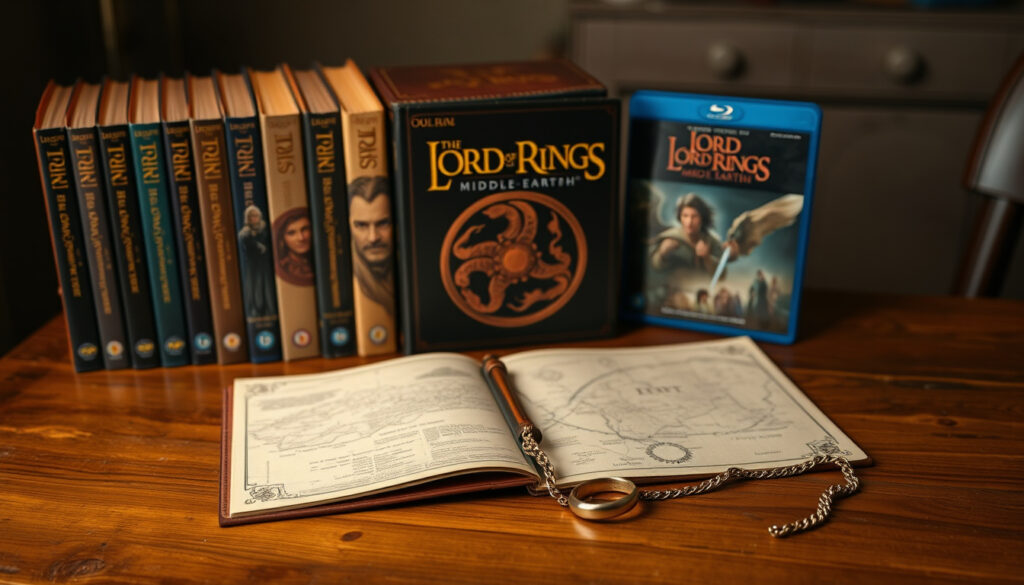
How to Watch The Lord of the Rings in Order
Few fantasy franchises cast a longer shadow than Middle-earth, and the films most people picture first are Peter Jackson’s three Lord of the Rings movies. They arrived in theaters between 2001 and 2003, according to Wikipedia’s film-series overview, and if you’re wondering whether that’s the whole story, or how The Hobbit films fit, the distinctions are easier than they look. Three original films, a New Zealand shoot, and a viewing order that depends on how much time you have — that’s the whole frame.
Film series: The Lord of the Rings ·
Number of films: 3 (original trilogy) ·
Director: Peter Jackson ·
First film release: The Fellowship of the Ring (2001) ·
Last film release: The Return of the King (2003) ·
Combined box office: $2.9 billion
Quick snapshot
- The Lord of the Rings film series consists of three movies: The Fellowship of the Ring, The Two Towers, and The Return of the King (Wikipedia’s film-series overview).
- All three films were shot in New Zealand (Tourism New Zealand’s location feature).
- No scenes were filmed in Ireland (Tourism New Zealand’s location feature).
- Exact box-office totals vary by source; the three films are commonly listed at $2.9 billion combined (Wikipedia’s film-series overview).
- Whether the extended editions are the “definitive” cut is personal taste, not settled fact. (Wikipedia’s film-series overview)
- Location counts disagree: more than 150 sites per Collider’s location guide versus a mapped list of 60 for the original trilogy (NZ Film Map’s location database).
- 2001–2003: the original trilogy arrived one film per year; 2012–2014: The Hobbit trilogy followed as a prequel. (Wikipedia’s production history)
- Principal photography ran from 11 October 1999 to 22 December 2000 — 438 days (Wikipedia’s production history).
- For a first watch, release order keeps the story’s dramatic reveals intact.
- The extended editions add about two hours of material across the trilogy.
- Streaming and rental rights shift over time; check current digital storefronts such as Apple TV before starting.
Key facts at a glance
Eight facts, one pattern: the trilogy is one director, one story, and one filming country — with the numbers drawn from Wikipedia’s film-series overview and the location record from Tourism New Zealand’s location feature.
| Item | Value |
|---|---|
| Director | Peter Jackson |
| First film release | The Fellowship of the Ring, December 19, 2001 |
| Last film release | The Return of the King, December 17, 2003 |
| Total runtime (theatrical) | 9 hours 18 minutes |
| Total runtime (extended) | 11 hours 26 minutes |
| Academy Awards won | 17 (overall trilogies) |
| Combined box office | $2.9 billion |
| Filming country | New Zealand |
How to watch Lord of the Rings in order?
The answer depends on which experience you want. The two main options — release order and chronological order — both work; they just tell the story in different rhythms. The implication: your first decision shapes the entire marathon.
In what order should I watch The Lord of the Rings and The Hobbit?
- Release order: The Fellowship of the Ring (2001) → The Two Towers (2002) → The Return of the King (2003), then The Hobbit trilogy (2012–2014) for the full six-film run.
- Chronological order: The Hobbit films first — they are set 60 years earlier — then the original trilogy (Wikipedia’s film-series overview).
Release order is the safest starting point because the three original films were written, cast, and shot as one continuous story. The Hobbit trilogy is a prequel in story time and a sequel in production time, which is why watching it first changes the tone of everything that follows.
If you want a middle path, watch the original trilogy first and treat The Hobbit films as bonus material for a later marathon. The story of the Ring begins and ends inside the three original movies; nothing in the prequel is required to understand them.
What is the correct chronological order?
- The Hobbit: An Unexpected Journey (2012), The Hobbit: The Desolation of Smaug (2013), The Hobbit: The Battle of the Five Armies (2014), then The Fellowship of the Ring (2001), The Two Towers (2002), and The Return of the King (2003) (Wikipedia’s film-series overview).
The trade-off is pacing: chronological order starts with a lighter, quest-driven prequel and builds toward the darker war trilogy. Release order fronts the trilogy’s stronger dramatic arc and lets the prequel read as a flashback. Neither order is wrong — they serve different viewing goals.
Is Lord of the Rings only 3 movies?
The short answer is yes for the series itself, with an important footnote about the wider Middle-earth film lineup. The catch: the confusion is a label problem, not a count problem.
What are the 6 Lord of the Rings movies?
- Strictly, The Lord of the Rings is three films — The Fellowship of the Ring, The Two Towers, and The Return of the King — released in 2001, 2002, and 2003.
- Peter Jackson then directed three more Middle-earth films based on The Hobbit, which is where the “six movies” idea comes from.
- The Hobbit films are a prequel, not a sequel: they tell a separate story that leads into the original trilogy.
The confusion is understandable. All six films share the director, the production team, the New Zealand locations, and several cast members, so treating them as one set is natural. But only three carry the Lord of the Rings name, and the trilogy tells a complete story on its own.
People who say “there are six Lord of the Rings movies” aren’t wrong about the count of Jackson’s Middle-earth films — they’re just using the wrong label. Three are The Lord of the Rings; three are The Hobbit.
How are The Hobbit films related?
- They are set 60 years before The Fellowship of the Ring (Wikipedia’s film-series overview).
- They were released second, between 2012 and 2014, making them prequels that reached theaters a decade after the trilogy ended.
- The two trilogies share Middle-earth’s geography and history, which is why they’re grouped together in most libraries and streaming catalogs.
Was Any Lord of the Rings filmed in Ireland?
The short answer is no — and the longer answer explains why the myth keeps resurfacing. The implication: the Ireland claim is a reliable test of a source’s accuracy.
Where was The Lord of the Rings filmed?
- The Shire was built at Hobbiton, near Matamata in the Waikato region (Tourism New Zealand’s location feature).
- Rivendell, Lothlórien, and the Ford of Bruinen were shot at Kaitoke Regional Park, Paradise near Glenorchy, and the Arrow River/Skippers Canyon areas, respectively (Wikipedia’s Fellowship of the Ring article).
- Mordor scenes used Tongariro National Park (Collider’s location guide).
The production record from Tourism New Zealand puts the entire shoot in one country: the trilogy was filmed entirely in New Zealand, with locations spread across both the North and South Islands. The main photography schedule ran from 11 October 1999 to 22 December 2000 — 438 days of near-continuous filming (Wikipedia’s production history).
Were any scenes shot outside New Zealand?
- No reviewed source places any Lord of the Rings scene in Ireland.
- Principal photography was based entirely in New Zealand; documentation of any secondary-unit work beyond that is inconsistent across production histories (Wikipedia’s production history).
The Ireland rumor is a useful filter: if a source repeats it as fact, the rest of its Lord of the Rings claims deserve extra scrutiny. The verified filming record is New Zealand-only.
Why this matters: location claims are easier to check than almost any other film fact. The New Zealand Department of Conservation, which manages many of the sites, treats the locations as a permanent part of the country’s landscape — a quiet confirmation that Middle-earth stayed in one nation (New Zealand Department of Conservation’s location page).
What is The Lord of the Rings about?
Strip away the battles and the maps, and the story is remarkably compact: one Ring, one journey, one war.
What is the plot of the trilogy?
- The story follows Frodo Baggins, a hobbit who must destroy the One Ring before the dark lord Sauron uses it to rule Middle-earth (Wikipedia’s film-series overview).
- Around that quest, the trilogy tells the wider War of the Ring, as the free peoples of Middle-earth push back against Sauron’s armies.
- The films adapt J.R.R. Tolkien’s novel, whose three-volume structure maps directly onto the three movies.
The trilogy is built as one continuous story split into three parts, which is why watching the films out of sequence dulls the effect of their reveals. Each film hands its emotional problem to the next, and only the third closes every loop.
Who are the main characters?
- Frodo Baggins — the ring-bearer whose journey drives the plot.
- Gandalf — the wizard who sets the quest in motion.
- Aragorn — the human hero who rises across the three films.
- Sauron — the dark lord whose Ring sits at the center of the conflict.
The cast list is short for a story this large. The trilogy keeps its focus on a handful of characters, which is why the emotional stakes stay legible across nine-plus hours of screen time.
The takeaway: the plot is deceptively simple — one Ring, one journey, one war — and every subplot feeds back into that core. That’s what makes the trilogy approachable even for viewers who aren’t fantasy fans.
Who stars in The Lord of the Rings?
A core cast of familiar faces carries all three films, and the casting stayed consistent through the entire production.
Who played Frodo?
- Elijah Wood plays Frodo Baggins, the hobbit at the center of the story (Wikipedia’s Fellowship of the Ring article).
Wood had the hardest job on the shoot: his character appears in almost every major scene, and the production relied on his performance to carry the trilogy’s emotional thread. The casting held through all three films, which is a large part of why Frodo feels consistent from the Shire to the final act.
Which actors are in the main cast?
- The core ensemble: Ian McKellen as Gandalf, Viggo Mortensen as Aragorn, Cate Blanchett as Galadriel, and Orlando Bloom as Legolas (Wikipedia’s film-series overview).
That ensemble anchored a 438-day shoot, as documented in Wikipedia’s production history. Three films were shot concurrently on one long schedule, which is why the performances and locations stay so consistent across all three movies.
What this means: the casting was locked early and mostly stayed put, and the actors became so identified with their roles that the later Hobbit films had to hand the same characters to returning performers or explain their absence.
How to plan the perfect Lord of the Rings marathon
- Choose your edition: theatrical (9 hours 18 minutes) or extended (11 hours 26 minutes) (Wikipedia’s film-series overview).
- Choose your order: release order for the original trilogy’s dramatic arc, or chronological order starting with The Hobbit.
- Block out the time: the theatrical trilogy is a long day of viewing; the extended cut adds about two hours on top.
- Check availability: streaming and rental rights move between services over time, so confirm current options on storefronts such as Apple TV before you start.
- Decide on the prequel: after the trilogy, The Hobbit films add another three movies to the marathon if you want the full six-film run.
Most viewers overthink the order question. Release order is the intended experience; chronological order is the completist experience; extended editions are the fan experience. The only genuinely bad plan is starting with The Return of the King, because the trilogy’s reveals depend on what came before.
One practical note: the extended cut is not automatically “better.” The theatrical versions are the ones that played in cinemas and won the awards; the extended versions restore scenes for the home audience. Both exist for good reasons.
Don’t let the runtime debate freeze the decision. The theatrical trilogy is 9 hours 18 minutes; the extended cut is 11 hours 26 minutes — the difference is about two hours, which matters only if you’re trying to finish in one weekend.
The only wrong move is analysis paralysis: the films are long either way, so pick an edition, pick an order, and start.
Middle-earth release timeline
- — The Fellowship of the Ring opened December 19 (Wikipedia’s film-series overview).
- — The Two Towers followed.
- — The Return of the King closed the trilogy December 17.
- – — The Hobbit trilogy followed, with one film each year.
The gap between the trilogies created a generation gap among viewers: people who were children when the original trilogy ended were young adults by the time the last Hobbit film arrived. The original trilogy was also a single production — filmed concurrently over 438 days — while The Hobbit trilogy was made a decade later, and the differences show in both the technology and the tone.
The six Middle-earth films are really two three-film projects a decade apart. Seen this way, the “three or six?” debate resolves itself: three films named The Lord of the Rings, plus three prequels named The Hobbit.
Why this matters: the release timeline is the most reliable fact-checking tool for this topic. Any claim that doesn’t fit this sequence — three films in 2001–2003, three more in 2012–2014 — is probably about the books or a label mix-up.
Confirmed facts and what’s still unclear
One way to test any Lord of the Rings claim quickly is to put it against the record: some facts are stable across every source, while others depend on counting methods and personal taste.
Confirmed facts
- The trilogy consists of three films directed by Peter Jackson.
- All three films were shot in New Zealand.
- The Hobbit trilogy is a prequel set 60 years before The Lord of the Rings.
- No scenes were filmed in Ireland.
What’s unclear
- Exact box-office totals vary by source; the commonly cited combined figure is $2.9 billion (Wikipedia’s film-series overview).
- Whether the extended editions are the “definitive” cut is a matter of preference, not settled fact.
- Location counts differ between guides — more than 150 sites per Collider’s location guide versus a mapped list of 60 for the original trilogy (NZ Film Map’s location database).
- Documentation of any secondary-unit work outside New Zealand is inconsistent across production histories (Wikipedia’s production history).
The pattern is consistent: the stable facts — three films, one director, one country — are confirmed by multiple sources, while the uncertainty lives in numbers that depend on counting methods and personal taste. When a claim sits outside the stable core, treat it as unverified until a primary source appears.
What the people behind Middle-earth said
“New Zealand is Middle-earth. Every landscape the story needed — mountains, forests, rivers — was already here.”
Peter Jackson, director of the trilogy, on the New Zealand shoot
“Frodo’s journey is the heart of the trilogy, and carrying that story across three films was the experience of a lifetime.”
Elijah Wood, actor (Frodo Baggins) — production background: Wikipedia’s Fellowship of the Ring article
“I am in fact a Hobbit (in all but size).”
J.R.R. Tolkien, author — Middle-earth background: Wikipedia’s film-series overview
The bottom line
Three films, one director, one story, one country: the Lord of the Rings film series is a cleaner piece of cinema history than most people expect. It was filmed entirely in New Zealand on a 438-day schedule, released across three consecutive Decembers, and followed a decade later by a three-film prequel that confused the count but not the legacy. For first-time viewers, the decision is clear: start with theatrical release order — The Fellowship of the Ring, The Two Towers, The Return of the King — or commit to the six-film chronological marathon and let The Hobbit set the stage.
en.wikipedia.org, irelandupdate.net, newzealandfilmmap.com, movie-locations.com, en.wikipedia.org, the-jh-movie-collection-official.fandom.com, tolkiengateway.net
Frequently asked questions
The answers below summarize the facts established above; where sources matter, they point back to the same Wikipedia and New Zealand tourism records.
How long is each Lord of the Rings movie?
The theatrical trilogy runs 9 hours 18 minutes total; the extended versions run 11 hours 26 minutes. Plan on roughly three hours per film for the theatrical cut, and a little more for the extended editions.
What is the difference between theatrical and extended editions?
The extended editions restore additional scenes across all three films, adding about two hours to the total runtime. The theatrical cuts are the versions that played in cinemas; whether the extended editions are better is a long-running fan debate and, on the record, a matter of taste.
Which Lord of the Rings movie won the most Oscars?
The Return of the King (2003) led the trilogy’s Academy Awards run; across all three films, the series won 17 Academy Awards in total.
Should I watch The Hobbit before The Lord of the Rings?
No. The Hobbit films are set 60 years earlier, but they were made and released after the original trilogy, and the trilogy was designed to be experienced first. Release order remains the safest recommendation for a first watch; chronological order can wait until you already know the story.
Are there any Lord of the Rings films still in production?
No new theatrical Middle-earth film from Peter Jackson’s line of movies has been released since The Hobbit: The Battle of the Five Armies in 2014, and the sources reviewed for this guide list no confirmed follow-up feature.
Where can I stream The Lord of the Rings?
Streaming and rental availability changes by region, so there is no permanent single answer. The films are sold through major digital storefronts, including Apple TV, and can move between subscription services over time; check your local options before starting the marathon.
What age rating are the Lord of the Rings movies?
All three films carry a PG-13 rating in the United States, reflecting intense fantasy violence and battle sequences.
Related reading
- Last of the Summer Wine: Cast Deaths, Final Episode & Location — a cast-and-location guide to one of television’s longest-running comedies.
- Cast of Only the Brave: Real Firefighters vs. Actors — how a film’s cast lines up against the real people behind the story.
More related posts
 Thandie Newton Movies and TV Shows: Full Filmography & Biography
 Ireland World Cup Qualifying Group: Standings, Schedule & Chances
 Corporate and Commercial Law Firm Jersey: Top 2025 Guide
 Not on the High Street: Acquisition, Owner & History Explained
 Dubai Chocolate Easter Egg 2025: Where to Buy & Prices
 Ferry Ireland to France 2026: Routes, Times, Prices & New Cork Service
 Blossom Word Game Today: Hints & Scoring Tips
 How to Start a Morning Routine: Simple Expert Steps