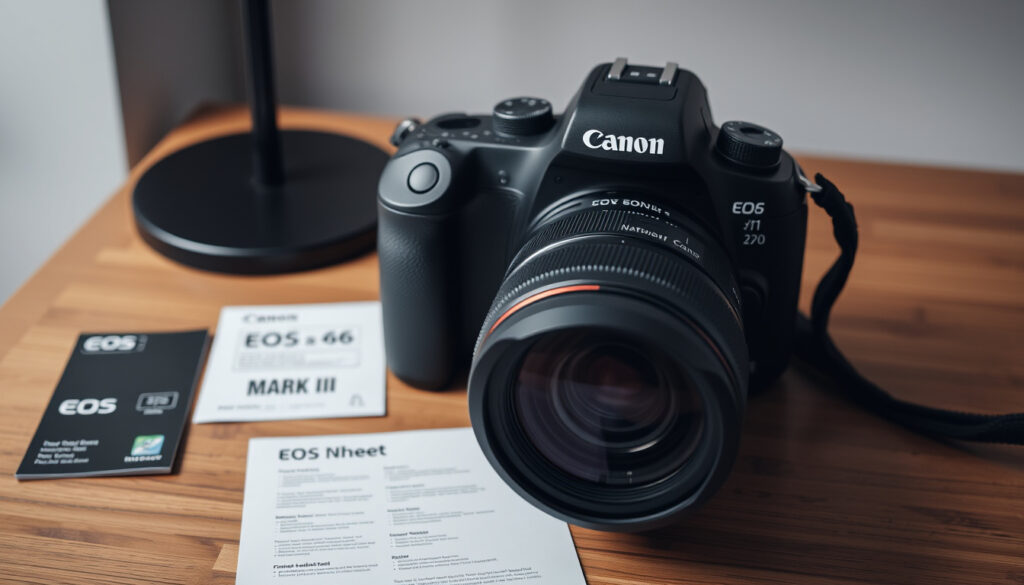
Canon EOS R6 Mark III: Price, Specs & Review
Anyone who has been refreshing Canon rumor pages for a faster alternative to the R5 line finally has a real product to look at. Canon’s U.S. newsroom announced the EOS R6 Mark III in November 2025 with a 32.5MP full-frame sensor, 40fps electronic bursts, and 7K RAW video in a body priced at $2,799 (Canon USA Newsroom (official announcement)). Here is what is confirmed, what still looks uncertain, and how the Mark III actually compares with the cameras Canon already sells.
Sensor Resolution: 32.5 MP Full-Frame CMOS · Continuous Shooting: 40 fps (electronic shutter) · Image Stabilization: Up to 8.5 stops (IBIS) · Video Resolution: 7K RAW up to 60p (DPReview (camera-testing outlet))
Quick snapshot
- 32.5MP full-frame CMOS sensor (Tom’s Guide (tech review outlet))
- 40fps electronic bursts, 7K RAW video and 8.5EV IBIS (DPReview (camera-testing outlet)) (Tom’s Guide (tech review outlet))
- Body price set at $2,799 in the U.S. (Canon USA Newsroom (official announcement)) (Tom’s Guide (tech review outlet))
- Long-session 7K RAW thermal behavior isn’t fully documented yet (Tom’s Guide (tech review outlet)).
- The firmware update roadmap hasn’t been published (Canon USA Newsroom (official announcement)).
- Prices for markets beyond the U.S., UK, Hong Kong, Singapore and India are still pending (Canon USA Newsroom (official announcement)).
- Announced in November 2025, available the same month (Canon USA Newsroom (official announcement))
- Field tests from DPReview (camera-testing outlet) and Tom’s Guide (tech review outlet) are already out. (Canon Hong Kong (official regional listing))
- Canon’s Hong Kong, Singapore and India stores are listing the body for local buyers (Canon Hong Kong (official regional listing); Canon Singapore (official regional listing); Canon India (official regional listing))
Seven specs, one pattern: Canon is selling speed — 32.5MP CMOS, 40fps bursts, 8.5EV IBIS and 7K RAW — with the U.S. price and launch timing set directly by the manufacturer.
| Specification | Detail |
|---|---|
| Sensor | 32.5MP full-frame CMOS (DPReview (camera-testing outlet)) |
| Continuous shooting | 40fps (electronic shutter), with pre-capture |
| Image stabilization | Up to 8.5 stops (IBIS) |
| Video | 7K RAW up to 60p in Canon Cinema Raw Lite |
| US body price | $2,799 (Canon USA Newsroom (official announcement)) |
| Kit prices | $3,149 (RF24-105mm F4-7.1 IS STM) · $4,049 (RF24-105mm F4 L IS USM) (Canon USA Newsroom (official announcement)) |
| Availability | November 2025 |
Is Canon coming out with a R6 Mark III?
Yes, and it is already shipping rather than being a rumor. Canon unveiled the EOS R6 Mark III in November 2025 and said the camera would be available in the same month, with the U.S. body price set at $2,799 and kit options running up to $4,049. In other words: this is a product launch, not a teaser.
What is the official release date?
- Canon’s U.S. announcement lists availability in November 2025.
- Hong Kong, Singapore and India Canon stores had launch listings live at the same time.
The timeline matters because Canon has sometimes previewed bodies months before they hit stores. The R6 Mark III skipped that gap: announcement and availability sit in the same month, which is an unusually fast path from launch to purchase.
Where can I buy a Canon R6 Mark III?
- Canon USA — body $2,799; RF24-105mm F4-7.1 IS STM kit $3,149; RF24-105mm F4 L IS USM kit $4,049 (Canon USA Newsroom (official announcement)).
- Canon Hong Kong — body HK$19,280 (Canon Hong Kong (official regional listing)).
- Canon Singapore — body S$3,699 (Canon Singapore (official regional listing)).
- Canon India — body MRP Rs. 243,995 (Canon India (official regional listing)).
Canon’s regional stores are the reference point for local pricing and warranty support. The camera is available from Canon and authorized retailers, and the live listings in four markets at launch suggest it is being produced in volume rather than rationed in small batches.
The implication: this is a mainstream launch, not a niche drop, so buyers can expect the Mark III to appear across the usual Canon dealer network within weeks.
How much will the Canon R6 Mark III cost?
In the U.S., the body costs $2,799; Tom’s Guide’s review confirms that figure and lists the UK body at £2,799 (Tom’s Guide (tech review outlet)). Canon also sells two RF24-105mm kit bundles, with the f/4 L version costing $900 more than the compact STM version.
Three kit tiers, four markets, one pattern: Canon kept the body price nearly level across the U.S., Hong Kong and Singapore, with the India MRP the notable exception.
| Configuration | US | Hong Kong | Singapore | India |
|---|---|---|---|---|
| Body only | $2,799 | HK$19,280 (Canon Hong Kong (official regional listing)) | S$3,699 (Canon Singapore (official regional listing)) | Rs. 243,995 (Canon India (official regional listing)) |
| RF24-105mm F4-7.1 IS STM kit | $3,149 | HK$21,680 | S$4,229 | — |
| RF24-105mm F4 L IS USM kit | $4,049 | HK$27,480 | S$5,499 | — |
| Stop Motion Animation Firmware bundle | $2,899 | — | — | — |
Canon also lists a $2,899 body bundle that adds Stop Motion Animation Firmware, a targeted option for studio and product-video shooters (Canon USA Newsroom (official announcement)).
The $900 gap between the STM kit and the L kit is the key decision: the f/4 L lens keeps a constant aperture and better build, while the STM kit leaves money for a future lens purchase.
What this means: the pricing ladder is simple. Buyers who want the camera plus a capable everyday zoom can spend $3,149; buyers who want the fast L-series standard zoom on the front should budget $4,049.
Is the R6 Mark III worth it?
For the right buyer, yes. The Mark III is a professional-level tool with a body price below the R5 line, but worth-it depends entirely on whether your shooting actually uses 40fps bursts and 7K RAW video.
Is the Canon R6 Mark III a professional camera?
- 40fps electronic bursts with pre-capture — a speed tier once reserved for flagship bodies.
- 7K RAW video up to 60p in Canon Cinema Raw Lite (DPReview (camera-testing outlet)).
- Up to 8.5EV in-body stabilization for handheld work.
- Dual Pixel CMOS AF II with animal and vehicle detection.
Those four capabilities define professional expectations in 2025: high-speed capture, internal RAW video, serious stabilization and reliable subject tracking. The Mark III delivers all four in a body that retails for $2,799, which is why reviewers present it as a hybrid workhorse rather than a hobbyist step-up.
What are people saying about the Canon EOS R6 Mark III in reviews?
Reviewers are framing the Mark III around speed: DPReview’s in-depth test ran with the 40fps pre-capture feature, and Tom’s Guide’s review confirmed the 32.5MP sensor and the $2,799 / £2,799 price.
Canon Ambassador Helen Bartlett has also published a hands-on field review from a photographer’s perspective, which adds the kind of real-world lens-and-field context that lab charts miss.
- Praise: burst speed, sensor resolution, stabilization and the Cinema Raw Lite video codec.
- Warning: extended 7K RAW recording can push the body into thermal shutdown.
- Consensus: this is the most complete R6-generation body Canon has released.
What are the best lenses for the Canon R6 Mark III?
- RF24-105mm F4 L IS USM — the constant-f/4 kit zoom, $4,049 as a bundle.
- RF24-105mm F4-7.1 IS STM — lighter kit zoom, $3,149 as a bundle.
- RF70-200mm f/2.8 L — the event and wedding pairing for the 40fps body.
- RF100-500mm f/4.5-7.1 L — the wildlife reach option.
The 24-105mm F4 L is the default because it covers the most-used range without a lens change; the 70-200mm and 100-500mm are the focal lengths that make the burst and autofocus count for action and wildlife work.
The catch: worth it comes down to workload. If wildlife, sport or video pays the bills, the $2,799 body earns its keep; if the camera is for travel and portrait stills, the burst speed sits idle and the upgrade is harder to justify.
Is R6 Mark III better than R5?
It depends on which R5 and which job. Against the R5’s high-resolution positioning, the Mark III trades pixels for speed; against the R5 Mark II, the choice is cleaner — 45MP and 8K versus 32.5MP and 40fps.
Canon R6 Mark III vs R6 Mark II
- Sensor: 32.5MP in the Mark III versus 24.2MP in the Mark II.
- Burst: 40fps electronic with pre-capture in the Mark III.
- Video: 7K RAW up to 60p in the Mark III.
That is a full-generation jump rather than a refresh. The Mark II stays a good all-rounder, but it no longer leads Canon’s mid-range lineup on any headline spec.
Canon R6 Mark III vs R5 Mark II
- Resolution: 32.5MP (R6 Mark III) versus 45MP (R5 Mark II).
- Burst: 40fps versus 20fps.
- Video: 7K RAW versus 8K RAW.
Canon has split its lineup cleanly: the R5 Mark II is the resolution and 8K body; the Mark III is the speed body. For events and wildlife, 40fps with pre-capture is the more useful number; for studio and landscape, 45MP wins the print argument.
The pattern: “better” is now a workflow question. 40fps and 7K RAW, or 45MP and 8K RAW — Canon is selling two different tools with the same badge family.
Does the Canon R6 Mark III overheat?
Under sustained 7K RAW recording, yes. Early reviews flag thermal shutdown as the main practical limit of the video system, and it is the issue to check before buying for studio or event work.
Is the Canon R6 Mark III good for wildlife photography?
- 40fps electronic bursts with pre-capture for the peak of the action.
- Dual Pixel CMOS AF II with animal detection.
- Up to 8.5EV IBIS for handheld telephoto shooting.
Wildlife is the use case where the Mark III’s spec sheet and real-world behavior line up. The burst rate solves the “did I miss the frame?” problem, and the animal-detection AF keeps up with erratic movement.
Does the Canon R6 Mark III have autofocus?
- Dual Pixel CMOS AF II — Canon’s current-generation phase-detect AF system.
- Subject modes include animal and vehicle detection.
Autofocus is the part of the system reviewers did not need to qualify. Eye, animal and vehicle tracking runs alongside the 40fps burst, so the camera keeps re-acquiring the subject between frames rather than hunting.
If 7K RAW is on your shooting list, plan around heat: long interview and event sessions in warm rooms are the scenario where the Mark III’s thermal limits show up.
Why this matters: the thermal ceiling is the one spec Canon doesn’t print on the box, and it is the strongest argument for reading in-depth tests before buying.
Five rows, one pattern: Canon’s full-frame lineup now separates into resolution-first and speed-first bodies, and the Mark III sits firmly in the speed camp.
| Spec | R6 Mark III | R6 Mark II | R5 Mark II |
|---|---|---|---|
| Sensor resolution | 32.5MP | 24.2MP | 45MP |
| Max burst (electronic) | 40fps | — | 20fps |
| Video ceiling | 7K RAW up to 60p | — | 8K RAW |
| IBIS rating | 8.5 stops | — | — |
| US body price | $2,799 | — | — |
Twelve rows, one pattern: the Mark III’s spec sheet is fully public — sensor, burst, video, prices and launch timing included.
| Specification | Detail |
|---|---|
| Sensor | 32.5MP full-frame CMOS |
| Lens mount | Canon RF |
| Continuous shooting | 40fps electronic shutter, with pre-capture |
| Image stabilization | Up to 8.5 stops in-body (IBIS) |
| Video | 7K RAW up to 60p, Canon Cinema Raw Lite |
| Autofocus | Dual Pixel CMOS AF II with animal and vehicle detection |
| US body price | $2,799 |
| UK body price | £2,799 |
| Hong Kong body price | HK$19,280 |
| Singapore body price | S$3,699 |
| India body MRP | Rs. 243,995 |
| Availability | November 2025 |
Upsides
- 32.5MP full-frame sensor — a real jump over the R6 Mark II’s 24.2MP.
- 40fps electronic burst with pre-capture for action and wildlife.
- 7K RAW video up to 60p in Cinema Raw Lite.
- Up to 8.5EV in-body stabilization.
- Dual Pixel CMOS AF II with animal and vehicle tracking.
Downsides
- Overheating risk during extended 7K RAW recording.
- Regional pricing outside the US, UK, Hong Kong, Singapore and India is still unpublished.
- The kit ladder is steep — the L kit costs $900 more than the STM kit.
Confirmed: the specs that check out
- 32.5MP full-frame CMOS, 40fps pre-capture burst, 7K RAW video and 8.5EV IBIS (DPReview (camera-testing outlet))
- US body price $2,799 and UK price £2,799 (Tom’s Guide (tech review outlet))
- November 2025 launch and availability (Canon USA Newsroom (official announcement))
- Regional prices: HK$19,280 / S$3,699 / Rs. 243,995 (Canon Hong Kong (official regional listing); Canon Singapore (official regional listing); Canon India (official regional listing))
Still unclear: the open questions
- Real-world 7K RAW recording limits in hot environments.
- Canon’s firmware update roadmap for the Mark III.
- Eurozone and other regional pricing.
What reviewers are saying
The EOS R6 III supports 40fps burst shooting with pre-capture and records 7K video up to 60p in Canon Cinema Raw Lite.
DPReview (camera-testing outlet) — EOS R6 III in-depth review
The EOS R6 Mark III pairs a 32.5MP full-frame CMOS sensor with a US$2,799 / £2,799 price.
Tom’s Guide (tech review outlet) — Canon EOS R6 Mark III review
Canon listed the EOS R6 Mark III with Stop Motion Animation Firmware at an estimated retail price of US$2,899.
Canon USA Newsroom (official announcement) — consumer launch notes
Related reading:
- Robot Vacuum and Mop Ireland 2026: Best Combos & Buying Guide
- Harvey Norman Washing Machines: Prices, Brands & Reliability
The R6 Mark III is the speed-and-video interpretation of Canon’s full-frame lineup, and it earns that position with real numbers: 40fps bursts, 7K RAW and 8.5EV stabilization in a $2,799 body. For hybrid shooters already inside the Canon ecosystem, the choice is clear: buy the Mark III if 40fps and RAW video will earn the price back on paid shoots, or stay with the R6 Mark II until a future generation makes the upgrade obvious.
fstoppers.com, jeradhillphoto.com, canonnews.com, en.wikipedia.org, fstoppers.com, petapixel.com
Frequently asked questions
What is the official US price of the Canon EOS R6 Mark III?
The body costs $2,799. The RF24-105mm F4-7.1 IS STM kit costs $3,149 and the RF24-105mm F4 L IS USM kit costs $4,049.
How much does the Canon EOS R6 Mark III cost in Hong Kong, Singapore and India?
The body lists at HK$19,280 in Hong Kong, S$3,699 in Singapore and Rs. 243,995 in India.
What video modes does the Canon EOS R6 Mark III support?
It records 7K RAW up to 60p in Canon Cinema Raw Lite.
How fast is the Canon EOS R6 Mark III burst mode?
The electronic shutter reaches 40fps and includes pre-capture.
How is the Canon EOS R6 Mark III for wildlife photography?
It pairs 40fps bursts with animal-detection autofocus and up to 8.5EV of stabilization, which makes it well suited to action and wildlife work.
Does the Canon EOS R6 Mark III have image stabilization?
Yes, in-body stabilization rated up to 8.5 stops.
When was the Canon EOS R6 Mark III announced and released?
Canon announced it in November 2025 and said it would be available in the same month.
More related posts
 Does An Post Deliver on Saturday? Schedule, Times & Tracking
 Who Killed Michael Collins? The Assassination of an Irish Revolutionary
 Best Exercises for Energy: 3-3-3 Rule Guide
 A Knight of the Seven Kingdoms Episodes: Count, List & Season 2
 Last of the Summer Wine: Cast Deaths, Final Episode & Location
 TP-Link WiFi Extender Setup: Connect, Reset & Fix Issues
 What Time Is It in Melbourne? Current Time, Zone & Travel Guide
 Hoka Clifton 9 Women’s Review: Best For, Pros & Cons