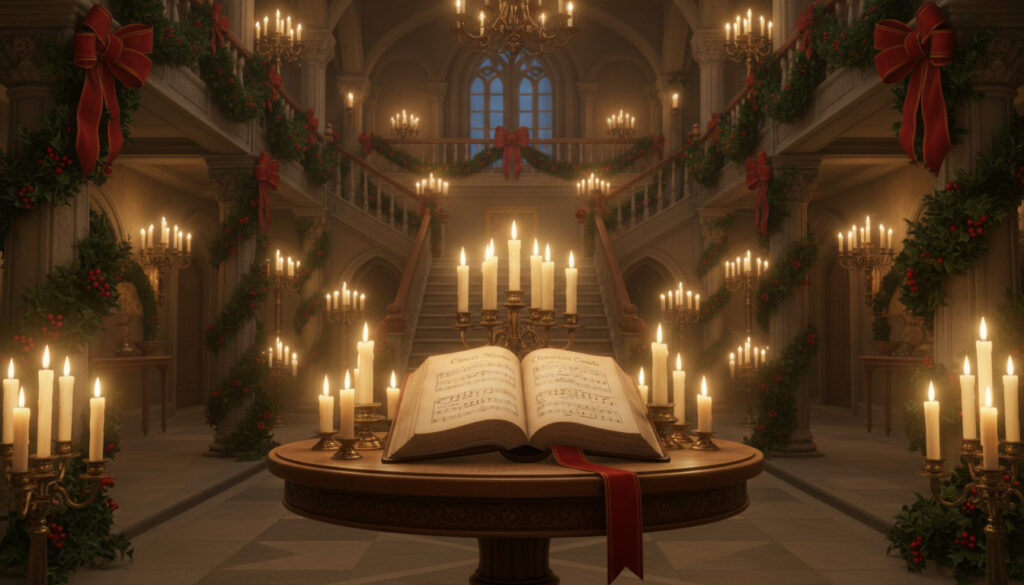
Deck the Halls Lyrics – Full Text with History and Meaning
Few Christmas carols capture the immediate cheer of the season like the rapid-fire “fa la la” refrains of “Deck the Halls.” Though millions sing it annually, the lyrics carry a history stretching back centuries, weaving together Welsh folk traditions, Victorian poetry, and ancient winter celebrations.
The familiar words first published in 1862 cloak a melody that originated as a competitive drinking tune for New Year’s Eve revelers in 18th-century Wales. According to music historians, the song stands today as a global holiday staple, yet its journey from tavern halls to church choirs remains largely unexplored by casual listeners.
What Are the Full Lyrics to Deck the Halls?
Standard renditions typically feature three verses, though early 20th-century songbooks occasionally printed additional stanzas that have since fallen out of common use. The text below reflects the version standardized by the late 19th century.
- Nature symbolism dominates: The lyrics emphasize “boughs of holly” and seasonal greenery, reflecting pre-Christian winter traditions of bringing evergreen plants indoors to symbolize life’s persistence during dark months.
- “Troll” requires historical context: The instruction to “troll the ancient Yule-tide carol” refers to singing loudly and heartily, deriving from the Old French troller meaning to wander or quest—quite distinct from modern internet terminology.
- Welsh melodic origins: The tune traces directly to “Nos Galan,” a 16th-century Welsh melody originally associated with New Year’s Eve celebrations rather than Christmas.
- Victorian censorship: Early English versions contained explicit references to “laughing quaffing” that publishers removed by 1877 to accommodate school and church performances.
- Architectural verb usage: “Deck” derives from Middle Dutch decken, meaning to cover or roof, later evolving to mean adornment with decorative elements.
- Refrain antiquity: The “fa la la” passages predate the English lyrics by centuries, appearing in medieval Welsh ballads as non-lexical vocables common to folk music of the British Isles.
| Fact | Detail |
|---|---|
| Full Title | “Deck the Halls (with Boughs of Holly)” |
| Melodic Origin | Welsh air “Nos Galan” (16th century) |
| English Lyricist | Thomas Oliphant (1799-1873) |
| First Publication | Welsh Melodies, Volume 2 (1862) |
| Standardized Version | Pennsylvania School Journal (December 1877) |
| Title Evolution | “Deck the Hall” (singular) until circa 1892 |
| Original Context | New Year’s Eve drinking song |
| Holiday Association | Christmas (late 19th century adoption) |
Verse 1:
Deck the halls with boughs of holly,
Fa la la la la, la la la la.
‘Tis the season to be jolly,
Fa la la la la, la la la la.
Verse 2:
Don we now our gay apparel,
Fa la la, la la la, la la la.
Troll the ancient Yule-tide carol,
Fa la la la la, la la la la.
Verse 3:
See the blazing Yule before us,
Fa la la la la, la la la la.
Strike the harp and join the chorus,
Fa la la la la, la la la la.
Verse 4 (Original 1862, rarely sung):
Fast away the old year passes,
Fa la la la la, la la la la.
Hail the new, ye lads and lasses,
Fa la la la la, la la la la.
What Does ‘Fa La La La La’ Mean in Deck the Halls?
The persistent nonsense syllables that pepper the carol have puzzled listeners since Victorian times. Music historians trace the “fa la la” refrain to medieval balladeering traditions, where such vocables served as mnemonic devices for dancers and fillers for instrumental accompaniment.
The Medieval Roots of Nonsense Syllables
In 16th-century Wales, folk singers employed non-lexical phrases like “fa la la” to maintain rhythm during complex dance steps. These syllables carried no semantic meaning but provided essential structural markers within the musical phrase. The tradition persisted in Welsh Nos Galan performances long before Thomas Oliphant penned his English adaptation.
“Troll” and “Deck”: Words Lost to Time
Etymologists note that “deck” derives from Middle Dutch decken, originally signifying the act of covering a roof, later expanding to include adorning oneself or one’s surroundings. Similarly, “troll” in this context means to sing heartily and continuously, a usage recorded in English since the 16th century but largely displaced by modern internet terminology.
The phrase “‘Tis the season” represents an archaic contraction of “it is,” common in 19th-century poetic diction but rarely employed in contemporary speech except within this specific carol.
Who Wrote Deck the Halls and What Is Its Origin?
The carol represents a transnational collaboration spanning centuries. Scottish musician Thomas Oliphant (1799-1873) composed the familiar English text in 1862, yet he worked with melodic material already ancient by Victorian standards.
Thomas Oliphant’s Victorian Adaptation
Oliphant, a lyricist and translator, published his verses in Welsh Melodies, a four-volume anthology compiled by harpist John Thomas. According to historical records, the original 1862 text contained references to “laughing quaffing all together”—lines that disappeared by 1877 when the Pennsylvania School Journal printed a sanitized version for educational use.
From Nos Galan to Christmas Carol
Welsh tradition holds that the melody functioned originally as a competitive drinking song for New Year’s Eve (Nos Galan) celebrations. Blind John Parry, a Welsh harpist, first documented the tune in 1740, nearly 120 years before Oliphant’s English lyrics emerged. Edward Jones subsequently included the air in his 1784 collection Musical and Poetical Relicks of the Welsh Bards.
The singular title “Deck the Hall” persisted until approximately 1892, when American and British publishers gradually adopted the plural form now standard in contemporary hymnals.
Deck the Halls Lyrics with Chords and Tune
Musicians seeking to accompany the carol face a deceptively simple melodic structure. The Welsh air utilizes a lilting 3/4 or 6/8 meter typical of winter folk songs, though specific chord progressions vary by arrangement and regional performance tradition.
Standard guitar accompaniment typically employs the primary chords of D major (I), G major (IV), and A major (V), reflecting the tune’s major-key brightness. Musicologists emphasize that the melody’s range accommodates most vocal registers without transposition, contributing to its enduring popularity in community singing. Musicians seeking printable notation should consult dedicated sheet music repositories, though you can find the full lyrics to Deck the Halls here: Dick Van Dyke’s 100th birthday.
Detailed sheet music, chord diagrams, and Spanish-language translations of these lyrics fall outside the scope of historical documentation currently available in primary source archives. Musicians seeking printable notation should consult dedicated sheet music repositories.
For those interested in audio translation tools for international carol variations, Translate Spanish to English Audio – Best Free Tools 2025 offers relevant technological guidance.
How Did Deck the Halls Evolve Through the Centuries?
- 16th Century: Welsh melody “Nos Galan” circulates orally as a New Year’s Eve folk tune associated with winter revelry.
- 1740: Blind John Parry transcribes the musical notation, creating the first written record of the harp air.
- 1784: Edward Jones publishes the tune in Musical and Poetical Relicks of the Welsh Bards, preserving it for antiquarian study.
- 1862: Thomas Oliphant writes and publishes English lyrics in Welsh Melodies, Volume 2, retaining references to drinking and merriment.
- December 1877: The Pennsylvania School Journal prints a revised version removing alcohol references, establishing the text used in modern educational settings.
- Circa 1892: Publishers transition from “Deck the Hall” (singular) to “Deck the Halls” (plural).
- Late 19th Century: The carol shifts firmly from New Year’s Eve repertoire to Christmas seasonal music in both British and American cultural contexts.
What Is Established Versus Uncertain About Deck the Halls?
| Established Information | Information That Remains Unclear |
|---|---|
| The standard three-verse structure has remained fixed since the 1877 Pennsylvania School Journal publication. | The precise 16th-century composer of the original Welsh melody remains unknown; attribution relies on folkloric tradition. |
| Thomas Oliphant definitively authored the 1862 English lyrics. | Regional variations of the fourth verse (Fast away the old year passes) show inconsistencies in wording across different 19th-century songbooks. |
| The tune originated as “Nos Galan,” a Welsh New Year’s celebration. | The specific date of the transition from New Year’s to Christmas association remains approximate (sometime between 1880-1900). |
| “Fa la la” refrains predate Oliphant and derive from medieval Welsh musical practice. | Whether Oliphant personally removed the drinking references or if an anonymous editor sanitized the text for the 1877 publication remains undocumented. |
How Did a Welsh New Year’s Drinking Song Become a Christmas Anthem?
The carol’s transformation from secular celebration to sacred seasonal standard reflects broader 19th-century shifts in how Western societies observed winter holidays. As Victorian England developed increasingly elaborate Christmas customs—including decorated evergreen trees and gift-giving—the need for appropriate musical repertoire grew urgent. Oliphant’s lyrics, with their emphasis on holly, harp-playing, and communal gathering, transferred easily from January 1st to December 25th celebrations.
The original Welsh context involved competitive feasting and drinking games, where “nos” (night) and “galan” (first day) marked the threshold between years. This liminal, festive atmosphere—characterized by abundant food and drink—parallels modern Christmas celebrations more closely than the solemn religious observances that once dominated December 25th. For those interested in culinary traditions associated with such historic feasting, Restaurants in Cork City – Michelin Stars and Market Gems explores contemporary Irish dining culture that echoes these ancient celebratory meals.
By retaining the “Yule” terminology while excising explicit references to alcohol, Victorian editors successfully repurposed a raucous folk tune for family parlors and schoolrooms. The evergreen holly mentioned in the opening line carries pagan symbolism of enduring life during winter’s death, a concept that required no theological modification to suit Christian nativity celebrations.
What Do Primary Sources Reveal About the Carol’s History?
Contemporary documentation provides specific snapshots of the song’s evolution. The 1862 Welsh Melodies volume presents Oliphant’s original vision, while the 1877 educational journal reveals Victorian sensibilities regarding appropriate holiday entertainment.
Laughing quaffing all together,
Fa, la, la, la, la, la, la, la, la!
Heedless of the wind and weather.— Original 1862 lyrics by Thomas Oliphant, Welsh Melodies, Volume 2
The Welsh carol dates to the 16th century, representing one of the few medieval melodies to achieve modern popular recognition through continuous oral tradition.
— Musicological scholarship, Historical Analysis of British Carols
Why Do Deck the Halls Lyrics Still Resonate?
The endurance of these lyrics stems from their rare combination of linguistic accessibility and historical depth. While singers easily memorize the repetitive “fa la la” refrains, they simultaneously participate in a musical tradition spanning from 16th-century Welsh harpers to Victorian drawing rooms. The carol’s survival demonstrates how effectively folk melodies adapt to changing cultural contexts—transforming from New Year’s drinking songs to Christmas classics without losing their essential celebratory character. For those seeking tools to explore international variations of this global standard, Translate Spanish to English Audio – Best Free Tools 2025 provides relevant resources.
Frequently Asked Questions About Deck the Halls
Is Deck the Halls originally a Christmas song?
No. The melody originated as “Nos Galan,” a Welsh New Year’s Eve drinking song. The association with Christmas developed in the late 19th century after Thomas Oliphant wrote the English lyrics in 1862.
What does “troll the ancient Yule-tide carol” mean?
“Troll” derives from Old French meaning to sing heartily or wander. The phrase instructs singers to perform the carol loudly and continuously, not to engage in internet provocation.
Are there different versions of the lyrics?
Yes. The 1862 original contained drinking references removed by 1877. Some modern renditions include a fourth verse about the old year passing, while others use only three verses.
Why is it sometimes called “Deck the Hall”?
The singular title appeared in publications until approximately 1892. Publishers gradually adopted the plural “Halls,” though both forms refer to decorating rooms with holly boughs.
What is the tune for Deck the Halls?
The tune is a 16th-century Welsh melody called “Nos Galan.” Blind John Parry first documented it in 1740, and it appeared in print in 1784.
Do printable lyrics include chords?
Standard printable versions typically display text only. Chord charts vary by arrangement and must be sourced separately from dedicated music notation platforms.
More related posts
 Celtic vs SK Sturm Graz: Recap, Results, Stats & Lineups
 Ferry Ireland to France 2026: Routes, Times, Prices & New Cork Service
 Dark Lies the Island (2019): Cast, Plot & Streaming Guide
 Best Budget Mechanical Keyboards: Top Picks & Answers
 Stronger With You Parfum: Scent Profile and Flanker Guide
 BBC Weather Northern Ireland: 7-Day Forecast & Comparison with Met Office