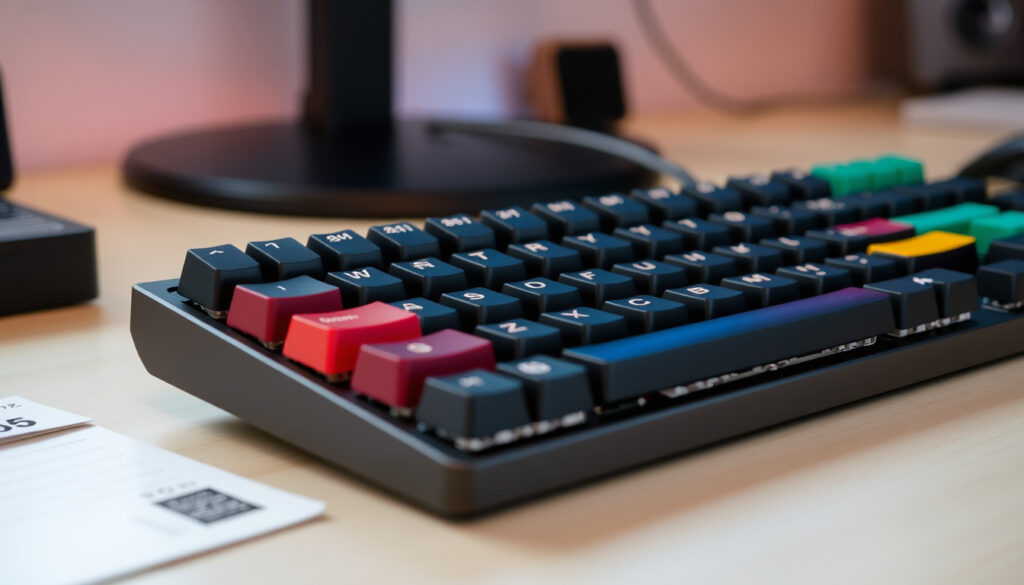
Best Budget Mechanical Keyboards: Top Picks & Answers
There’s a moment every first-time mechanical keyboard shopper knows: you’ve narrowed the search to “budget,” and suddenly you’re staring at switch names, size abbreviations, and price tags that swing from $40 to $150. The good news is that Tom’s Hardware already points to solid boards for closer to $50, which means the budget tier is no longer a compromise — it’s a starting point, and this guide gathers those picks, the Reddit consensus, and straight answers on layout and lifespan so you can buy once and stop second-guessing.
Budget price range: $50–$100 ·
Common switch types: Cherry MX, Gateron, Outemu ·
Standard switch rating: 50 million keystrokes ·
Popular form factors: 60%, 75%, TKL ·
Top community pick: Akko 5075B VIA at $60 ·
Average daily keystrokes: 8,000–15,000
Quick snapshot
- Capable mechanical keyboards exist well below $55 (Tom’s Hardware, PC hardware testing outlet)
- 75% boards are now described as the default 2026 layout because they keep arrows and F-keys visible (TechEngage (tech explainer publication))
- Tri-mode wireless and hot-swap sockets now appear in the $55–$70 band (MechanicalKeyboard.net (keyboard specialist site))
- Whether 60% or 75% is universally better for gaming depends on genre and hand position
- Real-world switch lifespan varies with typing habits and quality control
- Alternative layouts like Dvorak and Colemak remain niche outside enthusiast circles
- 2026 Reddit buying guides are comparing 10 sub-$100 boards and focusing on what actually matters (Reddit r/buybestguide, community buying-guide forum)
- Wireless and gasket-mounted boards keep dropping in price, pulling premium features into the budget bracket (Reddit r/buybestguide, community buying-guide forum)
- Expect more VIA support and pre-lubed switches in the $50–$70 bracket
- QWERTY stays the default; typing isn’t going away even as voice input improves
Four sources, one pattern: the budget keyboard conversation has shifted from “will it feel cheap” to “which premium feature do you want included.” The table below sorts the facts that keep coming up in buying guides.
| Fact | Value | Source |
|---|---|---|
| Tri-mode wireless 75% board | AULA F75 Pro — $55–$70 | MechanicalKeyboard.net |
| Wired hot-swap 75% board | Keychron V1 — $42–$85 | MechanicalKeyboard.net |
| 75% layout status | Default for 2026 — keeps arrows and F-keys visible | TechEngage (tech explainer publication) |
| Budget 75% with display and gasket mount | Ajazz AK820 Pro — around $60 | Tom’s Hardware |
| Cheapest credible wired board | Havit KB487L — about $39.99 | Tom’s Hardware |
| Standard switch endurance rating | 50 million keystrokes | Industry standard rating |
| Average daily typing volume | 8,000–15,000 keystrokes | Typical user estimate |
What is the best and most affordable mechanical keyboard?
Tom’s Hardware’s budget roundup found plenty of mechanical keyboards under $100, with several solid options closer to $50 (Tom’s Hardware, PC hardware testing outlet). The models below keep coming up as the value leaders:
- Keychron C2 Pro — often below $55 for the white backlit model, with double-shot PBT keycaps and customization through VIA or Keychron Launcher
- Ajazz AK820 Pro — around $60, a 75% board with a small color display, gasket mount, metal volume knob, and hot-swap switches
- Royal Kludge R65 — $50–$60, a compact board with dedicated arrow keys, which many small keyboards skip
- Havit KB487L — about $39.99, the cheapest credible entry point
Hot-swap sockets matter more than any other spec in this price range. They turn a $60 keyboard into an upgrade platform: if the stock switches feel too light or too loud, a $20 set of switches changes the entire typing personality of the board. That one feature separates a budget keyboard you’ll use for years from one you’ll replace in months.
Keyboard-focused roundups add wireless to the same equation. The AULA F75 Pro at $55–$70, the Epomaker TH80 V2 Pro at $78–$85, and the RK R65 at $60–$70 all appear in MechanicalKeyboard.net’s under-$100 list as tri-mode wireless, hot-swap options (MechanicalKeyboard.net, keyboard specialist site).
The $50–$100 band now delivers features — gasket mounts, displays, tri-mode wireless — that were once reserved for $150+ customs. The budget buyer’s problem isn’t finding quality; it’s choosing which quality matters most.
Trade-offs are real. A $40 full-size board gets you mechanical switches but usually skips hot-swap sockets and nicer keycaps, while a $60 barebones kit like the Akko 5075B VIA expects you to supply switches and caps yourself — that’s how it lands at $60 as the Reddit community’s most-cited value pick.
The pattern: every serious pick in this segment lands between $40 and $85, and the differences come down to wireless, hot-swap, and layout — not raw typing speed. Decide those three things first and the model almost chooses itself.
Is a 60% keyboard better for gaming than a 75% keyboard?
Sixty percent boards drop the arrow keys, the function row, and everything above the number row. Seventy-five percent boards keep arrows and most F-keys in a slightly longer frame. TechEngage calls 75% the default layout for 2026 precisely because it keeps arrows and F-keys visible (TechEngage (tech explainer publication)). That framing matters more than the marketing chatter: the size war isn’t about which board types faster, it’s about where the missing keys go when you need them.
What are the downsides of a 60% keyboard?
- No dedicated arrow keys — navigation requires a function-layer combination
- No function row — media keys and in-game shortcuts get slower to reach
- Limited productivity — spreadsheet work and document editing feel cramped without arrows
- Steeper learning curve — muscle memory from a full-size board doesn’t transfer cleanly
If your gaming is 90% WASD movement and a few nearby keys, those missing keys rarely matter. The moment you type an essay, navigate a spreadsheet, or use shortcuts that depend on F-keys, the 60% frame shows its limits. Competitive FPS players often prefer it for the extra mouse space and uniform hand position, but that’s a physical advantage, not a speed hack.
Why are 75% keyboards so popular?
- Adds arrow keys back without adding a numpad
- Retains most of the function row, shrinking the compromise
- Fits nearly the same desk footprint as a 60% board
- Widely available under $70, including tri-mode wireless boards like the AULA F75 Pro
The 75% shape wins because it refuses to make you choose. You keep the keys you use daily, lose only the numpad, and still free up desk space for a large mousepad. That balance is why roundups now treat it as the default recommendation rather than a niche middle ground.
Do pros use 60% keyboards?
- Yes, particularly in FPS titles where mouse space and hand position matter
- The advantage is desk space, not keyboard responsiveness — a 60% board doesn’t make you faster
- Most pros remap layers and customize their keymaps before a match
- Outside competition, many of the same players use 75% or TKL boards for daily work
There’s no evidence that a smaller layout improves reaction time; the benefit is physical, not electrical. A smaller board lets the mouse travel farther before hitting the keyboard, which helps low-sensitivity aiming. But the same reduced reach makes everyday typing more awkward, which is why the middle ground keeps winning converts.
The trade-off: buying a 60% board for a game you play three hours a month will cost you more in daily frustration than it saves in desk space. Let your average week, not your ranked sessions, decide the layout.
How long do 50 million keystrokes last?
Most entry-level switches carry a 50 million keystroke rating, a manufacturer’s endurance estimate under laboratory conditions. It’s the standard marker you’ll see on budget boards, and it’s more useful than most marketing numbers because it converts into years.
What is the lifespan of a keyboard?
- Average user: roughly 8,000–15,000 keystrokes per day
- At that pace, 50 million keystrokes works out to about 9–17 years
- Whole-keyboard lifespan is often shorter than switch rating: keycaps, stabilizers, and PCBs can fail first
- Dust, crumbs, and humidity shorten effective life more than raw keystroke counts
The arithmetic is straightforward: 50,000,000 ÷ 10,000 keystrokes per day ≈ 5,000 days, or roughly 13 years at the middle of that range. Even a heavy writer who doubles the daily average gets more than seven years before the rated endurance runs out. And remember, the rating is per switch, not a test of the whole assembled keyboard — what actually kills budget keyboards is rarely worn switches; it’s spilled coffee, a dead USB port, or a broken case latch.
Switch ratings measure one individual switch, not the whole keyboard. A board can advertise 50 million keystrokes while its stabilizers, keycaps, and case clips fail in year two — the rating sells confidence, but the rest of the assembly decides durability.
Why this matters: if you’re choosing between a $60 board and an $80 board, switch endurance shouldn’t keep you up at night. The cheaper failure points are keycaps, stabilizers, and the habits of whoever eats lunch over the keyboard.
Is QWERTY outdated?
Every few years the argument resurfaces that QWERTY is a 19th-century compromise kept alive by inertia. The honest answer: it’s outdated as an optimization but not as a standard, and nothing in the keyboard market is close to displacing it. QWERTY was designed in the mechanical typewriter era to reduce jamming, and its survival has more to do with habit than with ergonomics.
What does Russian QWERTY mean?
- Russian QWERTY maps Cyrillic characters onto the standard QWERTY key positions
- It’s a labeling convention for bilingual keyboards, not a separate layout standard
- It matters mainly if you type in both Cyrillic and Latin scripts on one board
You’ll see “Russian QWERTY” on some bilingual listings, especially for budget boards sold across European markets. It doesn’t change the physical layout — the same key positions still match the QWERTY you already know.
Will typing become obsolete?
- Voice dictation and AI text generation have improved, but both still need hands-on review and editing
- Typing remains the fastest reliable input for code, documents, and structured data
- Keyboards are being reinvented, not abandoned — split ergonomic boards and custom layouts are growing
- No credible timeline exists for keyboards disappearing from offices or homes
QWERTY’s real advantage is network effect: it’s the layout everyone already knows, and every operating system ships it as the default. Dvorak, Colemak, and Workman offer efficiency gains for trained typists, but switching costs weeks of productivity and leaves you with a layout that isn’t available on every device. The future of typing isn’t the removal of QWERTY — it’s more software remapping and more ergonomic hardware on top of the same key positions.
Alternative layouts keep losing to QWERTY not because they’re worse, but because the switching cost is paid upfront while the benefit appears only after months of practice. That’s why QWERTY stays the default even as voice input improves.
What this means: don’t wait for a layout revolution before buying a budget keyboard. The board, not the letters printed on it, is where your money should go.
What are the best budget mechanical keyboards recommended by Reddit?
Reddit’s keyboard communities are merciless about bad value, which makes them a useful sanity check. In 2026, r/buybestguide started a sub-$100 comparison roundup that tests the gap between spec sheets and real-world feel (Reddit r/buybestguide, community buying-guide forum), then followed it with a separate guide dedicated entirely to the “best keyboard under $100” search (Reddit buying-guide thread). The same threads warn against buying purely on price: a $35 board that needs replacing in six months is more expensive than a $70 board that lasts five years.
Across r/keyboards, r/MechanicalKeyboards, and r/BudgetKeebs, the consistent pattern is consensus around the $60–$100 sweet spot. The criteria usually look like this:
- Value for money — not the lowest price, but what you get at that price
- Hot-swap support — changing switches without soldering is a must for most enthusiasts
- Build materials — aluminum or stiff plastic frames beat flexy budget cases
- Consistency — community trust follows boards that hold up across multiple units
The Akko 5075B VIA barebones kit is the most-cited “best value under $100” answer on Reddit, and wired boards like the Keychron V1 remain steady recommendations for people who want hot-swap without wireless. The warning attached to every community pick is availability: models and revisions change fast, so a consensus board from last season may not be the same keyboard this season.
Community picks age fast. A model loved at $60 can gain or lose features when a revision lands, and stock levels swing wildly. Check the latest threads before buying a “consensus” board from an old guide.
The implication: Reddit’s real value isn’t a single winner, it’s the criteria — hot-swap, build quality, honest pricing. Use those criteria when you shop, and the exact model matters less than the tolerances you demand.
Three archetypes, one pattern: the budget segment has split into “cheap and complete,” “feature-dense 75%,” and “customize-it-yourself.” Each serves a different buyer.
| Model | Price | Layout | Standout features | Source |
|---|---|---|---|---|
| Keychron C2 Pro | from ~$55 | Full-size | Double-shot PBT keycaps, VIA + Keychron Launcher, best for numpad users | Tom’s Hardware |
| Ajazz AK820 Pro | ~$60 | 75% | Color display, gasket mount, metal volume knob, hot-swap | MechanicalKeyboard.net |
| Akko 5075B VIA (barebones) | ~$60 | 75% | Hot-swap, no switches or keycaps included, best for custom builders | Community consensus (Reddit) |
One spec sheet, one reality check: the numbers that matter at this price are switch rating, layout size, and whether the board accepts new switches later.
| Spec | Typical value in budget segment |
|---|---|
| Switch types | Cherry MX, Gateron, Outemu |
| Switch endurance rating | 50 million keystrokes |
| Common layouts | 60%, 75%, TKL, full-size |
| 60% layout missing keys | Arrow keys and function row |
| 75% layout strength | Arrows + most F-keys in a compact frame |
| Connectivity | Wired, wireless, or tri-mode (Bluetooth + 2.4GHz + USB) |
| Hot-swap availability | Common on $55–$85 boards (AULA F75 Pro, Ajazz AK820 Pro, Keychron V1) |
| Keycap quality | Double-shot PBT on Keychron C2 Pro and Ajazz AK820 Pro |
| Software customization | VIA and Keychron Launcher support on Keychron C2 Pro |
| Barebones kit example | Akko 5075B VIA at ~$60, switches and keycaps sold separately |
| Typical daily typing volume | 8,000–15,000 keystrokes |
| Realistic lifespan at 10k keystrokes/day | About 13 years, based on a 50M rating |
Upsides
- Real mechanical switches for under $50, with the Havit KB487L around $39.99
- Hot-swap sockets let you change switches without soldering on many $55–$85 boards
- Tri-mode wireless is now common below $70
- VIA and Keychron Launcher customization appear on budget boards like the Keychron C2 Pro
- Compact layouts free up desk space without forcing a full-size compromise
Downsides
- Build quality and quality control vary more than on premium boards
- 60% layouts drop arrow keys and the function row
- Barebones kits like the Akko 5075B VIA need switches and keycaps bought separately
- Stock keycaps and stabilizers are often the first things budget makers cut
- Wireless models add battery management and firmware complexity compared with simple wired boards
Confirmed facts
- Budget mechanical keyboards range from $50 to $100, with credible boards near $40 (Tom’s Hardware, PC hardware testing outlet)
- 75% is the default recommendation for 2026, per TechEngage
What’s unclear
- Whether 60% or 75% is universally better for gaming depends on genre and preference
- Exact real-world lifespan of budget switches varies with usage and quality control
- Future adoption of Dvorak, Colemak, and Workman outside enthusiast circles is uncertain
- How long specific budget models stay in stock before revisions is hard to predict
- Standard 50 million keystroke rating is a manufacturer’s lab estimate; real-world switch lifespan varies with usage and quality control
- QWERTY’s dominance is based on habit, but whether it is outdated as an optimization remains debated
“The best value under $100.”
— frequent verdict in r/keyboards on the Akko 5075B VIA
“A budget-friendly mechanical keyboard that doesn’t compromise on quality.”
— Keychron, describing the V series
“Delivers mechanical performance without draining your wallet.”
— NerdTechy, on the Redragon K521
Nobody needs to overspend on a mechanical keyboard right now. The $50–$100 band includes hot-swap sockets, tri-mode wireless, and gasket mounts that were premium features a few years ago, and the community’s best-value answer — the Akko 5075B VIA barebones kit — costs around $60. For the average buyer in this market, the choice is clear: buy a hot-swappable 75% board in the $55–$70 range and keep the option to upgrade switches later, or spend half as much on a full-size budget board and treat it as a disposable first keyboard.
reddit.com, wfhlounge.com, mkbguide.com, gagadget.com, reddit.com, ovrclock.com, keebsforall.com, reddit.com
Frequently asked questions
Are budget mechanical keyboards good for typing?
Yes — especially if you choose a hot-swappable board and can experiment with switch feel. Budget boards with gasket mounts or decent stabilizers now type far smoother than the $30 membrane keyboards they replace.
What switch type is best for a budget mechanical keyboard?
For a first board, a light linear switch is the safest choice: quiet, smooth, and forgiving. Tactile switches give more feedback but can feel rough on stock budget boards, and clicky switches are best avoided in shared offices.
Can I upgrade switches on a budget mechanical keyboard?
Only if the board has hot-swap sockets. Models like the Ajazz AK820 Pro and the AULA F75 Pro support switch swapping without soldering, so you can change the switch feel in minutes.
How do I clean a budget mechanical keyboard?
Turn the board off, remove the keycaps, and blow out debris with compressed air. Wipe the plate with a damp microfiber cloth, and wash the keycaps in warm soapy water if they are greasy. Keep liquids away from the switches.
What is the best budget mechanical keyboard for a programmer?
Programmers usually want arrow keys and a function row, which points to a 75% or TKL board with tactile switches. The Keychron V1, a wired hot-swap 75% in the $42–$85 range, is a frequent pick for coding-heavy workflows.
Is it worth spending more than $100 on a mechanical keyboard?
For most people, no. The $55–$100 range covers hot-swap sockets, quality keycaps, and wireless; past that you are paying for case materials, better stabilizers, and diminishing returns.
Do budget mechanical keyboards have hot-swappable switches?
Increasingly, yes. Tri-mode wireless boards in the $55–$70 range, like the AULA F75 Pro, typically include hot-swap sockets. Wired budget boards are more varied, so check the spec list before buying.
Related reading
More related posts
 Cat Deeley New Boyfriend: Separating Fact from Fiction
 Bank Holidays in Ireland 2020: Dates and Full List
 Best Stroller Travel Systems 2025: Top Parent-Tested Picks
 When Is the Next Bank Holiday? Ireland & NI 2026
 BBC Weather Northern Ireland: 7-Day Forecast & Comparison with Met Office
 Deck the Halls Lyrics – Full Text with History and Meaning
 BBC Weather Northern Ireland: 7-Day, 14-Day, Hourly Forecasts
 End of Life Care: What to Expect, Symptoms, and Irish Services