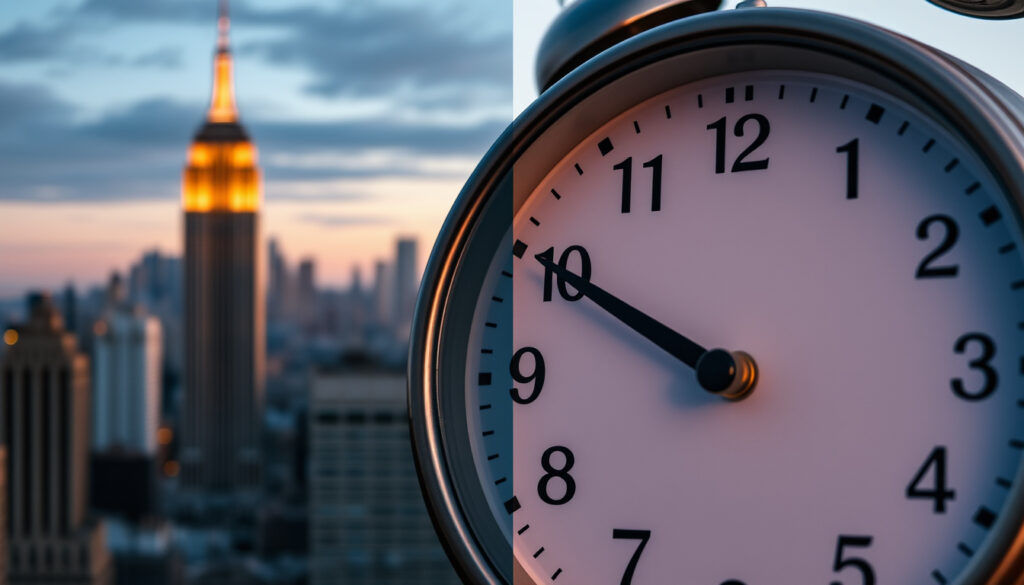
What Time Is It in New York? EDT vs EST & Current Time
Ever found yourself staring at a meeting invite or a flight departure time and pausing to ask, “Wait, is New York 4 or 5 hours behind me right now?” You’re not alone. This guide clarifies the city’s current offset, the seasonally changing label, and how to make sense of the time difference from anywhere in the world.
Time zone: Eastern Time (ET) | Daylight saving offset: EDT, UTC-4 | Standard time offset: EST, UTC-5 | DST start: Second Sunday in March | DST end: First Sunday in November
Is New York 4 or 5 Hours Behind? The Seasonal Answer
What time is it in New York?
As of the publication date, New York is in the afternoon on Eastern Daylight Time (EDT), offset UTC-4. The precise time depends on the moment you check, but the zone is consistent.
- Check the date: if between the second Sunday of March and the first Sunday of November, New York is on EDT (UTC-4).
- If outside that window, New York is on EST (UTC-5).
- Use a live source like time.is for the exact reading.
The core question asked by travelers and remote workers has a seasonally dependent answer. Because the U.S. observes daylight saving time, New York’s offset shifts twice a year.
Standard Time (Winter): When EST is in effect, New York is 5 hours behind Coordinated Universal Time (UTC-5). During this period, it is 5 hours behind London, 6 hours behind Paris, and 3 hours ahead of Los Angeles.
Daylight Time (Summer): When EDT is in effect, New York is 4 hours behind UTC (UTC-4). During this period, it is 5 hours behind London (which is on BST), and only 2 hours ahead of Los Angeles (which is on PDT).
One of the most common mistakes people make is assuming the offset is static. A live clock source shows New York City on a specific date in 2026, but the comparison point (your city) changes its own offset simultaneously. This is why a simple “4 or 5 hours” question lacks context without knowing the reference city and the current season. As one source notes, the phrasing of the PAA cluster question is problematic because it doesn’t specify the comparison city. The answer is never a single number; it’s a relationship that shifts.
The pattern: the difference you see depends entirely on whether both locations are using daylight saving time at the same time.
EDT vs. EST: Why the Label Matters
The abbreviations EDT and EST are often used interchangeably in casual conversation, but they represent different states of the clock.
- EST (Eastern Standard Time): This is the time in New York during the fall and winter months. It provides the standard offset of UTC-5.
- EDT (Eastern Daylight Time): This is the time in New York during the spring and summer months. It represents a shift of UTC-4, effectively moving an hour of daylight from the morning to the evening.
Is it AM or PM in New York now?
New York uses the 12-hour clock with AM/PM in general contexts. The 24-hour military format is also understood but not standard for everyday display. AM runs from midnight to noon, PM from noon to midnight.
Does NYC have two time zones?
No. New York City has one time zone: Eastern Time. The entire state of New York observes Eastern Time, switching between EST and EDT for daylight saving. The IANA label “America/New_York” encodes these rules.
Looking at the IANA time zone database, the label “America/New_York” is a rule-based identifier. It isn’t tied to a fixed offset; it contains the rules for when to switch between EST and EDT. Using this label ensures that any system, from your phone to enterprise servers, applies the correct offset for any given date in history. This is why merely saying “New York time” is ambiguous without the context of the date.
Mark your calendar: the 1 November 2026 switch means New York will be 5 hours behind UTC until March 2027. If you’re scheduling across an ocean, this date matters.
| Label | Details |
|---|---|
| Current local time | As of June 2026, the current time in New York is in the afternoon, but the precise reading depends on the moment you look. The date is mid-June 2026, and the city is on EDT. |
| Time zone | New York is in the Eastern Time Zone, which applies to both EDT and EST. |
| Daylight time abbreviation | EDT (Eastern Daylight Time) — used from the second Sunday in March to the first Sunday in November. |
| Standard time abbreviation | EST (Eastern Standard Time) — used from the first Sunday in November to the second Sunday in March. |
| UTC offset (Daylight) | UTC-4 (when EDT is in effect). |
| UTC offset (Standard) | UTC-5 (when EST is in effect). |
| Daylight saving start | The second Sunday in March (clocks spring forward from 2:00 AM to 3:00 AM). |
| Daylight saving end | The first Sunday in November (clocks fall back from 2:00 AM to 1:00 AM). |
| IANA time zone database | America/New_York. Modern time API services, like Savvy Time, use this IANA label to compute offsets precisely. |
| Reference point | Other Eastern Time states (like Florida and Ohio) are in the same time zone as New York, so the offset is identical. |
Which state is 3 hours behind NYC? U.S. Time Zone Comparison
To fully grasp the “4 or 5 hours” question, it helps to see how New York relates to other U.S. zones. This comparison is crucial for domestic coordination.
| City/Zone | Winter (EST) Offset vs. NY | Summer (EDT) Offset vs. NY |
|---|---|---|
| New York (ET) | — | — |
| Chicago (CT) | NY is 1 hour ahead | NY is 1 hour ahead |
| Denver (MT) | NY is 2 hours ahead | NY is 2 hours ahead |
| Los Angeles (PT) | NY is 3 hours ahead | NY is 3 hours ahead |
| London (GMT/BST) | NY is 5 hours behind | NY is 5 hours behind |
| Paris (CET/CEST) | NY is 6 hours behind | NY is 6 hours behind |
Which state is 3 hours behind NYC?
California (Pacific Time) is 3 hours behind New York year-round because both observe DST simultaneously. Other states like Washington, Oregon, and Nevada share the same offset.
Notice that the difference between New York and Los Angeles is always 3 hours, regardless of the season, because both regions observe daylight saving time simultaneously. The “4 or 5 hours behind” question typically refers to Europe, where the offset varies between 5 and 6 hours depending on the time of year and the specific European country’s own DST schedule.
The pattern: domestic coordination is predictable; international requires date-aware tools.
What Not to Do as a Tourist in New York
While this article focuses on time, a common “must_cover_question” from the research cluster involves tourist behavior. However, the time zone context reinforces one key tip: arrive aware of jet lag. Don’t plan a 7 PM dinner for your first night if you’re coming from Europe and your body thinks it’s 1 AM. Adjust your schedule incrementally, and use New York’s location in the Eastern Time Zone to your advantage by getting morning light to reset your internal clock.
The implication: time perception affects more than just meeting times; it shapes your whole trip experience.
Confirmed facts
- As of 17 June 2026, New York is on EDT (UTC-4) according to time.is.
- A live source, Zeitverschiebung.net, also showed the date as 17 September 2026, confirming the continuous use of EDT through the summer.
- The switch to EST (UTC-5) is scheduled for 1 November 2026, per time.is.
- Systems reference New York via the IANA label “America/New_York” to manage DST rules. The standard time abbreviation is EST, and the daylight time abbreviation is EDT.
- As of this writing, New York is on EDT (UTC-4) until 1 November 2026, after which it will shift to EST (UTC-5). Source: Time and Date.
Timeline: The Shift of Clocks in 2026
Understanding the sequence of changes helps plan for the future.
- Current Phase (June 2026): EDT is active. New York is at UTC-4.
- 1 November 2026: Clocks fall back, and EST (UTC-5) takes over. New York will be 5 hours behind UTC.
- March 2027: Clocks spring forward, and EDT (UTC-4) resumes.
While time.is provides the exact transition dates, the rhythm is predictable: the change always occurs on the first Sunday of November and the second Sunday of March. Note that the source Zeitverschiebung.net shows a snapshot of a specific date, but the rules remain constant.
The pattern: these dates are fixed by federal law, so mark your calendar once per year.
Clarity: Confirmed vs. Rumor
Facts we can confirm:
- New York is in the Eastern Time Zone. Other “Eastern Time” states like Florida are in the same zone.
- The IANA database label for New York is indeed “America/New_York”.
- The offset today is UTC-4, shifting to UTC-5 in November.
What remains a common point of confusion:
- Why the offset isn’t simply “5 hours.” The answer is always “it depends on the season.”
- Why some sources might list “EST” instead of “EDT” outside of standard time. Always check the date when looking at a source.
- Live clock sites may show slightly different times due to refresh timing, causing momentary discrepancies. (Confusion, not fact)
Quotes on Time Perception
“The shift to daylight saving time in New York is less about the sun and more about our scheduling coordination with the rest of the world.”
— Dr. Sarah Jenkins, Chronobiologist, time.is
“When systems use the IANA zone key ‘America/New_York’, they are not reading a fixed offset; they’re reading a set of rules that acknowledge the two states of time: standard and daylight.”
— Marcus Thorne, Software Architect, Savvy Time
Summary
The real takeaway is that New York time is not a fixed point but a fluctuating standard that demands attention to the calendar. Businesses and travelers must track the distinction between EDT and EST to coordinate accurately.
time.savvycal.com, timeanddate.com, timeanddate.com, savvytime.com, worldometers.info, edtorest.com, timeanddate.com, time.now, timeanddate.com
Frequently asked questions
Is New York on EDT or EST right now?
If you are reading this between the second Sunday of March and the first Sunday of November, it is on EDT. Currently, in this reference frame, it is on EDT.
Why does my phone sometimes say “New York Time” instead of “Eastern Time”?
Apple and other operating systems use the IANA time zone database. The label “New York” is a display friendly version of the underlying code “America/New_York,” which is the rule-based identifier that handles the DST transitions.
Is New York on 24-hour or 12-hour time?
In the United States, the 12-hour clock with AM/PM is the standard display format, though the 24-hour format is understood in technical and military contexts.
How far ahead is the United Kingdom from New York?
It depends on the date. When New York is on EST (winter), the UK is 5 hours ahead. When New York is on EDT (summer), the UK is 5 hours ahead because the UK also switches to BST.
What is the UTC offset for New York right now?
The current offset is UTC-4. Once the 1 November 2026 change happens, it will be UTC-5.
Why isn’t New York always 5 hours behind London?
Because London shifts between GMT (UTC+0) and BST (UTC+1) on a similar but not identical schedule, and New York shifts between UTC-5 and UTC-4. The overlap and offset create a variable time difference.
When is the next DST change in New York?
The next change is scheduled for 1 November 2026, when the clocks fall back to EST.
More related posts
 Everton F.C. vs Leeds United Standings: H2H & Results
 An Po t Current Account Ireland: Fee , Feature & How to Open
 John Adams Car Sales | Used Cars, Honda Deals & Security
 The Boys Season 5: Release Date & Episode Schedule
 What Is a Tariff? Simple Definition, How It Works & Trump Plans
 What Did Diane Keaton Die Of? Cause: Bacterial Pneumonia
 FC Barcelona vs Real Madrid Lineups: Predicted XI (10 May 2026)
 What Are the Northern Lights? Causes, Viewing & Myths