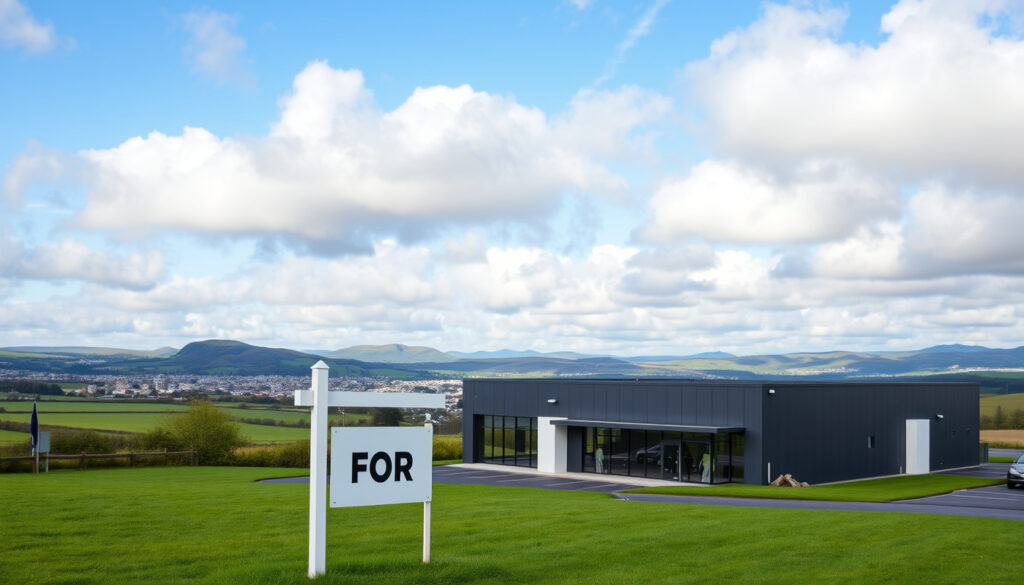
Commercial Property for Sale in Ireland: 2025 Guide
Anyone who has spent an afternoon clicking through property listings knows the feeling: the search filters multiply, the map pins overlap, and the difference between a promising opportunity and a money pit isn’t always obvious. This guide cuts through the noise, comparing the major platforms where commercial property for sale in Ireland is actually listed, and walks through the practical steps of the buying process—so you can move from browsing to closing with a clearer head.
Commercial properties on Daft.ie: 3,955 ·
Properties in Dublin: 444 ·
2025 investment volumes: €2.4 billion ·
Q3 2025 transactions: €693.6 million
Quick snapshot
- Daft.ie currently lists 3,955 commercial properties for sale in Ireland (Daft.ie)
- SCSI projects capital values to rise by 15% and rental values by 19% in 2025 (Society of Chartered Surveyors Ireland)
- CBRE Ireland reports €394 million invested in Q2 2025 alone (CBRE Ireland)
- Exact listing counts on CBRE’s portal are not publicly aggregated
- Future market trajectory depends on interest rate movements and occupier demand
- The pace of interest rate cuts in 2025 remains uncertain
- SCSI’s mid-year 2025 review describes an “early recovery phase” (Society of Chartered Surveyors Ireland)
- Dublin office completions in 2025 forecast at 62,000 sq m, the lowest since 2015 (The Irish Times)
- Year-to-date investment volumes hit €1.6 billion by Q3 2025 (Business Plus)
- Residential led Q3 investment with a 37% share; offices followed at 35% (Business Plus)
The numbers below capture the key market data as of early 2025.
| Metric | Value | Source |
|---|---|---|
| Total commercial properties on Daft.ie | 3,955 | Daft.ie |
| Properties in Dublin | 444 | Daft.ie |
| 2025 capital value growth projection | +15% | SCSI |
| 2025 rental value growth projection | +19% | SCSI |
| Q2 2025 investment | €394 million | CBRE Ireland |
| H1 2025 investment | €940 million | CBRE Ireland |
| Q3 2025 transactions | €693.6 million | Business Plus |
| 2025 full-year investment (Savills) | €2.4 billion | Irish Real Estate News |
| 2025 volumes vs. 10-year average | 40% below | Irish Real Estate News |
What are the best platforms to find commercial property for sale in Ireland?
The Irish commercial property market has several listing platforms, each with different strengths. Daft.ie dominates the volume game with 3,955 active listings on its commercial search page. For higher-value or more specialized assets, CBRE Ireland’s portal offers a curated selection backed by a global real estate services firm (CBRE Ireland).
How does Daft.ie compare to other sites?
- Daft.ie: 3,955 listings, user-friendly filters by county, price, and property type
- CBRE.ie: professional-grade portal; listings often for larger portfolios or prime assets
- BusinessesForSale.ie: smaller pool, focused on businesses with attached premises
- Regional agencies: ERA Cork, for example, lists commercial sales in the southern region (ERA Cork)
Daft.ie is the volume play, but the real bargains in a recovering market often sit with specialist agencies who know their local patch better than a national portal ever will.
Which platform fits depends on what you are buying. A small retail unit in a provincial town will likely show up on Daft.ie. A multi-let office or industrial estate, on the other hand, may only appear on CBRE’s or a competitor’s confidential list.
The implication: start with Daft.ie for breadth, but register with a major agency to access off-market or unlisted opportunities.
How to find commercial property for sale near me in Ireland?
Location-specific searching is where the practical work begins. Daft.ie allows you to filter by county, city, or even a specific radius around a town. This is useful because the national market is not one market — it is a patchwork of local ones.
Using online search filters and setting up alerts
- Select your county (e.g., Kildare, Waterford, Kerry) directly on Daft.ie
- Refine by price range, property type (office, retail, industrial), and size
- Use the map view to see exactly where properties sit relative to transport links
- Create a Daft.ie account and save your search to receive email alerts for new listings
- Check agency sites directly—some properties only appear there
The pattern: properties near motorway junctions or rail links move faster and command higher prices per square meter. If you are flexible on location, you can stretch your budget significantly.
For a buyer in Dublin, proximity to the M50 can add a premium of 10–20% over comparable space 15 minutes further out. Deciding where to compromise on transport access is your first real strategic choice.
The pattern: location is the first filter, but understanding the premium is the second.
Where can I find used commercial property for sale?
Used commercial property—buildings that have had previous occupiers—makes up the bulk of what is listed on Daft.ie. The term covers everything from a converted shopfront to a decades-old industrial unit.
Benefits of buying used commercial property
- Often priced below replacement cost—you pay for the land and the shell, not the construction
- Established locations with proven footfall or transport access
- Potential for value-add through refurbishment
Checklist for used properties
- Inspect the building’s structural condition—roof, foundations, electrical, plumbing
- Verify zoning and planning permissions with the local authority
- Check for hidden liabilities: environmental contamination, outstanding rates, or easements
- Review the BER (Building Energy Rating) certificate for energy costs
The catch: a bargain shell can quickly become a budget trap if the roof needs replacing or the wiring is pre-1990s. Budget 10–15% above the asking price for unseen repairs.
What commercial property is available in Kildare, Navan, Waterford, and Kerry?
Regional markets behave differently from Dublin, and that is where opportunity lies for buyers willing to look beyond the capital.
Commercial property in Kildare
Kildare benefits from the M7/M9 corridors and proximity to Dublin’s southern commuter belt. Listings on Daft.ie for the county typically include industrial units, retail spaces, and some office accommodation. Use the Daft.ie county filter to see what is currently live.
Commercial property in Navan
Navan, in County Meath, sits on the M3 with strong road links to Dublin. The town’s commercial stock is mostly retail and light industrial, suited to local businesses or investors looking for yield in a commuter town.
Commercial property in Waterford
Waterford city has a compact commercial core with a mix of retail, office, and some larger industrial sites. The region has historically offered lower entry prices than Dublin.
Commercial property in Kerry
Kerry’s market is driven by tourism and agriculture. Commercial listings skew toward hospitality—guesthouses, pubs, restaurants—alongside agri-industrial units. Prices are typically lower, but rental demand is seasonal.
Regional markets can be thin—a buyer in Kerry may wait months for the right unit to appear. The trade-off is price: entry costs in regional towns are often 50% below Dublin’s average.
What this means: if your business or investment goal does not require a Dublin address, the regional market offers a better price-to-potential ratio—provided you have the patience to wait for the right listing.
What should I consider before buying commercial property in Ireland?
The decision to buy commercial property is as much about process as it is about price. Getting the legal, financial, and market research right is what separates a sound acquisition from a costly mistake.
Legal considerations
- Engage a solicitor who specializes in commercial property—conveyancing for commercial assets involves more complexity than residential
- Verify title, easements, and any restrictions on use
- Check zoning and planning permissions with the local authority; a use you intend may require a change of use application
- Review all leases if the property is tenanted; understand your obligations as a landlord
Financing options
- Commercial mortgages are available from Irish banks, but terms differ from residential: typically 60–70% loan-to-value, with repayment periods of 15–20 years
- Ask about interest-only periods for investment properties
- Alternative lenders and private finance may fill gaps for unusual assets
Market research
- Compare prices per square meter across regions on Daft.ie
- Monitor SCSI’s commercial property market reviews for trend data (Society of Chartered Surveyors Ireland)
- Understand the local occupier demand: who is renting space in the area, and are they growing?
The winning move: do your legal homework before you fall in love with a building. A solicitor’s €1,000 fee upfront is cheap insurance against a €50,000 title problem later.
What does the 2025 market data tell us?
The market signals for 2025 point to a market in transition. SCSI’s projections are bullish on values—15% capital growth and 19% rental growth (Society of Chartered Surveyors Ireland)—but the transaction data tells a more cautious story. Savills puts 2025 volumes at €2.4 billion, which is 40% below the 10-year annual average (Irish Real Estate News).
Investment flows are recovering, but unevenly. CBRE Ireland reports that investment sits at an early recovery stage, with the first half of 2025 seeing just over €940 million (CBRE Ireland). The mix tells its own story: by Q3, residential assets led with a 37% share, offices accounted for 35%, and industrial only 13% (Business Plus).
Why this matters: the market is not a monolith. Offices and residential are drawing capital, while industrial lags. A buyer should ask which sector they are betting on—and whether the data supports that bet.
Who is who in the market?
“The Irish commercial market is in an early recovery phase.”
— Society of Chartered Surveyors Ireland, mid-year 2025 review (Source)
“The re-emergence of capital is an early signal that values have found a floor.”
— Comment on CBRE Ireland’s Q2 2025 investment report (Source)
“Dublin office stock completions in 2025 are forecast to reach 62,000 sq m, the lowest level since 2015.”
— The Irish Times, quoting CBRE projection (Source)
“Investor sentiment is at a 0% net balance, while occupier demand is at +13%.”
— Society of Chartered Surveyors Ireland, Q2 2025 (Source)
The pattern: occupiers are coming back faster than investors. For a buyer, that mismatch is an opportunity—rental growth is coming (SCSI projects 19% in 2025), but yield compression is not yet in full swing.
Pros and cons of buying commercial property in 2025
Upsides
- Capital values projected to rise 15% in 2025 (SCSI)
- Rental values expected to grow 19% (SCSI)
- Investment volumes are recovering: €2.4 billion in 2025 (Irish Real Estate News)
- Occupier demand is positive at +13% net balance (SCSI)
Downsides
- Transaction volumes still 40% below the long-run average (Irish Real Estate News)
- Investor sentiment flat at 0% net balance (SCSI)
- Dublin office supply pipeline at a decade low—limited choice (The Irish Times)
- Financing is tighter for commercial vs. residential—expect 60–70% LTV
The balance: this is a buyer-friendly window if you have the patience and financing sorted. Values are projected to rise, but the market has not yet fully repriced—that gap is where the opportunity lives.
Summary
For an investor or a business owner in Ireland, the 2025 commercial property market is a paradox: values are projected to climb (SCSI foresees 15% capital growth), yet transaction volumes remain 40% below the long-run average. That combination—rising prices, thinner trade—means that the search for the right property takes longer, but those who find it are buying before the broader market fully wakes up. For the buyer in Dublin, the choice is clear: act on well-researched regional opportunities or face the crowded bidding rooms of the capital.
cushmanwakefield.com, scsi.ie, irishtimes.com, greshamhouse.com, irishtimes.com
Frequently asked questions
What is the average commercial property price per square meter in Ireland?
Commercial property prices vary widely by region and type. In Dublin, the average asking price for a commercial property is around €3,389 per square meter, based on listings on Daft.ie. Outside the capital, prices drop significantly—often to €1,500–€2,000 per square meter depending on the county and property type. Always compare per-square-meter prices across properties to get a true sense of value.
Do I need a commercial real estate agent?
Not required, but strongly recommended. An agent with local knowledge can access off-market listings and negotiate on your behalf. They also handle the search process, which saves time. If you are experienced and know exactly what you want, a direct approach on Daft.ie is possible—but for a first-time buyer, the agent’s fee is usually money well spent.
How long does the buying process take?
A commercial property purchase typically takes 2–4 months from offer to closing. This timeline includes legal due diligence (title search, planning checks), financial approval (if financing is needed), and contract exchange. Delays often arise when a property has tenancy issues or a complex title. Engaging a solicitor early keeps the process moving.
Can I buy commercial property as an investment?
Yes. Commercial property is a common investment vehicle in Ireland—either for rental income or capital appreciation. In 2025, SCSI projects rental values to grow 19%, which makes income-focused investment attractive. However, remember that commercial leases carry different risks than residential: longer vacancy periods and higher refurbishment costs when tenants leave.
What are the tax implications of buying commercial property in Ireland?
Buying commercial property triggers stamp duty at 7.5% of the purchase price (higher than residential). You will also pay local property-related taxes and, if you rent the property out, income tax on rental profits. Capital gains tax at 33% applies when you sell at a profit. Check Revenue’s guidance on commercial property for the latest rates and allowances—a tax advisor is essential for accurate planning.
Related reading
- Commercial property for rent in Ireland
- Guide to commercial leases
- Investment property tips
- Real estate market trends in Ireland
More related posts
 Katy Perry and Orlando Bloom Paddle Board: The Viral Incident
 An Po t Current Account Ireland: Fee , Feature & How to Open
 Easy Ways to Save Energy: 10 Proven Tips
 Mary-Kate Olsen Net Worth, Marriage, Children & Smoking
 Where to Travel in Summer: Best Destinations for July & August
 Liverpool vs Leicester City: head-to-head, records & relegation
 Madrid Derby: Atlético Madrid vs Real Madrid Guide
 BBC Weather Northern Ireland: 7-Day Forecast & Comparison with Met Office