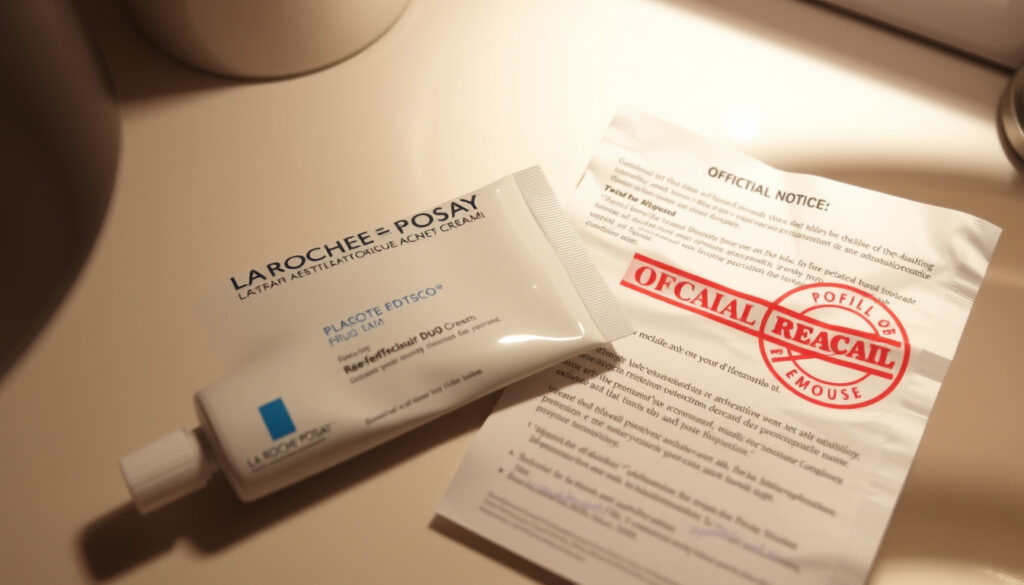
La Roche-Posay Effaclar Duo Recall & Discontinuation Guide
If you’ve been scanning drugstore shelves for your go-to acne spot treatment, you might have noticed something odd: La Roche-Posay Effaclar Duo has been getting harder to find after the March 2025 recall due to benzene concerns. Here’s what we know about the recall, the ingredients, and how to adjust your skincare routine if this was your daily staple.
Key active ingredient: 0.5% Salicylic Acid · Breakout reduction claim: Up to 3x fewer breakouts · Hydration duration: 24-hour hydration · Suitable skin types: Oily, acne-prone skin · Product variant in market: Effaclar Duo+M
Quick snapshot
- La Roche-Posay Effaclar Duo Dual Action Acne Treatment was recalled at the retail level in March 2025 (U.S. Food and Drug Administration)
- The product contains 0.5% salicylic acid as the active ingredient (CVS Pharmacy recall PDF)
- Only one specific lot (MYX46W) with expiry April 2025 was affected (U.S. Food and Drug Administration)
- Exact reason for recall beyond benzene contamination (full disclosure not yet public)
- Whether other batches or the non-U.S. Effaclar Duo+M variant are affected
- Official replacement product from La Roche-Posay for the recalled formulation
- 2024-03: Valisure’s initial findings on benzoyl peroxide breakdown published (Yale Medicine)
- 2025-03-11: FDA announces limited retail recalls after testing 95 products (U.S. Food and Drug Administration)
- Recalled product lot MYX46W had an April 2025 expiration (U.S. Food and Drug Administration)
- Consumers can return purchased recalled product to CVS for a full refund (CVS Pharmacy recall PDF)
- The FDA has not advised consumers using other Effaclar variants to take any action (U.S. Food and Drug Administration)
- Look for alternative salicylic acid treatments if your routine relied on Effaclar Duo (CVS Pharmacy recall PDF)
The FDA tested 95 benzoyl peroxide acne products, and more than 90% showed undetectable or extremely low benzene levels—the recall was narrow. One pattern across the six recalled products: all contained benzoyl peroxide, which Yale Medicine notes can break down into benzene over time.
| Specification | Detail |
|---|---|
| Brand | La Roche-Posay |
| Product Name | Effaclar Duo+M (original: Effaclar Duo) |
| Key Ingredient | Salicylic Acid (0.5%) |
| Main Use | Treatment of mild to moderate acne |
| Recall Status | Recalled by L’Oreal (retail-level, March 2025) |
| Discontinuation | Confirmed for U.S. market (original Effaclar Duo Dual Action) |
| Affected Lot | MYX46W, expiry April 2025 |
| Consumer Action | Return to CVS for full refund |
What is La Roche-Posay Effaclar Duo used for?
- Anti-breakout corrective gel moisturiser — intended to hydrate while treating acne (Boots product page)
- Unclogs pores to help prevent spots and breakouts (Meagher’s Pharmacy product page)
- Reduces post-acne marks and pigmentation
How Effaclar Duo targets acne and breakouts
The formula combines 0.5% salicylic acid with a microbiome-friendly base—making it a U.S. Food and Drug Administration-registered over-the-counter acne treatment.
Who should use Effaclar Duo: skin types and conditions
- Oily skin types prone to congestion
- Those with mild to moderate blemishes
- Users who need a daily moisturiser with active acne treatment
The trade-off: the same salicylic acid that clears pores can irritate dry or sensitive skin if overused.
Users in the U.S. who relied on the recalled lot face a temporary gap. For non-U.S. users, Effaclar Duo+M remains available, but it’s worth checking your local product label for the exact active ingredient concentration.
The implication: this gap may push U.S. consumers to explore alternative salicylic acid treatments sooner than expected.
Why is Effaclar Duo being discontinued?
- L’Oreal voluntarily recalled La Roche-Posay Effaclar Duo Dual Action Acne Treatment in March 2025 after U.S. Food and Drug Administration testing found elevated benzene in the product.
- Discontinuation appears linked to the recall—many U.S. retailers are no longer stocking it.
- Users report difficulty finding the product in stores.
L’Oreal recall announcement and reasons
According to ABC News, the recall was voluntary and affected several retail skin care products including La Roche-Posay. The FDA’s statement noted that only a limited number of products were recalled because elevated benzene was found in a small subset of the tested acne products.
Impact on product availability
Consumers who bought the recalled product at CVS can obtain a full refund by returning it to a store, per the CVS Pharmacy recall PDF. For online purchases, check the retailer’s return policy.
If you still have an unexpired tube, check the lot number: MYX46W is the only recalled batch. Other lots have not been flagged, but the overall discontinuation means you’ll need a replacement soon.
The pattern: the recall was narrow but the discontinuation is real, driving U.S. users to adapt their routines.
Does Effaclar Duo have salicylic acid in it?
- Yes—Effaclar Duo+M contains 0.5% salicylic acid (U.S. Food and Drug Administration)
- Salicylic acid exfoliates and unclogs pores
Salicylic acid concentration in Effaclar Duo+M
The product’s active ingredient is salicylic acid at 0.5%—a standard over-the-counter strength. The recalled lot (MYX46W) contained benzoyl peroxide as an additional active, but the non-U.S. variant “Effaclar Duo+M” continues to be sold with salicylic acid alone.
Role of salicylic acid in acne treatment
Salicylic acid is a beta hydroxy acid that penetrates oil-rich follicles to dissolve dead skin cells and excess sebum. Yale Medicine recommends consistent daily use for best results.
Why this matters: if you’re switching to a different salicylic acid product, check the concentration—0.5% is relatively low, so a product with 1% or 2% may require gradual introduction.
Can I use La Roche-Posay Effaclar Duo every day?
- Product is designed for daily use
- Apply once or twice daily according to tolerance
- Layer after cleanser and before heavier moisturisers
Recommended frequency for Effaclar Duo application
Boots product page describes Effaclar Duo+M as a “daily anti-breakout corrective gel moisturiser.” Start with once daily and increase to twice daily if your skin tolerates it. If you experience dryness, scale back.
How to use Effaclar Duo+M step by step
- Cleanse your face with a gentle, non-stripping cleanser.
- Pat skin dry—do not rub.
- Apply a pea-sized amount of Effaclar Duo+M to the entire face, avoiding the eye area.
- Follow with an oil-free moisturiser if needed.
- Use a broad-spectrum SPF 30+ in the morning, as salicylic acid increases sun sensitivity.
The pattern: Effaclar Duo works as a 2-in-1 treatment and moisturiser, but layering with other actives requires care.
What not to mix with Effaclar Duo?
- Avoid combining with strong AHAs, BHAs, or retinoids
- Do not layer with other acne spot treatments unless directed by a dermatologist
- Be cautious with vitamin C or benzoyl peroxide in the same routine
Skincare ingredients incompatible with Effaclar Duo
Using Effaclar Duo with other exfoliating acids (glycolic acid, lactic acid, high-concentration salicylic acid) raises the risk of over-exfoliation. Similarly, retinoids like tretinoin or adapalene can cause excessive irritation when paired with salicylic acid. ABC News reported that even the recalled benzoyl peroxide version carried irritation risks.
Signs of over-exfoliation and irritation
- Redness, tightness, or stinging
- Peeling skin not related to active acne
- Increased breakouts (purging that lasts longer than 4 weeks)
The catch: if you’re already using a prescription acne treatment, check with your dermatologist before adding Effaclar Duo—the risk of chemical burns is real.
“Anti-breakout corrective gel moisturiser that hydrates and reduces breakouts”
— Boots product description
“Unclogs pores to help prevent spots & breakouts”
— Meagher’s Pharmacy product page
For U.S. consumers who relied on the recalled Effaclar Duo, the choice is clear: switch to a non-recalled salicylic acid treatment from the Effaclar range (if available) or consult a dermatologist for a tailored alternative that respects your skin’s tolerance. The recall was narrow, but the discontinuation is real—so adjusting now beats scrambling later.
Related reading: Laser Hair Removal Cork: Costs, Clinics, and Expert Guide · Hoka Clifton 9 Women’s Review: Best For, Pros & Cons
Frequently asked questions
Is Effaclar Duo safe to use after the recall?
If your tube is from a different lot (not MYX46W), the FDA has not flagged it. However, the product has been discontinued in the U.S., so any remaining stock may be old.
What are the side effects of Effaclar Duo?
Common side effects include mild dryness, peeling, and initial purging. More severe irritation is rare but possible if overused or mixed with strong actives.
How does Effaclar Duo compare to other salicylic acid treatments?
At 0.5% salicylic acid, it’s a gentle daily option. Products like CeraVe SA Renewal (0.5%) or Paula’s Choice 2% BHA are stronger but require less frequent use.
Can I still buy Effaclar Duo online?
Some third-party sellers may still have stock, but the official La Roche-Posay U.S. site no longer lists it. Check expiration dates before purchasing.
What is the difference between Effaclar Duo and Effaclar Duo+M?
Effaclar Duo+M is the current international variant. The recalled U.S. version (Effaclar Duo Dual Action) contained benzoyl peroxide; Duo+M relies on salicylic acid alone.
Does La Roche-Posay have a replacement for Effaclar Duo?
La Roche-Posay has not announced a direct U.S. replacement. The Effaclar range still includes other cleansers and serums with salicylic acid.
More related posts
 Liverpool F.C. vs Barnsley F.C. Timeline: H2H & Results
 Signs of Low Iron: Symptoms, Causes, and Treatment
 Travis Kelce Net Worth: 4% of Taylor Swift’s Fortune
 MPG to L/100km Converter: US/UK Formulas & Benchmarks
 Love at First Sight: Meaning, Science & 2023 Movie Guide
 99 Nights in the Forest Codes – Active List April 2026
 Vinnie Jones in the Country Season 3: Release Date & Streaming
 Stronger With You Parfum: Scent Profile and Flanker Guide