Can You Bring Food Through Airport Security? 2026 Rules
If you’ve ever stood in an airport security queue wondering whether that homemade sandwich or bottle of soup will make it past the X-ray belt, you’re not alone. The rules shifted significantly for Irish airports — liquids and gels now get much more generous treatment than travelers remember from the old 100ml bottle days.
Dublin Airport food container limit: up to 2 litres · Exempt items: baby food, special dietary liquids · Previous liquids rule: 100ml maximum no longer applies
Quick snapshot
- Dublin Airport allows containers up to 2 litres through security (Dublin Airport Official)
- Clear plastic bag requirement no longer applies (Dublin Airport Official)
- How strictly individual airlines enforce carry-on food allowances beyond official policy
- Whether duty-free purchases at departure airports follow separate inspection rules
- 2026: Dublin Airport lifted the 100ml liquids limit (Dublin Airport Official)
- 2020: Brexit reclassified Great Britain as non-EU for Irish customs purposes (Dublin Airport Official)
- Travelers should separate security screening (carry-on) from customs declaration (border) when packing food
The table below consolidates key Dublin Airport security rules alongside Irish customs thresholds for food imports.
| Category | Rule | Source |
|---|---|---|
| Dublin liquids limit | 2 litres max per container | Dublin Airport Official |
| Exempt foods | Baby food, special diets | Dublin Airport Official |
| Prohibited examples | Soups, syrups over limits | Dublin Airport Official |
| Hand luggage allowance | Dietary requirements permitted | Dublin Airport Official |
| Infant formula (non-EU origin) | Under 2 kg, original packaging | Food Safety Authority of Ireland (government regulatory body) |
| Infant formula (EU origin) | Under 10 kg, commercially branded | Food Safety Authority of Ireland (government regulatory body) |
| Fresh nuts and fruits (non-EU) | Up to 5 kg | Food Safety Authority of Ireland (government regulatory body) |
| Dried herbs and spices (non-EU) | Up to 2 kg | Food Safety Authority of Ireland (government regulatory body) |
Can you bring food through Dublin airport security?
Yes — and the rules are far more forgiving than many travelers assume. Dublin Airport security now permits liquids and gels in containers up to 2 litres in carry-on baggage. The old 100ml maximum limit no longer applies, and you no longer need to pack liquids inside a clear plastic bag for screening.
For those carrying food for medical reasons or dietary requirements, Dublin Airport explicitly allows essential foodstuffs through security. Cork Airport follows the same policy, with specific exemptions for baby food and food for passengers on special diets.
Liquids and gels rules
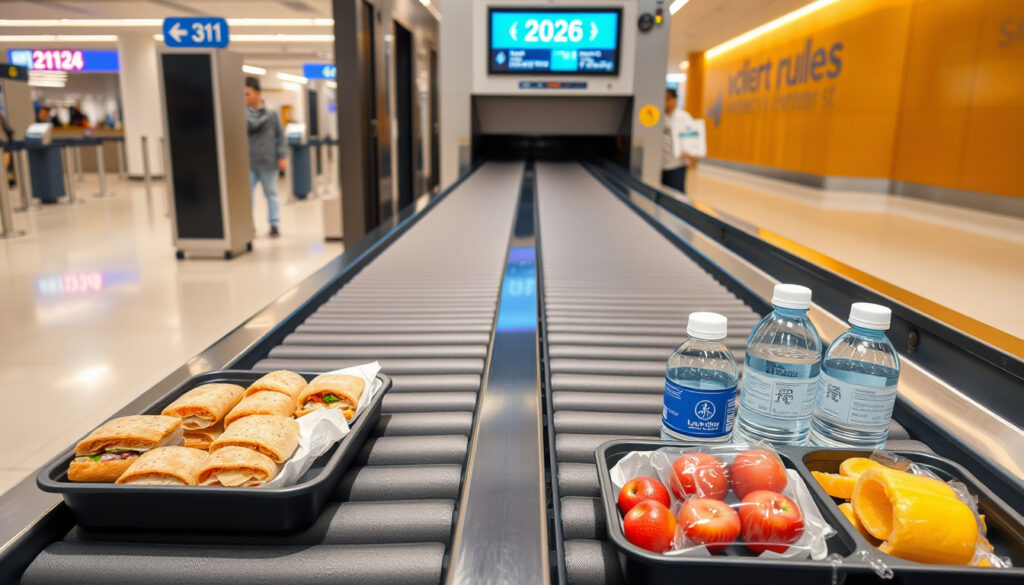
Solid foods — sandwiches, fruit, biscuits, chocolate bars — pass through airport security without restriction. The change applies specifically to liquids and gels, which now follow the updated container limit of up to 2 litres per item. This covers soups, sauces, yogurts in travel containers, and similar items that previously would have been confiscated or surrendered at the security checkpoint.
Exemptions for special diets
Passengers with medical conditions or specific dietary needs can carry specialized nutrition through security. Baby food and powdered infant milk also receive exemptions. Cork Airport’s official guidance specifically names these categories as allowed regardless of the standard liquid rules.
Dublin Airport’s updated 2-litre container policy means you can bring a full bottle of water or a container of soup through security — something that would have been unthinkable under the old 100ml rule. Pack what you need for the journey, not what security will let through.
Can you bring food through airport security in a suitcase?
Checked baggage operates under different rules entirely. Security screening applies to hand luggage — the bags that pass through the X-ray scanners. A suitcase in the hold never reaches a security officer’s hands during the passenger screening process.
The practical implication: anything legally allowed through Irish customs can go inside checked luggage. The Food Safety Authority of Ireland guidance applies to what arrives in Ireland, not what departs.
Hand luggage vs checked baggage
Hand luggage undergoes X-ray screening, which means all food items — solid or liquid — must be visible on the scanner and comply with current container limits. For dietary requirements, passengers can bring specialized foods in hand luggage without restriction beyond standard security screening procedures.
Full suitcase restrictions
No specific bans exist on packing food inside a full suitcase for outbound flights. However, airlines enforce weight and dimension limits on checked bags, and heavy food items — canned goods, jars, bottled liquids — add up quickly. For international departures from Ireland, check your airline’s specific carry-on and checked baggage policies.
Budget carriers with strict carry-on limits mean food items compete with clothes and toiletries for overhead bin space. A suitcase full of provisions for your destination fits in the hold — but not the cabin.
What food cannot go through airport security?
Airport security screens for items that could pose a risk in the cabin — not for customs compliance. With Dublin’s updated rules, liquid and gel restrictions focus on container size rather than the substance itself. Items over 2 litres per container, however, still face scrutiny.
Security flags differ from what customs seizes. A container of soup within the 2-litre limit passes screening but might trigger questions at the border if arriving from a restricted origin.
Prohibited liquids over limits
Any single container exceeding 2 litres gets flagged at Dublin Airport security screening, regardless of its contents. The previous 100ml ceiling is gone, but the upper boundary remains. For context: most standard water bottles hold 500ml to 1 litre, so the new limit accommodates substantial quantities.
Pastes and gels examples
Yogurt pots, hummus tubs, baby food pouches, and similar semi-liquid items fall within the 2-litre rule. Items previously restricted under the 100ml regime — travel-sized toiletries, small soup containers — now pass freely if within the new container limit.
What kind of snacks can you take through TSA?
TSA governs US airport security — so this matters primarily for passengers traveling to or via American airports. For Ireland, Dublin, Cork, and Shannon set the standards, which are aligned with updated EU guidelines allowing larger liquid containers than the TSA’s current 100ml limit for US domestic flights.
Snacks broadly fall into two categories: solid items always pass through security anywhere, and liquid or gel items must meet the relevant jurisdiction’s container limits. A solid sandwich, pack of biscuits, or chocolate bar causes no friction at any checkpoint globally.
Solid snacks permitted
Cereal bars, dried fruit, nuts, bread products, chocolate bars, hard cheeses, and similar solid items pass through Dublin Airport security without condition. TSA similarly permits solid food through US checkpoints. The complication arises with spreads — nut butters, soft cheeses, hummus — which classify as liquids or gels under current definitions.
TSA vs EU rules
TSA currently enforces a 100ml container limit on liquids and gels for international departures from US airports. EU airports, including Dublin, adopted the more generous 2-litre threshold. If your journey originates in the US, the stricter TSA rule applies until you clear US exit screening. Connecting through an EU airport after that point, your carry-on items face re-screening under local rules.
US-based travelers benefit from packing solid snacks for the outbound flight and saving liquid or gel items for purchase after clearing US security. Irish travelers enjoy the more relaxed 2-litre rule for their return journeys. Solid food moves freely across both jurisdictions.
Can you bring water through Dublin airport security?
Yes — water in containers up to 2 litres passes through Dublin Airport security screening. The days of finishing your water bottle before reaching the checkpoint are over. Under the updated rules, a full reusable bottle or sealed water container causes no issue as long as the container itself does not exceed 2 litres capacity.
For passengers who prefer to purchase drinks after security rather than carry them through: Dublin Airport’s post-security shops and cafés offer water, coffee, and other beverages for immediate consumption or travel provision.
Current liquids policy
Dublin Airport’s current liquids policy permits containers up to 2 litres in carry-on baggage, with no requirement for clear plastic bag presentation. Electronics no longer need to be removed from bags during screening — a parallel change that streamlines the security experience alongside the updated food and drink rules.
Post-security purchase
Travelers preferring not to carry liquids can purchase water and other beverages after clearing security. Airport pricing varies, but post-security options include high street brands alongside airport-exclusive vendors. For long-haul flights, purchasing drinks post-security ensures you have refreshments for the gate and boarding process.
Customs rules differ from security screening. Bringing water through Dublin security is straightforward, but importing water from outside the EU could trigger declaration requirements. Always separate airport security rules from border customs rules when packing food or liquids.
How to pack food for Dublin Airport in 5 steps
Five steps cover the practical decisions from home to boarding gate, keeping security rules and customs implications separate.
- Identify your food type. Solid foods (sandwiches, fruit, chocolate, biscuits) face no container restrictions. Liquid or gel foods (soup, sauce, yogurt, hummus) must fit within the 2-litre per container limit at Dublin Airport security.
- Choose your bag. Hand luggage for items you want during the journey and flight; checked baggage for heavier food items, cans, and jars destined for your destination. Remember airline weight limits on checked bags.
- Check origin for customs. If you’re bringing food into Ireland from outside the EU, verify the item against FSAI guidance before departure. Meat, milk, and dairy from non-EU countries (including Great Britain post-Brexit) are prohibited.
- Pack for security. At Dublin, Cork, or Shannon, liquid and gel food items up to 2 litres per container pass without clear bag presentation. No need to separate drinks for screening — but keep items accessible for scanner inspection if requested.
- Declare if required. Arriving passengers using the Red Channel must declare restricted food items. The Green Channel is for nothing to declare only. Customs officials seize undeclared prohibited items, and Revenue officers can issue on-the-spot penalties for excess goods.
Packing food for Irish airport travel requires knowing whether you’re carrying through security (for the journey) or importing across the border (for consumption in Ireland). These are separate questions with separate rules.
What customs restrictions apply to food arriving in Ireland?
The customs line operates independently from security screening — and the rules tighten considerably. Arriving passengers face restrictions based on where their food originated, with significant consequences for non-compliance.
Irish Revenue Service and the Food Safety Authority of Ireland jointly enforce import rules. Meat, milk, and dairy products from non-EU countries face outright bans. Great Britain, following Brexit, now falls into this restricted category for Irish customs purposes.
Customs officials actively seize and destroy these items at the border to protect the local agricultural sector from disease.
— Roafly Travel Guide (travel information provider)
Chocolate, confectionery, cakes, and biscuits in personal quantities generally enter Ireland freely from non-EU countries — provided they contain no meat or dairy ingredients. American sweets with no animal products pose no issue. Homemade baked goods from outside the EU can arrive if they exclude fresh dairy and meat.
Customs allowances apply individually. Combining allowances between family members to bring in extra quantities of restricted goods is not permitted. Using the Green Channel when you carry undeclared restricted items risks permanent confiscation and financial penalties from Revenue officers.
Summary
Dublin Airport’s updated security rules in 2026 make traveling with food substantially easier than the old 100ml regime. Liquid and gel items up to 2 litres per container now pass through security screening without restriction, and solid foods face no limits at all. The practical benefit is real: you can bring soup, hummus, or a full water bottle through the checkpoint without pre-planning a disposal strategy.
But airport security and border customs are distinct processes. Food passing through Dublin, Cork, or Shannon screening can still face scrutiny at the customs line if arriving from outside the EU. Meat, milk, and dairy from non-EU countries — including post-Brexit Great Britain — are prohibited entries. Gifts containing fresh meat or dairy face the same restriction. Travelers importing food from the US, UK, or other non-EU origins must verify their items against FSAI guidance before departure.
For Irish travelers heading abroad, the rules of their destination country apply at that border. For visitors arriving in Ireland, the customs rules above determine what reaches the terminal exit. Packing decisions made at home ripple through both checkpoints — security first, customs second. For passengers with dietary needs or medical requirements, exemptions exist at both stages, but knowing which exemption applies where prevents unpleasant surprises at the queue.
Related reading: Dublin Airport hotels and shuttles
Dublin and Cork now allow up to 2L of liquids and gels through security, a change that also applies to aerosols on a plane alongside unrestricted solids.
Frequently asked questions
Can you bring food through airport security Ryanair?
Ryanair enforces standard EU carry-on limits for cabin baggage. Food items in hand luggage must fit within the airline’s size and weight restrictions for personal items or carry-on bags. Ryanair does not impose food-specific bans beyond standard security rules — containers up to 2 litres pass Dublin Airport security screening regardless of which airline you fly.
Can you bring food through airport security Ireland?
Yes. Dublin Airport, Cork Airport, and Shannon Airport follow the updated Irish security policy allowing containers up to 2 litres for liquids and gels in carry-on baggage. Solid foods face no restrictions at security screening at any Irish airport.
Can you bring food through airport security Cork?
Cork Airport applies the same rules as Dublin — containers up to 2 litres for liquids and gels, solid foods unrestricted at security screening. Cork Airport’s official guidance specifically notes exemptions for baby food and food for passengers on special diets.
Can I pack a suitcase full of food?
For checked baggage on departing flights from Ireland, no food-specific bans apply. However, airline weight limits (typically 15–23 kg per checked bag depending on ticket class) constrain how much you can pack. Heavy items like canned goods and glass jars add up quickly. For inbound flights to Ireland from outside the EU, customs restrictions apply regardless of which bag the food travels in.
What is not allowed in Dublin Airport?
At Dublin Airport security screening: containers exceeding 2 litres for liquids and gels, and items that pose an aviation security risk. At Irish customs (arriving passengers): meat, milk, and dairy products from non-EU countries; items from high-risk areas containing pests; undeclared restricted goods. The Green Channel is for passengers with nothing to declare only.
Can you bring food through airport security Shannon?
Shannon Airport applies the same Irish security policy as Dublin and Cork. Liquid and gel food items in containers up to 2 litres pass carry-on screening without restriction. Shannon’s customs procedures follow the same Red/Green Channel system as other Irish airports for arriving international passengers.
Can you bring food through airport security international?
Security screening rules vary by country of departure. If flying internationally from an EU airport, Dublin’s 2-litre rule applies during your outbound screening. If departing from a US airport on an international flight, TSA’s current 100ml liquid limit applies. Always check the security rules for your departure airport, not your destination, when packing liquids and gels.
More related posts
 TP-Link WiFi Extender Setup: Connect, Reset & Fix Issues
 Dingle v St Finbarrs: Conor Geaney Free Wins Munster Title
 2025 Ireland Presidential Election: Connolly’s Victory
 When Is the Next Bank Holiday? Ireland & NI 2026
 Ladies European Tour Leaderboard Today: Live Scores & News
 Convert Euro to Sterling – Live Rates and Savings Guide
 Samsung Galaxy Tab A9 Review: Worth Buying
 NFL Croke Park Tickets: Buy, Prices, Availability 2025