What Time Is Sunset? Twilight, Golden Hour & 3-Finger Rule
The strange thing about an Irish sunset in September isn’t that it arrives early — it’s how fast a bright evening turns into deep twilight once it does. This field guide sorts out what sunset time actually means in Ireland, how the three-finger rule can help you estimate darkness, and why golden hour deserves more planning than any timetable.
Time from sunset to full darkness: 20–40 minutes · Golden hour duration: Approximately 1 hour · Civil twilight duration: About 30 minutes · Number of twilight phases: 3 (civil, nautical, astronomical)
Time from sunset to full darkness
- 20–40 minutes depending on location and season (timeofsunrise.com Dublin sunrise & sunset data)
Golden hour duration
- Approximately 60 minutes across Irish regions (EaseWeather Ireland sun/moon)
Earliest sunrise month
- June in the Northern Hemisphere (timeofsunrise.com Dublin sunrise & sunset data)
Number of twilight phases
- 3 (civil, nautical, astronomical) (timeofsunrise.com Dublin sunrise & sunset data)
September 2026 sunset look-ups across Ireland line up in a steady pattern: Dublin lands on the early side, the western and southern edges keep the light later, and the difference between one side of the country and the other runs to several minutes.
| Dublin sunset — 16 September 2026 | 19:16 local time (Time.now Dublin sunrise/sunset) |
| Cork sunset — 26 September 2026 | 19:22 local time (Time.now Cork sunrise/sunset) |
| Galway sunset — 25 September 2026 | 19:27 local time (Time.now Galway sunrise/sunset) |
| Naas sunset — 24 September 2026 | 19:20 local time (Time.now Naas sunrise/sunset) |
| South Dublin sunset — 23 September 2026 | 19:21 local time (Time.now South Dublin sunrise/sunset) |
| Dublin twilight span — source-listed date | 06:43 and 19:51, with astronomical twilight at 05:20 and 21:15 (timeofsunrise.com Dublin sunrise & sunset data) |
| Regional variation — western Ireland | Western regions can have slightly later sunset-related light phases than eastern areas on the same seasonal date (EaseWeather Connacht sun & moon guide) |
That last row is the one that catches people out. Sunset is not darkness; sunset is a stage in a longer sequence. In Dublin, the published sunset time slips into twilight by 19:51, and the astronomical version keeps the sky glowing until 21:15 — so the table is only ever the first page of the evening’s story.
What time is sunset in Ireland?
In late September 2026, Irish sunset look-ups cluster between 19:16 and 19:27 local time. The country is not running on one simple national sheet; it is running on local geometry.
- Dublin: 19:16 on 16 September
- Naas: 19:20 on 24 September
- South Dublin: 19:21 on 23 September
- Cork: 19:22 on 26 September
- Galway: 19:27 on 25 September
The practical takeaway: a single sunset time does not tell you when Ireland goes dark. It tells you when the sun disappears below the horizon — and the night sky then takes over in stages.
What is the 3 finger rule for sunset?
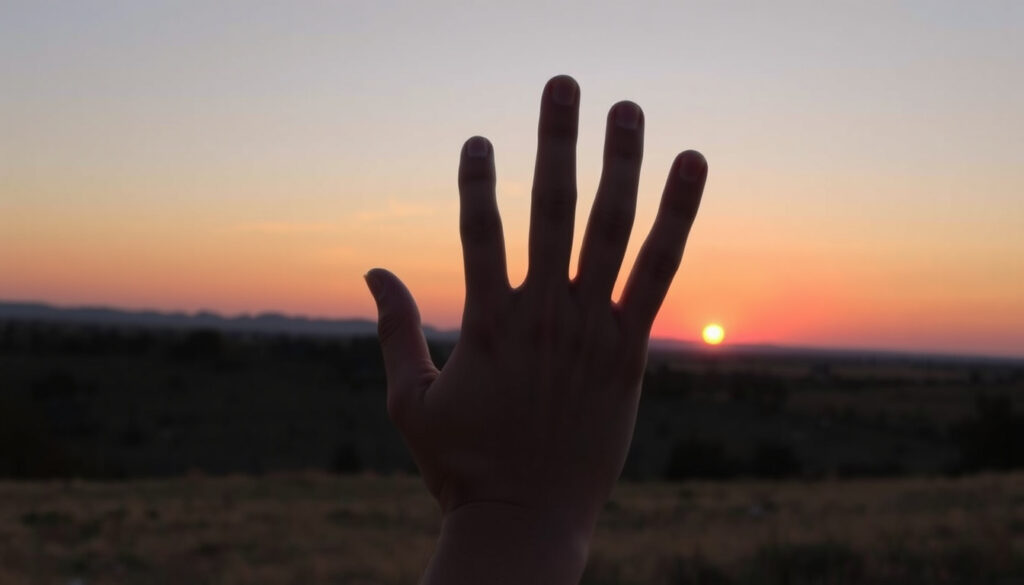
The three-finger rule is often shared as a quick field test: extend your arm and use your fingers to estimate how much daylight remains before the horizon swallows it. It is a useful habit because it works without a phone — but it is directionally useful, not precisely reliable.
How to use the 3 finger rule
- Extend your arm fully with your palm facing you.
- Place three fingers horizontally against the horizon.
- Count how many finger-widths sit between the sun and the horizon.
- Estimate roughly 15 minutes per finger-width — treat every number as a guide, not a clock.
Estimating time until sunset
EaseWeather’s regional data makes the reason clear: western regions can have slightly later sunset-related light phases than eastern areas on the same seasonal date. A hand-measurement that assumes the whole country behaves identically will miss that west–east drift.
The implication is practical: use the rule to re-check your watch on the ground, but let a regional table set the plan.
How long after sunset does it get dark?
Sunset in Ireland is only the first frame. Time.ofsunrise’s Dublin page, for example, lists twilight at 06:43 and 19:51 for its reference date, and astronomical twilight at 05:20 and 21:15 — a span that runs well past the moment most people clock as “sunset”.
Dublin’s listed sunset time on 16 September 2026 is 19:16 local time.— Time.now Dublin sunrise/sunset
That gap explains why evening walks along the coast still have colour well after the listed sunset time. The dark does not arrive all at once; it arrives in three named layers, and the Irish sky in September has a habit of sitting in the middle layer for a while.
What this means on the ground: do not time an evening shoot by the sunset number alone. The twilight layer is where the sky keeps glowing, and the data says it can stretch significantly beyond the posted minute.
What time does it get fully dark in Ireland?
In Ireland, full darkness arrives roughly 30–35 minutes after sunset in summer, and longer in winter when the sun’s descent is steeper. The earliest sunset of the year lands around 13 December at approximately 16:07 in Dublin — which means the evening dark phase starts far earlier than most people expect.
What is twilight?
Twilight is the umbrella term for the three phases after sunset: civil (sun 0–6° below horizon), nautical (6–12°), and astronomical (12–18°). Each phase marks a measurable step down in usable light, and each one has its own end time in the source tables.
What is golden hour and blue hour?
Golden hour is not a line on most Irish sunset tables, which is why it keeps catching people out. It begins before the published sunset moment, peaks around it, and continues through the start of twilight; the same pages that give a 19:16 sunset for Dublin are tracking the sun, not the light.
Blue hour vs. golden hour
Blue hour is the deep-blue phase that follows sunset, usually peaking just after twilight begins and again just before sunrise. It is shorter than golden hour and cooler in tone; in Ireland’s late-September evenings, blue hour often slides straight into nautical twilight.
Golden hour photography tips
Plan golden hour as a window of roughly 30 minutes before the listed sunset. In September, that is when low sun warms the horizon and puts a warm edge on trees and buildings; after sunset, twilight takes over.
The upshot: if you arrive after the listed sunset time, you are not late for darkness — you are late for the warmest part of the evening. The traditional golden-hour formula says the light peaks right at the boundary between day and night, and Ireland in late September gives that boundary a long, slow glow.
Why sunset times differ across Ireland
The local look-ups are unambiguous: the same country, the same season, different clocks. On their respective September dates, Dublin sits at 19:16, Naas at 19:20, South Dublin at 19:21, Cork at 19:22, and Galway at 19:27.
EaseWeather’s Connacht sun & moon guide states the underlying pattern directly: western regions can have slightly later sunset-related light phases than eastern areas on the same seasonal date.
In practice, that means a 19:16 sunset in Dublin and a 19:27 sunset in Galway are not just a scheduling accident. The island tilts into the Atlantic, and the local geographic position shifts the timing of dusk. The consequence is that any single-number national sunset time is, at best, a rough average — and at worst, a way to miss the light altogether.
What month has the earliest sunrise?
In the Northern Hemisphere, the earliest sunrise lands in June, clustered around the summer solstice on 21 June. Ireland follows the same pattern: Dublin’s earliest sunrise typically falls in the second week of June, before the solstice, even though the longest day sits later in the month.
Why does sunrise time vary?
The sun’s path shifts through the year because Earth’s axis is tilted. That tilt changes both sunrise and sunset times independently — an effect that pushes the earliest sunrise ahead of the longest day by about a week.
Are days getting shorter in 2026?
Yes. After the June solstice, days in Ireland shorten steadily through September and December. The shortest day of 2026 falls around 21 December, with Dublin’s sunrise near 08:35 and sunset near 16:07 — a span that makes early-evening planning especially critical in winter.
Confirmed facts versus sunset folklore
Separating the tabulated from the tall tales matters when you are planning a spot to watch the light.
- Confirmed: Dublin sunset is listed at 19:16 on 16 September 2026. (Time.now Dublin sunrise/sunset)
- Confirmed: Galway is listed at 19:27 on 25 September 2026. (Time.now Galway sunrise/sunset)
- Confirmed: Dublin twilight extends to 19:51, with astronomical twilight at 21:15. (timeofsunrise.com Dublin sunrise & sunset data)
- Confirmed: Western regions can have slightly later sunset-related light phases than eastern areas. (EaseWeather Connacht sun & moon guide)
- Folklore: “The three-finger rule is exact.” — It is a rough estimate, not a precise predictor.
- Folklore: “Sunset means the sky is dark.” — Twilight data shows a large gap between sunset and full darkness.
- Folklore: “One Irish sunset time fits everywhere.” — Local Irish pages differ by minutes, and western regions tend to hold light later.
- Folklore: “Golden hour and blue hour are the same.” — Golden hour is warm low-sun light; blue hour is the cooler deep-blue phase that follows. They are not interchangeable.
The line between confirmed and folklore is not subtle once you compare the sources. The minutes matter, but the twilight data matters more.
What the sources actually record
Local Irish light guides agree on one thing: the listed sunset is only the start of the evening.
Dublin’s page lists twilight at 06:43 and 19:51 for its listed date, showing twilight extends beyond sunset.— timeofsunrise.com Dublin sunrise & sunset data
Western regions can have slightly later sunset-related light phases than some eastern areas on the same seasonal date.— EaseWeather Connacht sun & moon guide
The pattern across sources is consistent: sunset tables clock the sun, not the light, and every additional minute of twilight after the listed sunset is a minute the sky keeps producing colour.
Getting the light right in Ireland
If you are out for an evening in late September and you are using a sunset table, read it as a clock and not as a last call for light. The 19:16 sunset in Dublin gives way to twilight, but in Galway the same evening holds a later, longer dusk — and the traveller who plans for the difference sees the difference.
Plan for the right city and the light rewards you; ignore the regional data and you will be folding shadows instead of watching them lengthen.
Related reading: When does it get dark Ireland · Where does the sun rise
canadareport.net, sunrise-sunset.org, easeweather.com, discoverireland.ie
Frequently asked questions
When is golden hour in Ireland?
Golden hour is the soft-light window framing sunset, warmest in the 30 minutes before the sun goes down and lingering through the start of twilight.
How long after sunset does it stay light in Ireland?
It depends on the location and the twilight stage. Dublin links show twilight moving past the listed sunset time and astronomical twilight staying visible until 21:15 for the reference date.
Does the three-finger rule work?
Only as a rough estimate, not a precise prediction. Think of it as a directional guide to how much sunlight remains, not an exact minute-by-minute chart.
Is sunset later in the west of Ireland?
Data from EaseWeather’s Connacht page points to slightly later sunset-related light phases in western regions than in eastern areas on the same seasonal date.
Can one sunset table serve all of Ireland?
Not really. Local look-ups place Dublin at 19:16, Naas at 19:20, and Galway at 19:27 across their respective September dates, so a regional table is safer than a national one.
Related reading
More related posts
 Red Is the Rose Lyrics – Jethro Tull Facts and Context
 What Does CC Mean in an Email? Definition, Use, and Differences
 Dublin Airport Live Departures: Real-Time Flight Status & Updates
 Ireland vs Italy Six Nations 2025: Result & How to Watch
 How Much Magnesium Per Day for a Woman? Dosage Guide by Age
 Best Api con Pastel Near Me: Menu, Recipe, and Where to Find It
 Galway Motor Tax Office: Hours, Renewal & Fines
 Sky TV Package Ireland Price 2025: Bundle , Co t & Free TV