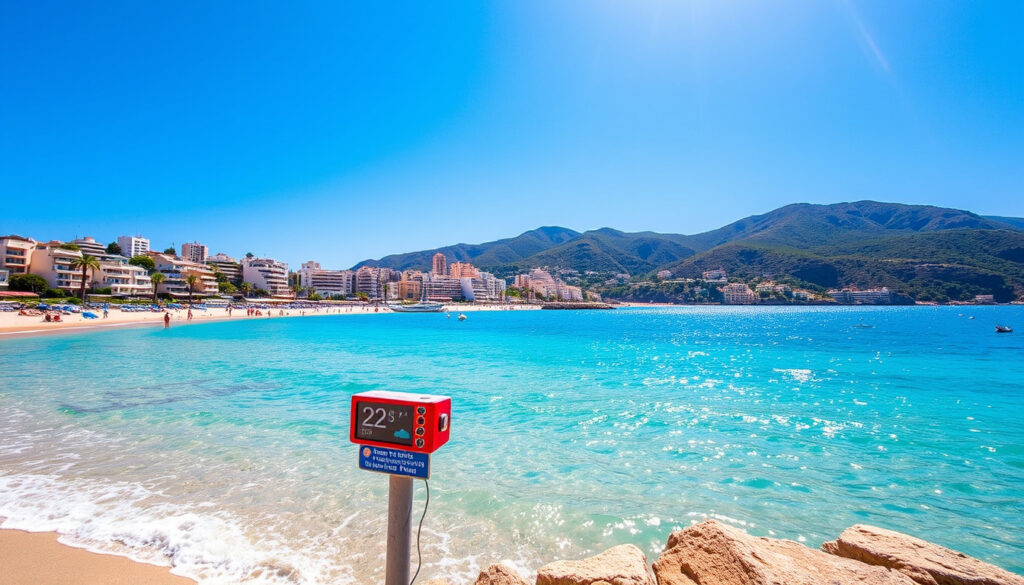
Nerja Weather Forecast 21 Days: Monthly Averages & Travel Tips
Anyone who has tried to plan a three-week holiday around a single forecast knows the feeling: the app says sun, the model updates, and suddenly it says rain. For Nerja, the smarter move is to plan around climate history — daytime highs climb from about 14°C in January to 31°C in July and August, according to Weather2Travel’s Nerja climate guide, so use those monthly averages to pick the window that matches your trip.
Average high in January: 16°C (61°F) · Average high in May: 24°C (75°F) · Average high in October: 24°C (75°F) · Best month for warmth and low rain: June to September · Cheapest month to fly: January (off-peak)
Quick snapshot
- Nerja has a Mediterranean climate — hot, dry summers and mild winters (Weather2Travel) (WeatherSpark)
- August is the hottest month, averaging 30°C (86°F) highs (WeatherSpark)
- Sea temperatures run from 15°C in winter to 23°C in August (Weather2Travel) (WeatherSpark)
- The hot season lasts about 2.9 months, from June 18 to September 14 (WeatherSpark) (WeatherSpark)
- Any 21-day forecast beyond two weeks is a trend, not a guarantee — the official reliable window is AEMET’s 7-day forecast (AEMET) (AccuWeather)
- January’s average high reads 14°C in Weather2Travel’s figures and 16°C in WeatherSpark’s model (WeatherSpark) (AccuWeather)
- Medium-range cloud cover swings between mostly sunny and partly sunny across the 10-day window (AccuWeather)
- Summer UV risk is described as extreme, but how fast you burn depends on skin type, time of day, and reflection off sand and water (Malaga Travel Guide) (AccuWeather)
- Hot season: June 18 – September 14 (WeatherSpark) (Malaga Travel Guide)
- Cool season: November 17 – March 17 (WeatherSpark) (Malaga Travel Guide)
- Sunshine peak: 11 hours a day in June and July (Weather2Travel) (Malaga Travel Guide)
- Best sunbathing window: May, June, September, and October (Malaga Travel Guide)
- For a 21-day beach stay, choose late May through early October (WeatherSpark) (Interhome)
- For the cheapest 21 days, book November–February and pack layers (Malaga Travel Guide) (Interhome)
- For the week itself, use AEMET’s official 7-day Nerja forecast instead of any 21-day app (AEMET) (Interhome)
- On the coast, Playa de Burriana’s fine sand and clear water make a natural base (Interhome)
Six numbers, one pattern: spring and autumn share the same pleasant 24°C highs, winter sits a full 8–10°C cooler, and the sea never fully catches up to the summer air.
| Monthly snapshot | Typical value |
|---|---|
| January average high | 16°C (61°F) · WeatherSpark |
| January sea temperature | 15°C (59°F) · Weather2Travel |
| February average high | 17°C (63°F) · Weather2Travel monthly averages |
| May average high | 24°C (75°F) · Weather2Travel monthly averages |
| October average high | 24°C (75°F) · Weather2Travel monthly averages |
| Cheapest month | January (off-peak) · low-season travel pricing |
What is the weather like in Nerja in January?
January is Nerja’s coldest month. WeatherSpark puts the average high at 60°F (16°C) and the average low at 47°F (8°C), while Weather2Travel’s daytime maximum reads a touch lower at 14°C and its night-time minimum at 5°C. The spread between the two data sets is normal — and worth knowing before you pack.
The bigger planning point is the forecast horizon. Many travellers check a Nerja weather forecast 21 days out and then wonder why it keeps changing: long-range models drift as new data arrives, and beyond 10–14 days they describe a trend, not a certainty. The closer you get to departure, the more weight you should give to the official 7-day municipal forecast from AEMET, Spain’s State Meteorological Agency.
Average temperatures and rainfall in January
- Average daytime high: 14–16°C (57–61°F), depending on the data set (Weather2Travel; WeatherSpark)
- Average night-time low: 5–8°C (41–46°F) (Weather2Travel; WeatherSpark)
- Rainfall: about 40mm across 6 wet days — with December’s 69mm and July’s 4mm marking the wet-dry range (Weather2Travel)
- Sunshine: about 6 hours per day through January and February (Weather2Travel)
What this means: January is the truest off-season month. The air is cool by Spanish standards, the sea sits at 15°C, and rain is more likely than in summer — which is exactly why it’s the cheapest month of the year to fly into the Costa del Sol.
January sunbathing is a coin flip: the averages promise 14–16°C and six hours of sun, but one cloudy day can erase an entire beach afternoon. Treat January’s warmth as a bonus, not a plan.
Can you sunbathe in Nerja in January?
- Air and sea: 14–16°C air with 15°C water — a beach walk works, sitting still doesn’t (Weather2Travel; WeatherSpark)
- Sunshine: about 6 hours — enough for a late-afternoon walk, not enough for a tan (Weather2Travel)
- Verdict: possible on milder afternoons in a sheltered spot, but this is not a sunbathing month
The honest answer: sunbathing works on the milder afternoons, in a sheltered spot, for about an hour before the breeze finds you. If your 21-day window lands in January, plan around sightseeing and quiet beaches — and let any sunny day be a pleasant surprise.
Can you sunbathe in Nerja in February?
February is January plus one degree. Daytime highs average 17°C (63°F), night-time lows ease to 9°C (48°F), and the sea holds at 15°C (59°F) — the same temperature as January, per Weather2Travel’s sea-temperature data. Rain eases slightly to about 35mm across 5 wet days.
February weather averages
- Average high: 17°C (63°F) — the first month with real afternoon warmth
- Average low: 9°C (48°F) — jacket weather after sunset
- Sea temperature: 15°C (59°F) — unchanged from January (Weather2Travel)
- Sunshine: about 6 hours a day, the same winter baseline (Weather2Travel)
The pattern: February is the last month of winter, not the first month of spring. What it does have is empty beaches and the lowest prices of the year — a fair trade if your priority is a quiet, affordable 21-day escape rather than a tan.
Sea water at 15°C plus 17°C air means you can sunbathe in a warm jacket, but you won’t swim without a wetsuit. Sunbathers who need guaranteed beach weather should shift their window by 10–12 weeks.
Sunbathing feasibility comparison with January
- Air: 17°C vs January’s 14–16°C — one degree better, same winter feel
- Sea: 15°C in both months — no meaningful change for swimmers (Weather2Travel)
- Sunshine: about 6 hours in both months — no change in tanning potential
- Rain: about 35mm over 5 days vs January’s 40mm over 6 — marginally drier
Compared with January, February adds roughly one degree of daytime warmth and a slightly drier week. The sea doesn’t move at all, so the swimming verdict is identical: this is a sightseeing month with a beach backdrop, not the reverse.
What is the weather like in Nerja in May?
May is the hinge month. Daytime highs reach 24°C (75°F), lows rest at a comfortable 14°C (57°F), and rainfall drops to about 15mm across 3 wet days. Sunshine is climbing toward its summer peak of 11 hours a day, per Weather2Travel’s monthly sunshine data.
May temperatures and sunshine hours
- Average high: 24°C (75°F) — warm enough for shorts, not hot enough for air conditioning
- Average low: 14°C (57°F) — a light layer for evenings
- Rainfall: about 15mm across 3 wet days (Nerja climate averages)
- Sunshine: heading toward 11 hours a day in June and July (Weather2Travel)
May is the first genuine sunbathing month. The sea is still warming from its winter floor, but the air makes lying on the sand work. On the coast, Playa de Burriana — Nerja’s main beach, with fine sand and crystal-clear water, according to holiday rental operator Interhome — is the obvious base for swimming and sunbathing.
The May sun is stronger than it looks. Local travel planners warn that southern Spain’s summer UV index is extreme, and their standard advice is blunt: bring Factor 50 sunscreen, a hat, and good sunglasses.
Best activities in Nerja in May
- Beach days: late-May sunbathing is reliable, with Burriana’s sand and clear water as the setting (Interhome)
- Sightseeing: 24°C highs make full-day exploration comfortable, with rain on only about 3 days
- Packing: shorts by day, a light jacket by night — the 10°C day-night swing is bigger than it feels
If you’re building a 21-day itinerary, the May weather pairs naturally with the Things to Do in Nerja – Attractions, Tips & Local Guide — the same conditions that make the beach comfortable also make the surrounding sights worth the walk.
How hot is Nerja in October?
October mirrors May almost exactly: daytime highs of 24°C (75°F), night-time lows of 16°C (61°F), and about 30mm of rain across 4 wet days. The difference is the sea, which holds more summer warmth than the air — about 20°C (68°F). AEMET’s current municipal forecast for Nerja shows the same shape, with daytime temperatures around 24–25°C and nights at 21–23°C.
October average temperatures and humidity
- Average high: 24°C (75°F) — the same as May, but with a warmer sea
- Average low: 16°C (61°F) — mild evenings, no real chill until November
- Sea temperature: about 20°C (68°F) — warm enough for most swimmers
- Rainfall: about 30mm across 4 wet days, mostly short showers
That combination is why October is the sleeper pick for a 21-day Nerja holiday: warm sea, warm air, and autumn light, with a fraction of the August crowd.
Is it warm enough to sunbathe in Spain in October?
October in Nerja is warmer than many northern European Julys, yet the beaches are half empty. The sea cools only about 3°C from August’s 23°C to October’s 20°C — a small price for a quiet beach.
Yes — in the right part of Spain.
Which part of Spain is warmest in October?
By October the country splits into three climate bands: the Canary Islands stay warmest at 26–28°C, Andalusia — including Nerja — holds around 24°C, and northern Spain cools to 18–20°C, according to Malaga Travel Guide, a local Costa del Sol travel planning site. Nerja sits on the warm side of that divide, with the Mediterranean holding its summer heat late.
What is the best month to visit Nerja?
There is no single best month — there’s a best month for each kind of traveller. The summer core delivers the hottest, driest weather, while May, June, September, and October balance warmth with manageable crowds and lower prices, according to the seasonal guidance from Malaga Travel Guide.
Month-by-month comparison of weather, crowds, and prices
- January–February: 14–17°C highs, 15°C sea, the year’s cheapest flights and stays — a sightseeing window, not a beach one (Weather2Travel)
- May–June: 24°C highs climbing toward 31°C, 10–11 hours of sun, minimal rain — the sunbathing sweet spot (Weather2Travel)
- July–August: 30–31°C highs, 23°C sea, just 3 rain days — peak heat, peak crowds, peak prices (Weather2Travel; WeatherSpark)
- September–October: 24°C highs, about 20°C sea, quieter beaches, prices easing again (Nerja climate averages)
The clear pattern: the cheapest months (January, February, November) and the true beach months (June to September) barely overlap. The intersection — early June and late September — is where smart 21-day planners aim.
Which month offers the best balance for sunbathing and sightseeing?
If you want the warmest sea and don’t mind crowds, July and August win. If you want 24°C days, warm-enough water, and room on the sand, May and September are the rational choice — same sun, smaller queue.
What is the cheapest month to go to Spain?
January, February, and November are the cheapest months for flights and accommodation, when off-peak pricing pushes hotel and flight costs to their seasonal floor. Nerja’s mild winter — 14–17°C by day — stays comfortable for exploring, but the 15°C sea and shorter daylight make those months a poor fit for a beach-focused 21-day trip.
Planning a 21-day trip around Nerja’s weather: the trade-offs
Any three-week window carries a seasonal trade-off. The clearest fork is between the shoulder months — May, June, September, and October — and the summer core of July and August. The decision mostly comes down to how much heat and crowd you’ll accept for warmer sea water.
Upsides
- 24°C highs in May and October are warm without July’s bite (Weather2Travel monthly averages)
- Sea water of about 20°C in October is close enough to August’s 23°C for comfortable swimming (Nerja climate averages)
- 10–11 hours of daily sunshine from June to July means long beach days (Weather2Travel)
- Lower prices and lighter crowds than the summer peak (Malaga Travel Guide)
Downsides
- February sea temperatures of 15°C make winter swimming a cold shock (Weather2Travel)
- Rain rises sharply outside summer — December averages 69mm, about 17 times July’s 4mm (Weather2Travel)
- UV in southern Spain is extreme in summer, so sun protection is mandatory (Malaga Travel Guide)
- Evenings in the cool season, from mid-November to mid-March, call for warm layers (WeatherSpark)
The trade-off is real: shoulder months give you most of the summer warmth at a lower price, and the summer core gives you the warmest sea at peak cost. The right window simply depends on which variable you weigh more heavily.
What’s confirmed and what’s unclear about Nerja weather
If you’re making a 21-day decision, separate the climate facts you can bank on from the forecast details you can’t.
Confirmed facts
- Nerja’s climate is Mediterranean: hot, dry summers and mild winters (Weather2Travel)
- August is the hottest month, at 30°C (86°F) average high, with sea water peaking at 23°C (WeatherSpark; Weather2Travel)
- July and August average just 3 rain days and 4mm of rainfall; December is the wettest month at 69mm (Weather2Travel)
- Sunshine runs from 6 hours a day in winter to 11 hours a day in June and July (Weather2Travel)
- AEMET, Spain’s State Meteorological Agency, publishes an official 7-day forecast for the municipality of Nerja (AEMET)
What’s unclear
- Exact weather 21 days out: forecast models drift after 10–14 days, so any precise long-range prediction is speculative (AEMET)
- January’s “true” average high: 14°C in one climate guide, 16°C in another — a real difference for packing (Weather2Travel; WeatherSpark)
- Winter sunbathing comfort depends on wind, shelter, and personal cold tolerance — no forecast captures that (WeatherSpark)
- Cloud cover in the medium range: AccuWeather’s 10-day window swings between mostly sunny and partly sunny conditions (AccuWeather)
- Summer UV risk is described as extreme, but how fast you burn depends on skin type, time of day, and reflection off sand and water (Malaga Travel Guide)
The dividing line is practical: anyone can plan a 21-day trip around climate averages, but the forecast details only become reliable in the final week before departure.
What forecasters and travel guides keep saying
The sources disagree on small numbers, but the broad pattern is consistent.
“Nerja’s climate comes down to a simple pattern: hot, dry summers and mild winters, with rain concentrated in the cool months and drought in summer.”
— Weather2Travel, climate data publisher for the Costa del Sol
“The hottest stretch of the year runs from mid-June to mid-September; by mid-November the cool season takes over and lasts until mid-March.”
— WeatherSpark, weather analytics service
“May, June, September, and October combine warm weather, manageable crowds, and lower prices.”
— Malaga Travel Guide, local travel planning resource
“Playa de Burriana is Nerja’s go-to beach: fine sand, crystal-clear water, and set up for both swimming and sunbathing.”
— Interhome, European holiday rental operator
“Official short-range guidance for Nerja is available through a seven-day municipal forecast.”
— AEMET, Spain’s State Meteorological Agency
The 21-day takeaway
The 21-day forecasts you find online will keep changing; the climate averages won’t. Nerja’s summer window is predictable enough to plan a holiday around, and its winter is gentle enough to enjoy on a budget. For a traveller locked into February dates, the consequence is simple: book the cultural trip, not the beach holiday. For anyone free to choose, the choice is equally clear — pick May or September, or you’ll end up paying peak-season prices for warmth you can get in the shoulder months.
Related reading
- Things to Do in Nerja – Attractions, Tips & Local Guide — pairs the May–October weather windows with a practical activity plan.
- Playa de las Americas Weather: 14-Day Forecast, Wind, and Surf — useful if you’re weighing the Canary Islands as a warmer winter alternative.
malagatravelguide.net, accuweather.com, tourismattractions.net, accuweather.com, travelchoreography.com, trip.com
Frequently asked questions
Is the six-week forecast for Nerja reliable?
No. Forecast models lose meaningful accuracy beyond 10–14 days, so a six-week outlook is a trend indicator, not a plan. For trip-week decisions, use the official 7-day municipal forecast from AEMET and re-check it in the days before you travel.
Can I swim in the sea in Nerja in May?
Usually, yes — if you tolerate moderately cool water. The sea warms from 15°C in February toward 23°C in August, so May sits in the refreshing range. Many visitors find it acceptable by late May, especially on sunny, calm days.
Does Nerja have a rainy season?
It has a wetter season rather than a true rainy season. Rainfall peaks in December at 69mm, while July and August average just 4mm across 3 rain days. Spring and autumn sit in between, with May at about 15mm and October at about 30mm.
What should I pack for Nerja in February?
Layers are the answer: daytime highs of 17°C, night-time lows of 9°C, and about 6 hours of sunshine. Add a windbreaker for the beach, warm layers for evenings, and sunscreen for exposed skin — the standard advice from local travel guides applies even in winter.
How do 21-day forecasts compare to 14-day forecasts for Nerja?
A 14-day forecast is more reliable but still drifts after day 7; a 21-day forecast is only useful for spotting general patterns, such as whether the window leans warm and dry or cool and wet. For concrete decisions, the official 7-day AEMET forecast is the one to trust.
What is the typical sea temperature in Nerja in June?
June catches the sea mid-warm-up: it climbs from 15°C in January–February to 23°C in August. By late June, the water is warm enough for swimming for most visitors, though it has not yet reached August’s peak warmth.
More related posts
 Cardinal Robert Francis Prevost Biography: Who is Pope Leo XIV
 Declan Breslin Donegal Tenancy Damages – Case Breakdown
 Samsung Galaxy Tab A9 Review: Worth Buying
 Houses for Sale Kildare – 2025 Prices and Top Towns
 World Cup 2026 Qualifiers: Ireland Advances to Play-Offs
 Simple Banana Bread Recipe: Basic, 3 & 4 Ingredient Versions
 Junior Cert 2026 Dates: Timetable, Fees & Results Guide
 Today’s UK Racing Results: Full List & Latest News (26 Sept 2026)