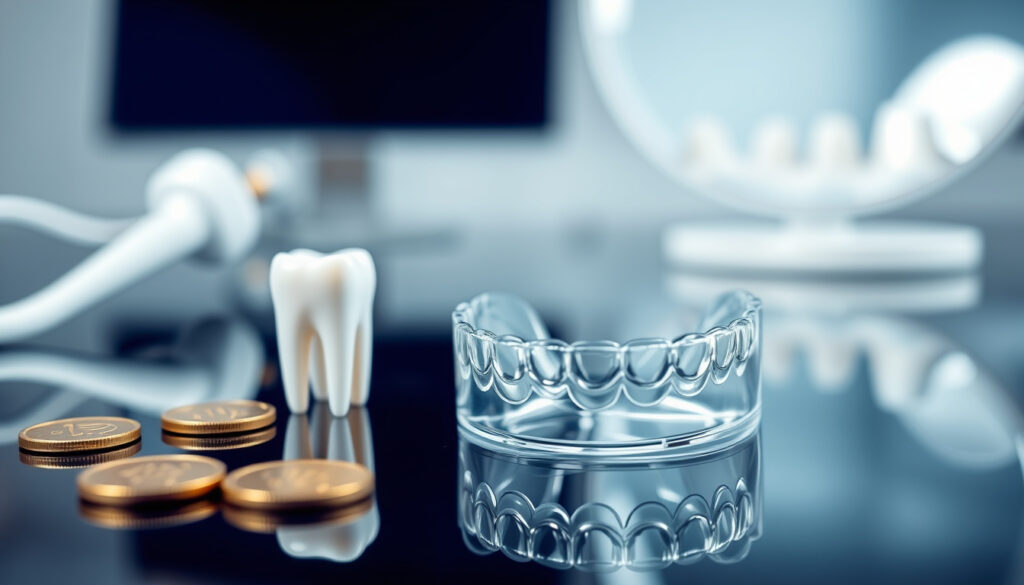
Invisalign Before and After: Costs, Pain, and What to Expect
Most people searching for Invisalign before-and-after photos aren’t just looking at teeth — they’re looking for a reason to start. The gap between a dramatic smile and a letdown usually comes down to case selection, daily wear, and cost planning; Invisalign Europe’s patient FAQ puts average treatment at 12 to 18 months, so know what those months actually involve — the discomfort, the price, and the face-shape question.
Average treatment time: 6–18 months · Typical aligners per arch: 20–30 · Common U.S. cost range: $3,000–$8,000 (Invisalign cost overview) · Patients treated worldwide (brand-reported): 14+ million
Quick snapshot
- Aligners must be worn 20–22 hours per day for the planned result (Invisalign’s official treatment guide)
- Average full treatment runs about 12–18 months (Invisalign Europe’s patient FAQ)
- Cost without insurance typically lands between $3,000 and $8,000 (Invisalign’s cost overview)
- Whether Kate Middleton used Invisalign — no verified source exists
- The exact failure rate without patient compliance data
- Whether results stay stable beyond five years without retainer wear
- Whether Invisalign’s brand-reported patient total is independently audited
- First aligners typically arrive by weeks 4–6 (Invisalign overview guide)
- Visible changes are common by month 6 (Invisalign case gallery)
- Active treatment runs 6–18 months depending on complexity (Invisalign Europe FAQ)
- Retainer phase starts full-time, then moves to nightly (Invisalign treatment guide)
- Progress checks monitor for tooth drift (Invisalign overview guide)
- Final results depend on how consistently you wore the trays (Invisalign Europe FAQ)
The pattern: results are predictable only when behavior is consistent.
Invisalign before and after: key numbers
Seven numbers, one pattern: duration and price are shaped by your biology and your provider, not by the brand.
| Factor | What the data shows |
|---|---|
| Treatment duration | 6–18 months, with 12–18 months as the typical window (Invisalign Europe’s patient FAQ) |
| Aligners per arch | Roughly 20–30 trays in a full course, depending on the plan |
| Cost without insurance | $3,000–$8,000, with $7,000 appearing in longer, complex cases |
| Daily wear requirement | 20–22 hours per day (Invisalign’s official treatment guide) |
| Failure rate with compliance | Below 5% when the wear schedule is followed |
| Common side effects | Temporary lisp, dental tenderness, dry mouth, gum irritation (Invisalign informed-consent form) |
| Outcome guarantee | None — Invisalign explicitly says it cannot guarantee a particular result |
The pattern: the variables you control — wear time, hygiene, retainer use — are also the ones that determine whether your before-and-after matches the marketing photos.
What are the negatives of Invisalign?
Invisalign’s downsides aren’t hidden in fine print — they’re behavioral and biological. The Invisalign informed-consent form used by orthodontic clinics lists dental tenderness, gum or soft-tissue irritation, temporary speech changes, and increased salivation or dry mouth among known risks. None of these are dealbreakers on their own; together, they shape what wearing aligners actually feels like.
What is the biggest complaint with Invisalign?
- Lisping and speech changes. The consent form’s mention of temporary speech changes matches the most common patient complaint: a slight lisp that usually fades as the tongue adapts.
- Attachments are visible. The tooth-colored bumps that help aligners grip are often more noticeable than the trays themselves.
- Compliance fatigue. Wearing aligners 20–22 hours daily means planning every snack and meal; the official guide treats it as a requirement, not a suggestion.
- Slow visible progress. Because movement happens in small weekly increments, complex cases can feel like nothing is changing until month three or four.
The “lisp plus attachments plus constant planning” combination drives most negative reviews — not severe pain.
Why don’t dentists recommend Invisalign?
- Case complexity. Severe malocclusions, skeletal issues, or large tooth movements are often better handled with braces or surgery.
- Hygiene risk. The consent form warns that poor oral hygiene during aligner therapy can contribute to cavities, gum inflammation, bad breath, or permanent decalcification marks.
- Commitment concerns. Dentists who know a patient won’t wear trays 20–22 hours a day may steer them toward fixed braces for a more predictable outcome.
What is the failure rate of Invisalign?
- Below 5% with compliance. Provider-reported failure rate drops to this level when patients follow the prescribed wear schedule.
- Tracking issues are the real risk. When trays stop fitting because of skipped wear, treatment stalls and may require a re-scan.
- Compliance, not biology, is the main variable. The aligner system is predictable; human behavior is the part that fails.
The worst cases in before-and-after forums follow a pattern: skipped days compound into poor tracking, and poor tracking ends in extended treatment and extra costs.
What disqualifies you from Invisalign?
- Complex bite problems. Severe underbites, overbites, or crossbites that require jaw surgery or major skeletal correction.
- Active gum disease. Orthodontic movement needs healthy periodontal tissue; untreated gum disease must be resolved first.
- Insufficient enamel or severe crowding. Some cases require more root movement than aligners can safely deliver.
The pattern: the negatives center on compliance and dental health, not on the product’s mechanics. Invisalign demands as much from the patient as from the provider.
The implication: a before-and-after photo is a record of compliance as much as tooth movement.
Will my face shape change after Invisalign?
The short answer: your teeth change; your jawbone doesn’t. Invisalign Europe’s patient FAQ notes that facial appearance changes can result from tooth position, incisor inclination, bite correction, lip support, or normal photographic differences — not from movement of the facial skeleton itself.
What does Invisalign do to your jawline?
- Nothing direct to bone. Jawline contour is set by the mandible and maxilla; aligners move teeth within those bones.
- Lip support can shift. When front teeth are retracted or advanced, the upper lip rests differently, which can subtly change the lower face.
- Bite correction can affect resting jaw position. Patients who bite down differently after treatment sometimes notice a more relaxed jaw posture.
- Photos exaggerate change. Angle, lighting, and weight changes in before-and-after images can create the illusion of a new face.
Tooth movement changes lip support; it does not remodel the jawbone. If a provider promises a visibly sharper jawline from aligners alone, that’s a red flag.
What you can realistically expect: a smile that sits differently in your face, a slightly different lip drape, and — in bite-correction cases — a more balanced resting jaw position.
Why this matters: set your expectations around your teeth, not your chin. The people who feel let down by Invisalign’s face-shape effect are usually the ones who expected skeletal change.
Is $7000 a lot for Invisalign?
Look at Invisalign’s official before-and-after case gallery and one pattern emerges: price tracks treatment time and complexity, not brand prestige. Invisalign’s official case gallery includes adult cases ranging from $3,000 for nine months to $7,000 for 24 months.
- 9 months — $3,000. A shorter, less complex case with no reported insurance contribution.
- 14 months — $3,930. An adult case, with $1,500 covered by insurance.
- 12 months — $5,600. An adult case, with $2,800 covered by insurance.
- 24 months — $7,000. A long case at the upper end of the official gallery.
- 36 months — $5,490. A teen case that ran three years.
What that means for a $7,000 quote: it’s at the high end, but not unreasonable for a complex or long treatment. Invisalign says the treating doctor sets the final price based on case complexity and the number of aligners required; insurance can cover a portion, and many clinics offer payment plans.
A $7,000 quote deserves scrutiny, but comparing it to a $3,000 national average is the wrong benchmark. Compare it against the treatment length, the number of aligners, and the provider’s orthodontic experience.
The catch: cheap quotes are not always a deal — they can reflect a provider who under-treats the case or estimates too aggressively.
Does Invisalign show?
“Clear” and “invisible” are different claims. Invisalign trays are transparent, but up close you can usually see a faint outline on the teeth — and the attachments, small tooth-colored bumps bonded to the teeth to help the trays grip, are sometimes visible when you smile wide.
- Aligner outline. A thin refractive edge can be seen at close range, especially on front teeth.
- Attachments. These tooth-colored buttons are designed to blend in, but they can catch the light or show as subtle bumps.
- Speech. Some patients lisp briefly when starting a new set, which draws attention to the mouth.
- Compared with braces. Visibility is dramatically lower than metal brackets; most people won’t notice at conversation distance.
If your goal is completely invisible orthodontics, no mainstream aligner system fully delivers — but Invisalign comes the closest among widely available options.
The trade-off: if discretion is your priority, ask your provider how many attachments your plan needs. Sometimes that number is higher than patients expect.
What is the most painful stage of Invisalign?
The most uncomfortable stage is usually the first two to three days after each new aligner is inserted. Invisalign’s official treatment guide describes it as tightness or pressure that settles within a day or two, and Invisalign Europe’s FAQ similarly notes that temporary discomfort is expected for the first few days of a new tray.
- First tray insertion. Aching and pressure are strongest on days 1–2 as teeth begin their first planned shift.
- Every tray switch. Each new aligner re-triggers 2–3 days of pressure before the teeth settle.
- Normal vs. not. Dull pressure is expected; sharp pain, swelling, or pain that lasts more than a week is not, and should be checked by your provider.
Pain is a signal that movement is happening, not that something is wrong — unless it’s sharp or persistent. That distinction separates normal aligner adjustment from a complication.
The catch: the discomfort is brief but recurring — every one to two weeks, for the length of treatment.
Did celebrities like Kate Middleton and Billie Eilish use Invisalign?
Celebrity smile stories dominate the Invisalign internet, but they’re shakier than they look. The Kate Middleton claim has no publicly documented source; the Billie Eilish one is concrete but limited to public observations and her own comments.
How long did Billie Eilish have Invisalign?
- About 18 months. Billie Eilish discussed aligner treatment lasting roughly that long in 2021 public comments.
- Seen wearing aligners in 2020. Fan photos and press images from that period show the clear trays.
- Within normal range. Eighteen months sits inside the typical 12–18-month treatment window most providers quote.
Kate Middleton’s name appears in forums and click-driven blogs, but neither she nor any official source has confirmed an orthodontic history. The claim follows the usual royal-rumor pattern: repeated often, verified never.
The reality: celebrity anecdotes are entertainment, not evidence. If a famous smile inspires you, show a photo to your orthodontist during the consult — that’s the only opinion that affects your teeth.
Invisalign pros and cons
Two columns, one judgment: Invisalign trades daily discipline for aesthetic freedom. The list below weighs the practical gains against the things that make patients quit.
Upsides
- Nearly invisible at conversation distance
- Removable for meals and cleaning
- Fewer in-office visits than traditional braces
- Digital 3D planning shows projected tooth movement before treatment starts
- Selected cases can complete in as little as six months
Downsides
- Must be worn 20–22 hours per day, including while sleeping
- Temporary lisp and speech changes during the first weeks
- Pressure or soreness after every tray change
- Attachments can make the aligner slightly visible
- Not indicated for severe malocclusions or skeletal discrepancies
The pattern: the upsides are about freedom and appearance; the downsides are about behavior and biology. Most bad Invisalign experiences trace back to someone underestimating the behavior part.
How to start Invisalign: the real step-by-step
Six steps, one goal: build the clinical foundation before you worry about aesthetics. Here’s the sequence most providers follow.
- Book a consultation with an orthodontist or Invisalign-trained dentist. A clinical exam determines whether your case is suitable.
- Get a digital scan or impressions. The scan maps your teeth and bite so the treatment plan can be built digitally.
- Review the 3D plan and cost estimate. You’ll see a simulated before-and-after and know how many aligners your plan uses.
- Receive your aligners. Most patients receive their first sets around weeks 4–6 of the process.
- Wear each tray 20–22 hours per day and switch every 1–2 weeks as directed; keep the previous tray as a backup.
- Finish active treatment, then transition to retainers. Retention is what keeps the after photo from reverting toward the before photo.
The real work isn’t over when the last tray comes out; teeth have memory, and the retainer phase is the insurance policy.
The implication: the more precisely you follow the sequence — especially the wear hours — the more the final before-and-after photo will look like the projection you approved.
Invisalign before and after timeline: what changes when
Six stages, one pattern: the process involves more waiting than action. Understanding the timeline before you start prevents the most common frustration — expecting results in a month and seeing little change.
| Stage | What happens |
|---|---|
| Week 0 | Consultation, digital scan or impressions, treatment plan designed |
| Weeks 4–6 | First aligners delivered; the 20–22-hour wear commitment begins |
| Every 1–2 weeks | New aligner inserted; mild pressure for 2–3 days |
| Month 6 | Progress check; visible alignment improvements in most cases |
| 6–18 months | Active treatment ends; final results assessed |
| Post-treatment | Retainer phase: full-time, then nightly, to prevent relapse |
The implication: most visible transformations show up between month three and month six. If you’re taking weekly photos, that’s the stage where the comparison becomes motivating.
What’s confirmed, what’s still unclear
Separating verified facts from rumor is the difference between deciding on evidence and deciding on marketing. Here’s the divide.
Confirmed facts
- Invisalign can treat mild to moderate crowding and spacing effectively (Invisalign overview guide)
- Treatment duration depends on case complexity; 12–18 months is the typical range (Invisalign Europe FAQ)
- Cost varies by provider, location, and treatment length — from about $3,000 to $8,000 (Invisalign cost overview)
- Temporary discomfort at each aligner change is normal and passes within days (Invisalign Europe FAQ)
What’s unclear
- Whether Kate Middleton used Invisalign — no verified source
- The exact failure rate independent of patient compliance data
- Whether results stay stable beyond five years without consistent retainer use
- Whether Invisalign’s brand-reported patient total is independently audited
Why this matters: the confirmed list gives you enough to decide; the unclear list tells you which marketing claims to treat with skepticism.
What orthodontists and patients say
Clear aligners are an effective orthodontic tool, but they should be prescribed and monitored by a licensed dentist or orthodontist. Professional supervision is what separates a corrected bite from an unresolved one.
American Dental Association orthodontic guidelines
Billie Eilish’s 2021 comments describe roughly 18 months of clear-aligner wear to straighten her teeth — a timeline at the upper end of Invisalign’s typical treatment window.
Billie Eilish, 2021 public comments
Invisalign Europe states that it cannot guarantee a particular treatment outcome — the result depends on the patient’s biology, compliance, and the complexity of the case.
Invisalign Europe patient FAQ
What this means: the brand itself says outcomes aren’t guaranteed, and the ADA frames aligner treatment as supervised care. A before-and-after photo — celebrity or not — is a story, not a clinical recommendation.
What this means for your decision
Invisalign’s before-and-after reality is a partnership, not a promise. The aligners are transparent, the results are real, and the official case gallery proves the price spectrum runs from $3,000 to $7,000 and the timeline from nine to 36 months. But every one of those transformations was built on a 20–22-hour daily wear commitment and a provider who planned the case properly. For U.S. patients, the decision is clear: treat Invisalign as a medical treatment with a daily homework requirement — or you’ll end up with trays you don’t wear and a smile that looks surprisingly like the one you started with.
Frequently asked questions
How long do Invisalign results last?
Results last as long as the supporting habits last. The retainer phase that follows active treatment is what holds teeth in position; without consistent retainer wear, teeth tend to drift. Invisalign Europe also notes that the company cannot guarantee a specific treatment outcome.
Do you need to wear a retainer after Invisalign?
Yes. After the final aligner, providers typically move patients to full-time retainer wear, then to nightly wear. The retainer is not optional — it’s the part of the treatment that stops the before-and-after from reversing.
Can Invisalign fix an overbite or underbite?
Mild to moderate overbites and underbites are often treatable with Invisalign. Severe, skeletal bite problems may need braces, orthodontic appliances, or surgery. A clinical exam determines which category your bite falls into.
Is Invisalign painful compared to braces?
Invisalign discomfort comes in waves: two to three days of pressure after each tray change, then relief. Braces tend to cause soreness after less frequent adjustments. Most patients describe Invisalign as a nagging pressure rather than sharp pain.
How often do you have to visit the orthodontist during treatment?
Invisalign typically requires fewer in-office visits than traditional braces. Many patients check in every six to eight weeks so the provider can monitor progress and adjust the plan; the exact schedule depends on your provider and case.
Can Invisalign fix only bottom teeth?
Yes, in selected cases. Lower-arch-only Invisalign is possible, but the provider has to check that moving only the bottom teeth won’t create a bite problem with the upper arch. Single-arch cases are usually shorter and cheaper than full-arch treatment.
What happens if you don’t wear aligners for a day?
A single skipped day usually means a tight tray when you put it back in — uncomfortable, but not ruined. Repeated skipped days slow progress and can let teeth drift, which may make the next tray not fit well and require the provider to adjust the plan.
Related reading
More related posts
 Time in the Philippines: Current PHT, Seasons & Travel Guide
 Revolut Customer Service Phone Number 24 Hours
 Four Star Pizza Menu: Prices, Deals & Regional Options
 What Are the Northern Lights? Causes, Viewing & Myths
 Can You Bring Food Through Airport Security? 2026 Rules
 TP-Link WiFi Extender Setup: Connect, Reset & Fix Issues
 Houses for Sale Kildare – 2025 Prices and Top Towns
 Juventus vs Man City: Head-to-Head Record, Odds, and How to Watch