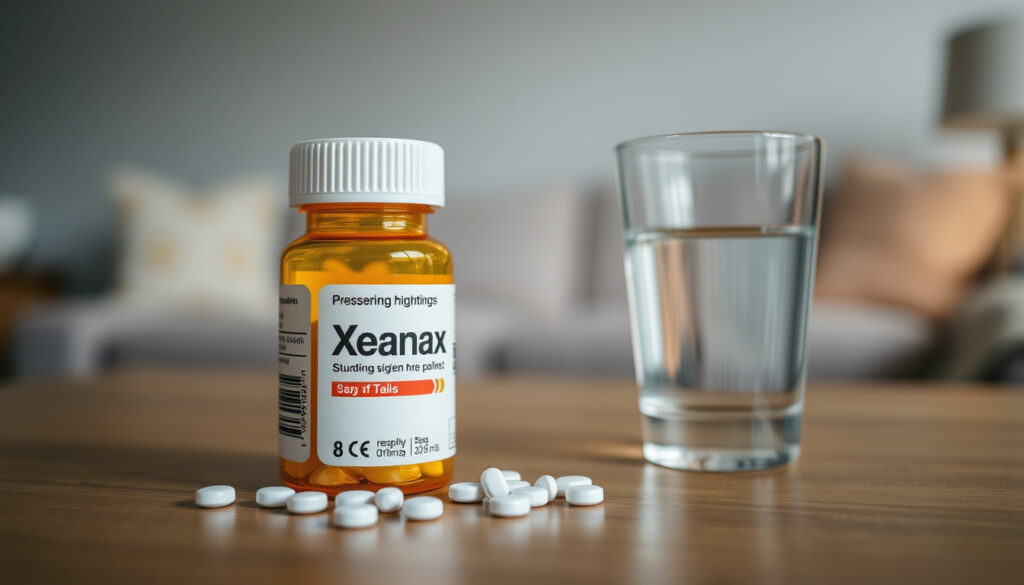
What Does Xanax Do? Uses, Side Effects, and Safety
Xanax delivers relief within minutes, but that same speed makes it one of the most dependence-forming benzodiazepines. For millions of people dealing with anxiety or panic, a small white pill offers quick relief, yet its fast onset and short half-life shape both medical use and abuse potential.
Drug class: Benzodiazepine ·
Onset of action: 30–60 minutes ·
Half-life: 11–13 hours ·
Common dosage: 0.25–0.5 mg ·
Controlled substance: Schedule IV (US)
Quick snapshot
- Xanax (alprazolam) is a benzodiazepine that enhances GABA activity (MedlinePlus (the US National Library of Medicine))
- FDA-approved for generalized anxiety disorder and panic disorder (FDA (US drug regulator))
- Onset of action is 30–60 minutes after oral administration (Cleveland Clinic) (MedlinePlus (the US National Library of Medicine))
- Common side effects include drowsiness, dizziness, and memory impairment (MedlinePlus) (MedlinePlus (the US National Library of Medicine))
- Long-term effects on cognitive function and memory are still under investigation
- Individual variability in response and metabolism is not fully understood
- The precise mechanism linking Xanax to insomnia relief is not entirely clear
- Peak effects occur 30–60 minutes after ingestion (FDA labeling)
- Acute effects subside after 4–6 hours
- Drug largely eliminated within 8–12 hours
- Growing focus on tapering protocols to manage withdrawal
- Research into non-benzodiazepine alternatives for anxiety continues
- Regulatory scrutiny over prescribing patterns for short-acting benzodiazepines
Eight key facts about Xanax, one pattern: the drug’s fast-acting nature cuts both ways — quick relief for anxiety, but also rapid dependence onset.
| Fact | Value |
|---|---|
| Drug name | Xanax |
| Generic name | Alprazolam |
| Drug class | Benzodiazepine |
| FDA-approved uses | Generalized anxiety disorder, panic disorder |
| Onset of action | 30–60 minutes |
| Half-life | 11–13 hours |
| Common dosage | 0.25–0.5 mg, up to 4 mg per day for panic disorder |
| Controlled substance schedule (US) | Schedule IV |
What happens to you when you take Xanax?
Within 30 to 60 minutes of taking a dose, Xanax enters the bloodstream and begins enhancing GABA activity in the brain, producing a calming effect, according to MedlinePlus (the US National Library of Medicine). The experience varies depending on dosage, tolerance, and individual metabolism.
Does Xanax calm you down immediately?
- Most users feel initial effects within 15–30 minutes, with peak calmness at 30–60 minutes
- The FDA labeling notes that Xanax can produce sedation and drowsiness as primary effects (FDA (US drug regulator))
- Euphoria may occur, particularly at higher doses or in recreational use
- Relief from anxiety is the intended therapeutic effect for patients with GAD or panic disorder (Cleveland Clinic)
Does Xanax make you sleepy right away?
- Drowsiness is one of the most commonly reported side effects — affecting a significant number of users (MedlinePlus)
- The FDA (US drug regulator) labeling for Xanax XR (extended-release) reports sedation and somnolence as most frequent advere events
- Sleepiness tends to peak alongside the drug’s maximum concentration, around 1–2 hours after dosing
- This sedative effect is why Xanax is sometimes used off-label for insomnia, though not FDA-approved for that purpose
Patients get relief from anxiety within an hour, but the same mechanism produces drowsiness that can impair driving or work. The FDA (US drug regulator) explicitly warns against operating machinery after taking alprazolam.
Bottom line: Xanax’s rapid onset makes it effective for acute anxiety, but the sedative effects are not optional — they come with every dose. Patients prescribed it should plan around drowsiness, especially during the first week of use.
The implication: The drug’s rapid onset demands careful scheduling to avoid impairment.
What is Xanax mainly used for?
The FDA has approved Xanax for two specific conditions: generalized anxiety disorder (GAD) and panic disorder with or without agoraphobia, as detailed in the official FDA labeling. Its sedative side effects mean it also gets used off-label for sleep, though experts caution against this.
Is Xanax better for sleep or anxiety?
- Anxiety relief is the primary FDA-approved indication; sleep effects are secondary and unintended
- The FDA (US drug regulator) does not list insomnia as an approved use
- Using Xanax for sleep carries the same dependence risk as using it for anxiety — and possibly faster tolerance buildup
- Mayo Clinic (leading US medical center) notes that older adults are especially prone to drowsiness and coordination problems
What does Xanax do for sleep?
- Xanax can help with sleep initiation because of its rapid onset and strong sedative effects
- Its short half-life means it metabolizes relatively quickly, so it may not keep someone asleep through the night
- The FDA (US drug regulator) labeling for Xanax XR reports that memory impairment and coordination problems occur in a notable percentage of patients
- Relying on Xanax for sleep can create a cycle of daytime drowsiness and nighttime wakefulness
Xanax works for sleep because it works for anxiety — the same GABA enhancement that quiets racing thoughts also sedates. But its short half-life creates a rebound effect that can make insomnia worse between doses.
Bottom line: Xanax treats anxiety effectively, and sleep improvement is a side benefit, not a primary indication. For chronic insomnia, non-benzodiazepine options or behavioral therapies are usually safer first-line choices.
What this means: The drug’s primary role is anxiety relief, and using it for sleep requires caution against dependence.
Is it safe to take Xanax before bed?
Many patients do take Xanax at bedtime, especially when prescribed for panic disorder with nocturnal symptoms. But safety depends on dose, individual tolerance, and whether the person lives alone or has fall risks.
Should I sleep on Xanax?
- Sleeping after taking Xanax is common and expected — the drug’s labeling lists somnolence as a major effect
- The FDA (US drug regulator) warns that alprazolam can cause confusion and coordination problems, increasing fall risk, especially in older adults
- If you sleep on Xanax, ensure no one needs to wake you for several hours — the sedative effect can make waking difficult
- Mayo Clinic (leading US medical center) advises against driving or operating machinery until you know how the drug affects you
How much Xanax is good for sleep?
- Typical starting doses for anxiety (0.25–0.5 mg) may be enough to promote sleep onset
- Higher doses increase the risk of next-day sedation, memory problems, and dependence
- The FDA (US drug regulator) sets a maximum daily dose of 4 mg for panic disorder, but sleep rarely requires more than 0.5–1 mg
- No standard “sleep dose” exists because the drug is not FDA-approved for insomnia
How long will Xanax keep you asleep?
- Acute sedative effects last approximately 4–6 hours, matching the drug’s duration of action
- A half-life of 11–13 hours means residual effects may help maintain sleep for some users
- Because the drug peaks quickly and declines, many patients wake after 4–5 hours as the drug level drops
- Individual metabolism varies widely, affecting total sleep duration
Is 0.5 mg of Xanax strong?
- 0.5 mg is considered a moderate dose — it’s the standard starting point for panic disorder treatment
- For someone new to benzodiazepines, 0.5 mg can produce noticeable sedation and relief
- Tolerance develops quickly, so what feels “strong” on day one may feel mild after two weeks of daily use
What is the best time to take Xanax?
- For anxiety that strikes during the day, morning or early afternoon dosing may work — but expect drowsiness
- For sleep purposes, taking it at bedtime aligns with the drug’s sedative peak
- The FDA (US drug regulator) advises taking the smallest effective dose for the shortest duration necessary
- Cleveland Clinic (leading US hospital system) recommends taking it exactly as prescribed, never adjusting timing without medical guidance
Older adults taking 0.5 mg at bedtime face a triple risk: Mayo Clinic (leading US medical center) data shows increased falls, confusion, and memory lapses. The FDA (US drug regulator) has a boxed warning on this drug class specifically for older patients.
What are the side effects of Xanax?
Side effects range from manageable to serious, and they affect nearly every system in the body. The MedlinePlus (the US National Library of Medicine) lists over a dozen common side effects and several that require immediate medical attention.
What does Xanax do to your face?
- Facial flushing, swelling, or rash can occur, though these are rare (MedlinePlus)
- Facial swelling, hives, or difficulty breathing may indicate a serious allergic reaction requiring emergency care
- Muscle relaxation can cause a droopy or relaxed facial appearance during peak effects
- Dry mouth affects some users, which may alter facial sensation or speech
What does Xanax do to blood pressure?
- Xanax can lower blood pressure slightly due to its calming effect on the central nervous system
- The FDA (US drug regulator) warns that combining Xanax with other CNS depressants can amplify this effect, leading to dangerous hypotension
- Patients with low blood pressure or those taking antihypertensives should be monitored closely
- These cardiovascular effects are generally mild but become significant when Xanax is mixed with alcohol or opioids
The MedlinePlus (the US National Library of Medicine) lists serious side effects including shortness of breath, seizures, rash, hives, swelling, difficulty breathing or swallowing, hoarseness, yellowing of the skin or eyes, confusion, speech problems, and coordination or balance problems. The FDA (US drug regulator) warns that concomitant use of benzodiazepines and opioids may result in profound sedation, respiratory depression, coma, and death.
Bottom line: Common side effects like drowsiness and dizziness are manageable, but the real risk is the combination potential — Xanax plus alcohol or opioids can be fatal. Anyone prescribed Xanax should know the FDA (US drug regulator) has a boxed warning on this interaction.
The pattern: The most serious risk is not from the drug alone but from combining it with other central nervous system depressants.
What type of drug is Xanax?
Xanax belongs to the benzodiazepine class of central nervous system depressants. The US government classifies it as a Schedule IV controlled substance, meaning it has a recognized medical use but also a known potential for abuse and dependence.
Is Xanax legal?
- Xanax is legal only with a valid prescription from a licensed healthcare provider
- Possession without a prescription is illegal in the US and most other countries
- The FDA (US drug regulator) classifies it as Schedule IV under the Controlled Substances Act
- Other countries have similar controlled substance classifications for alprazolam
What this means: Xanax is legal only under prescription, and misuse carries legal and health consequences.
Timeline of Xanax effects
Six moments from ingestion to elimination — the pattern: fast in, faster out, which drives both therapeutic benefit and abuse potential.
- 0–15 minutes: Inhalation or oral ingestion; drug enters bloodstream; minimal effects.
- 15–30 minutes: Initial feelings of calmness and relaxation may begin.
- 30–60 minutes: Peak plasma concentration; strongest sedative and anxiolytic effects (FDA labeling).
- 1–4 hours: Effects plateau and gradually decline; drowsiness common.
- 4–6 hours: Most acute effects subside; residual sedation may last longer.
- 8–12 hours: Half-life ends; drug largely eliminated from the body.
“Alprazolam (Xanax) is a medication that treats anxiety. It calms down your nervous system.”
“Xanax can be habit-forming. Misuse can cause addiction, overdose, or death.”
“Xanax is a benzodiazepine used to treat anxiety and panic disorders. However, it’s often misused.”
Summary: What does Xanax do — and what should you do about it?
Xanax delivers fast, effective relief for anxiety and panic, backed by decades of clinical use and FDA approval. But its short half-life and rapid onset create a double-edged profile: quick help when you need it, quick dependence if you don’t manage it carefully. For patients prescribed Xanax in the US, the choice is clear: use the lowest effective dose, never mix with alcohol or opioids, and work with your doctor on a plan that avoids long-term daily use, or risk the cycle of tolerance and withdrawal that the FDA (US drug regulator) warns about in its prescribing information.
Related reading: Signs of Low Iron: Symptoms, Causes, and Treatment
accessdata.fda.gov, xanax.com, accessdata.fda.gov, accessdata.fda.gov, accessdata.fda.gov, accessdata.fda.gov
Frequently asked questions
Can Xanax cause memory loss?
Yes, memory impairment is a known side effect. The FDA (US drug regulator) lists memory problems as a commonly observed adverse event in patients taking Xanax XR.
Is Xanax addictive?
Yes. Xanax is a Schedule IV controlled substance with known dependence and withdrawal risks. American Addiction Centers reports that misuse can lead to addiction, especially with regular use beyond a few weeks.
Can you drink alcohol while taking Xanax?
No. The FDA (US drug regulator) warns that combining benzodiazepines with alcohol can cause severe sedation, respiratory depression, coma, and death.
What should I do if I miss a dose of Xanax?
MedlinePlus (the US National Library of Medicine) advises taking the missed dose as soon as you remember, but skip it if it’s almost time for your next dose. Never double up.
How long does Xanax stay in your system?
Xanax has a half-life of 11–13 hours, meaning it takes about 2–3 days to be fully eliminated from the body in most people. Individual factors like age, liver function, and metabolism affect this.
Can Xanax be used for panic attacks?
Yes, panic disorder is one of the two FDA-approved indications. The FDA (US drug regulator) labeling specifically includes panic disorder with or without agoraphobia.
What is the difference between Xanax and Valium?
Both are benzodiazepines, but Xanax (alprazolam) has a shorter half-life (11–13 hours) than Valium (diazepam, half-life 20–50 hours). Xanax acts faster but wears off quicker, which affects both therapeutic use and withdrawal risk.
More related posts
 Andrew Mountbatten Windsor Royal Stipend: Payout Details
 Premier Inn Near Trinity College: Location & Reviews
 Colin Glen Forest Park Guide: Free Entry, Cafe, Zipline & Alpine Coaster
 Stronger With You Parfum: Scent Profile and Flanker Guide
 La Liga Standings 2024/25: Final Table and Results
 What Does BMW Stand For? Meaning & History | Bavarian Motor Works
 Premier Inn Near Trinity College: Best Dublin Stay
 Pamela Anderson Net Worth 2025: $20M After Debt & Taxes