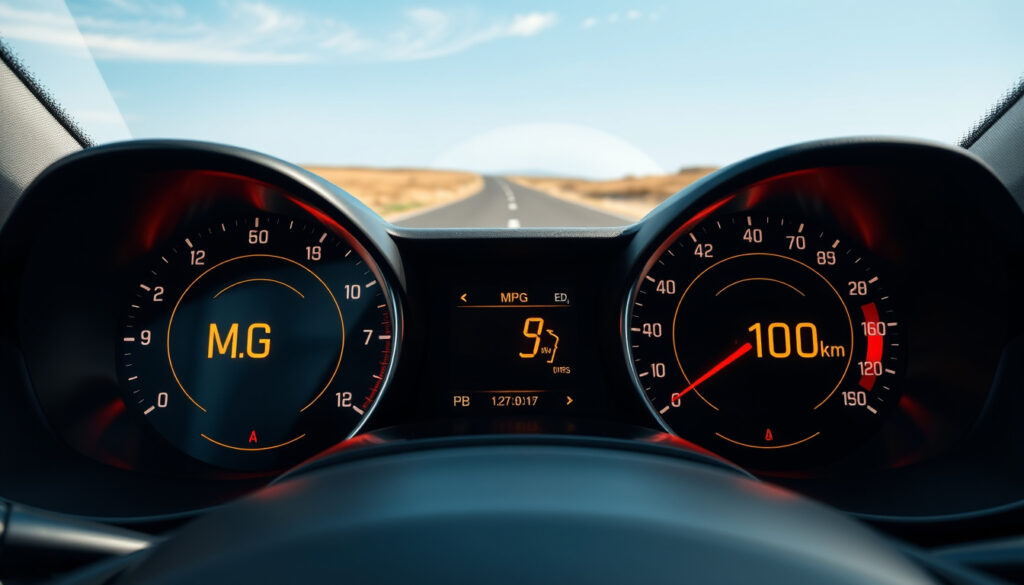
MPG to L/100km Converter: US/UK Formulas & Benchmarks
The US gallon (3.785L) and the Imperial gallon (4.546L) are not the same size — and that single difference explains why a car rated at 30 MPG in America reads differently on a German window sticker. A vehicle consuming fuel at a given rate produces two different MPG numbers depending on which gallon standard applies, while the metric L/100km figure remains identical regardless of origin.
1 US MPG = 235.21 L/100km · 1 UK MPG = 282.48 L/100km · 40 US MPG ≈ 5.88 L/100km
Quick snapshot
- US MPG uses the US liquid gallon (3.785L) (mpgtolitres.com)
- UK MPG uses the Imperial gallon (4.546L) (mpgtolitres.com UK)
- 1 US MPG = 235.21 L/100km (mpgtolitres.com)
- 1 UK MPG = 282.48 L/100km (mpgtolitres.com UK)
- Lower L/100km always means better fuel economy (utils.com)
- No single global average MPG — figures vary by region and vehicle class
- Canada and Australia use L/100km but source their data from US or UK test cycles
- Real-world driving often diverges from rated figures by 15–25%
- The Imperial gallon was standardised in 1824
- L/100km became the European standard in the 1970s
- Online converters started appearing in the early 2000s
- The Imperial gallon was defined in 1824; the US gallon was standardised in 1836
- L/100km became the European standard in the 1970s
- Online converters started appearing in the early 2000s
- EV adoption may reduce MPG-conversion relevance, but petrol hybrids keep the need alive
- More international car listings now show both MPG and L/100km side by side
- Regulatory alignment toward km/L is growing in Asian markets
- EV adoption may reduce MPG-conversion relevance, but petrol hybrids keep the need alive
- More international car listings now show both MPG and L/100km side by side
- Regulatory alignment toward km/L is growing in Asian markets
Two constants govern every fuel-economy comparison between US and UK markets. The US gallon holds 3.785 litres; the Imperial gallon holds 4.546 litres. Both countries measure distance in miles and fuel in litres, but the different gallon sizes make the same real-world consumption produce different MPG readings.
| Unit | Conversion factor | Source |
|---|---|---|
| US MPG to L/100km | 235.215 ÷ MPG | mpgtolitres.com |
| UK MPG to L/100km | 282.481 ÷ MPG | mpgtolitres.com UK |
| 1 L/100km to US MPG | 235.215 MPG | FloorLo converter |
| 1 L/100km to UK MPG | 282.481 UK MPG | FloorLo converter |
How do you convert UK MPG to L 100km?
Formula for UK MPG
Britain, Ireland and some Commonwealth countries measure fuel economy in miles per gallon using the Imperial gallon, which holds 4.54609 litres. That makes it roughly 20% larger than the US liquid gallon (3.785411784L). The conversion formula reflects that difference directly: L/100km = 282.481 ÷ UK MPG (mpgtolitres.com UK). Every 1 UK MPG corresponds to 282.481 litres consumed per 100 kilometres — a far higher divisor than the US figure of 235.215, precisely because one Imperial gallon covers more distance per unit of fuel.
The Imperial gallon is about 20% larger than the US gallon, so the same car shows a higher MPG number in the UK than in the US for identical real-world consumption — but a lower L/100km figure remains the universal marker of efficiency regardless of which MPG system is in use.
Step-by-step conversion
Working through a UK MPG conversion manually takes four straightforward steps. Starting with a UK-rated car at 35 MPG, you divide 282.481 by 35, which gives you approximately 8.07 L/100km. To reverse the process and check your result, multiply 8.07 by the UK MPG figure (35) and divide by 100 — the maths should bring you back to your original rating.
The derivation behind 282.481 comes from dividing the Imperial gallon volume in litres (4.54609) by the conversion factor from miles to kilometres (1.609344), then multiplying by 100. According to MyMathTables, the reverse formula — L/100km back to UK MPG — follows the pattern UK MPG = (100 × 4.54609) ÷ (1.609344 × L/100km).
US vs UK differences
Two constants determine every difference between US and UK MPG figures. The US gallon is 3.785411784 litres; the Imperial gallon is 4.54609 litres (CalculateMe.com). Because these volumes differ, the same real-world fuel consumption produces different MPG ratings and identical L/100km values wherever the metric standard applies.
As Omni Calculator notes, 1 US MPG = 1.201 UK MPG, and conversely 1 UK MPG = 0.8327 US MPG. The asymmetry is small but significant when cross-shopping imported vehicles. A US-spec Honda Civic rated at 31 MPG (city) translates to approximately 37.2 UK MPG — a figure that can look either impressive or disappointing depending on which side of the Atlantic you’re reading it.
What is 40 MPG in litres per km?
40 MPG US to L/100km
Plugging 40 US MPG into the formula L/100km = 235.215 ÷ 40 gives you 5.88 L/100km — a figure that sits comfortably in the efficient range for petrol cars. utils.com offers a quick mental shortcut: dividing 235 by the MPG figure gives a close estimate (235 ÷ 40 = 5.88 exactly with that round number). For everyday use, 5.88 L/100km represents about 48 mpg-e in electric-vehicle equivalence terms, placing it alongside many current hybrid models.
40 MPG UK to L/100km
Using the UK formula, 40 UK MPG converts to 282.481 ÷ 40 = 7.06 L/100km. That same vehicle rated at 40 UK MPG would show 7.06 L/100km — notably higher than the US equivalent because the larger Imperial gallon inflates the MPG number while the L/100km denominator stays the same. Inch Calculator confirms this with their own worked example: 5 UK MPG equals 56.496 L/100km, scaling consistently with the 282.481 constant.
Common equivalents table
Three values, one pattern: the higher the MPG, the lower the L/100km. Both US and UK systems share this inverse relationship — the math is identical, only the constant changes.
| US MPG | US L/100km | UK MPG | UK L/100km |
|---|---|---|---|
| 20 | 11.76 | 20 | 14.12 |
| 30 | 7.84 | 30 | 9.42 |
| 40 | 5.88 | 40 | 7.06 |
| 50 | 4.70 | 50 | 5.65 |
| 60 | 3.92 | 60 | 4.71 |
For UK buyers cross-referencing US specs: a 30 US MPG car (7.84 L/100km) performs identically to a 36 UK MPG car. That conversion uses the factor 1 US MPG = 1.200951 UK MPG (FloorLo), so the UK figure always reads about 20% higher for the same vehicle.
The same 40 MPG number can represent two different fuel-consumption realities. In the US system it translates to 5.88 L/100km; in the UK system it translates to 7.06 L/100km — a 20% apparent gap that disappears once both figures are expressed in L/100km.
MPG to L/100km Converter Miles per Gallon
Online converter tools
Dozens of free online tools handle this conversion instantly, eliminating the need for manual arithmetic. Omni Calculator provides bidirectional conversion between US MPG, UK MPG and L/100km on a single input screen. FloorLo adds km/L to the mix, which is the standard in Japan and parts of Asia. utils.com takes a regional approach, showing which countries use which system before the conversion happens.
Most converters default to US MPG if not specified. Before relying on any tool, verify it asks whether you mean US or Imperial gallons — a tool that assumes the wrong gallon type will return results off by roughly 20%.
Manual calculation steps
The step-by-step process works the same way for any MPG variant:
- Identify the gallon type. US MPG uses 3.785411784L per gallon; UK MPG uses 4.54609L per gallon.
- Choose the correct divisor. US: 235.215. UK: 282.481.
- Divide the divisor by your MPG figure. Result is L/100km.
- Check the result. Good petrol economy sits below 8 L/100km (US); excellent hybrid/electric territory is below 5 L/100km (US).
The mental shortcut offered by utils.com — dividing 235 by the US MPG figure for a quick estimate — works well for figures between 20 and 50 MPG, where rounding introduces less than 0.1 L/100km of error.
Popular conversions: 20, 30, 50 MPG
Five benchmarks cover the most common real-world scenarios:
- 20 US MPG (11.76 L/100km) — typical for large SUVs, pickup trucks. Below 12 L/100km is the threshold for acceptable petrol economy in this class.
- 30 US MPG (7.84 L/100km) — common for family sedans, small crossovers. A solid mid-range figure.
- 35 US MPG (6.72 L/100km) — efficient compact cars, some hybrids.
- 40 US MPG (5.88 L/100km) — high-efficiency petrol cars, plug-in hybrids in charge-sustaining mode.
- 50 US MPG (4.70 L/100km) — among the most efficient petrol-only vehicles; the Toyota Prius sits near this figure.
The pattern that emerges: each 5 MPG increment in the US system saves roughly 0.7–1.0 L/100km, with the savings per unit narrowing as efficiency improves. A jump from 20 to 25 MPG saves 2.35 L/100km; the same 5 MPG jump from 40 to 45 MPG saves only 0.65 L/100km — so fuel-savings conversations need context about starting point, not just improvement size.
The L/100km scale compresses at higher efficiency. A 1 L/100km improvement from 12 to 11 L/100km is modest in absolute terms but represents a significant MPG gain at the low end; the same 1 L/100km improvement from 6 to 5 L/100km signals a far larger MPG jump and typically requires hybrid or electrification technology.
Is 9.2l/100km good?
L/100km benchmarks
L/100km is an inverse scale — lower numbers mean less fuel consumed per kilometre, which means better efficiency. utils.com confirms this principle directly: L/100km is inversely proportional to MPG, so a lower reading is always preferable regardless of vehicle type. Three broad benchmark tiers apply across the petrol car market:
- Below 8 L/100km (US ≈ 29+ MPG) — excellent. Most hybrid vehicles and many diesel passenger cars sit in this range. High-efficiency turbocharged petrol engines also reach it.
- 8–10 L/100km (US ≈ 23–29 MPG) — average. Family sedans, compact SUVs, and base-model crossovers typically land here.
- Above 10 L/100km (US below 23 MPG) — below average for a passenger car. Large SUVs, full-size pickups, and performance vehicles commonly exceed this figure.
9.2 L/100km falls in the average-to-slightly-favourable zone — roughly equivalent to 25.6 US MPG. For a two-row SUV or a performance-oriented vehicle, 9.2 L/100km is respectable. For a compact hatchback, it’s on the higher side. Context of vehicle class and engine type matters more than the number in isolation.
Compare 9.2, 10.7, 11.5 L/100km
These three figures span the lower half of the efficiency range. A car at 9.2 L/100km uses 1.5 fewer litres per 100 kilometres than one at 10.7 L/100km — which translates to roughly 15% less fuel at the pump over the same distance. The gap between 10.7 and 11.5 L/100km is smaller but still meaningful for anyone tracking annual fuel expenditure.
At current UK fuel prices (illustrative), the difference between 9.2 and 11.5 L/100km across 15,000 annual miles could amount to £200–£300 in additional fuel cost per year, depending on vehicle efficiency and driving conditions. For fleet managers or high-mileage drivers, those decimals add up quickly.
Good vs average ratings
European fuel economy labels — the A–G rating system used on new car window stickers — classify anything below 6 L/100km as A or B, 6–8 L/100km as C, 8–10 L/100km as D, and above 10 L/100km as E or below. Under that framework, 9.2 L/100km earns a D rating — the middle of the road for a new petrol car in 2024.
“A car rated at 30 MPG (US) would be rated at approximately 36 MPG (UK).” — utils.com Fuel Economy Converter
What is a good MPG?
Average car MPG explained
The US EPA average for new passenger vehicles as of 2024 sits around 25–30 MPG combined (city and highway), a figure that has risen steadily from roughly 20 MPG in the early 2000s. Omni Calculator benchmarks the 25–30 MPG (US) range as standard for mainstream petrol vehicles — sedans, hatchbacks, small crossovers without hybrid assistance.
That translates to 7.8–9.4 L/100km in metric terms. European average new-car emissions, which correlate closely with L/100km figures, have fallen below 6 L/100km for some model segments as of 2023, driven by electric vehicle penetration and tighter fuel-economy standards.
45 MPG, 41 MPG ratings
A car achieving 45 US MPG (5.23 L/100km) sits in the high-efficiency tier — comparable to many current hybrid and plug-in hybrid models on the market. mpgtolitres.com confirms the US-to-metric conversion for this figure. At 41 US MPG (5.74 L/100km), the vehicle is similarly efficient; both figures are achievable with modern small-displacement turbocharged engines paired with hybrid assist, as seen in models like the Toyota Prius, Hyundai Ioniq Hybrid, and Honda Insight.
For UK buyers, 45 UK MPG translates to 6.28 L/100km — a figure that places a vehicle in the C/D range of European efficiency labels, solid but not class-leading. 41 UK MPG corresponds to 6.89 L/100km, still within the good-to-average bracket for a petrol car.
Petrol vs diesel benchmarks
Diesel engines typically consume 15–20% less fuel than their petrol equivalents for the same vehicle displacement, which in L/100km terms means a diesel counterpart to a 9 L/100km petrol car might consume 7.3–7.7 L/100km. However, diesel vehicles carry a higher list price, and the fuel-economy advantage narrows or reverses in urban driving with frequent stop-start patterns where diesel particulate filter regeneration cycles can offset savings.
For buyers weighing petrol versus diesel on L/100km alone: a petrol car at 7 L/100km versus a diesel at 5.8 L/100km represents roughly a 17% efficiency advantage for diesel. Whether that advantage is worth the purchase-price premium depends on annual mileage — most analysts suggest the crossover point for diesel payback is around 20,000 miles per year or more.
Related reading: 154 cm in feet conversion · Convert Euro to Sterling
Converting MPG to L/100km with US (235.2 ÷ MPG) or UK (282.5 ÷ MPG) formulas aligns closely with benchmarks in the formula chart converter guide for international drivers.
Frequently asked questions
What is 30 MPG to L/100km?
30 US MPG converts to 7.84 L/100km (235.215 ÷ 30). 30 UK MPG converts to 9.42 L/100km (282.481 ÷ 30). The US figure of 7.84 L/100km sits in the efficient-to-average range for a petrol passenger car.
What is 35 MPG to L/100km?
35 US MPG converts to 6.72 L/100km (235.215 ÷ 35). 35 UK MPG converts to 8.07 L/100km (282.481 ÷ 35). Both figures place the vehicle in efficient territory for a petrol car.
What is 50 MPG to L/100km?
50 US MPG converts to 4.70 L/100km (235.215 ÷ 50). 50 UK MPG converts to 5.65 L/100km (282.481 ÷ 50). Both figures represent excellent fuel economy, placing these vehicles near the top of the petrol-efficiency range alongside hybrid and high-efficiency diesel models.
Is 5.7 L/100km good?
5.7 L/100km is good. It is equivalent to roughly 41 US MPG or 49 UK MPG. Most hybrid vehicles and many high-efficiency diesel passenger cars sit between 4.5 and 6.0 L/100km in real-world testing.
Is 10.7 L/100km good?
10.7 L/100km is average to slightly below average for a petrol passenger car in 2024. Equivalent to approximately 22 US MPG, this figure is typical for mid-size SUVs, large sedans, and performance-oriented vehicles. A compact hatchback at 10.7 L/100km would be considered inefficient; a full-size pickup at 10.7 L/100km would be considered good.
Is 11.5 L/100km good?
11.5 L/100km is below average for a petrol passenger car, equivalent to roughly 20.5 US MPG. This figure is typical for large SUVs, full-size pickups, and performance vehicles. For context, the EPA threshold for a “green vehicle” rating in the US is generally above 30 MPG (below 7.84 L/100km).
Is 45 MPG good for petrol?
45 US MPG is excellent for a petrol vehicle — equivalent to 5.23 L/100km. This efficiency level is typically achieved only by hybrid vehicles, plug-in hybrids in electric mode, or highly optimised small-displacement turbocharged engines under steady-state driving conditions. Real-world results will typically be 10–15% lower due to stop-start traffic, climate control use, and spirited driving.
Is 41 MPG good for a car?
41 US MPG (5.74 L/100km) is excellent for a petrol car and good for any vehicle under 4.5 metres in length. At this figure the vehicle is typically a hybrid, a high-efficiency diesel, or a very aerodynamic small car with a downsized turbo engine. UK equivalent at 41 MPG is 6.89 L/100km — still a strong result in European terms.
More related posts
 How Deep Is the Mariana Trench? Depth, Facts & Exploration
 Match Attax Advent Calendar 2025/26: Contents, Value & Review
 Who Killed Michael Collins? The Assassination of an Irish Revolutionary
 Galway Motor Tax Office: Hours, Renewal & Fines
 Used BMW X3 for Sale Ireland: Best Years & Prices
 Easy Ways to Save Energy: 10 Proven Tips
 10 Day Weather Forecast Galway: Met Éireann, BBC & AccuWeather
 Cars Ireland for Sale 2025: Best Sites & Buyer’s Guide