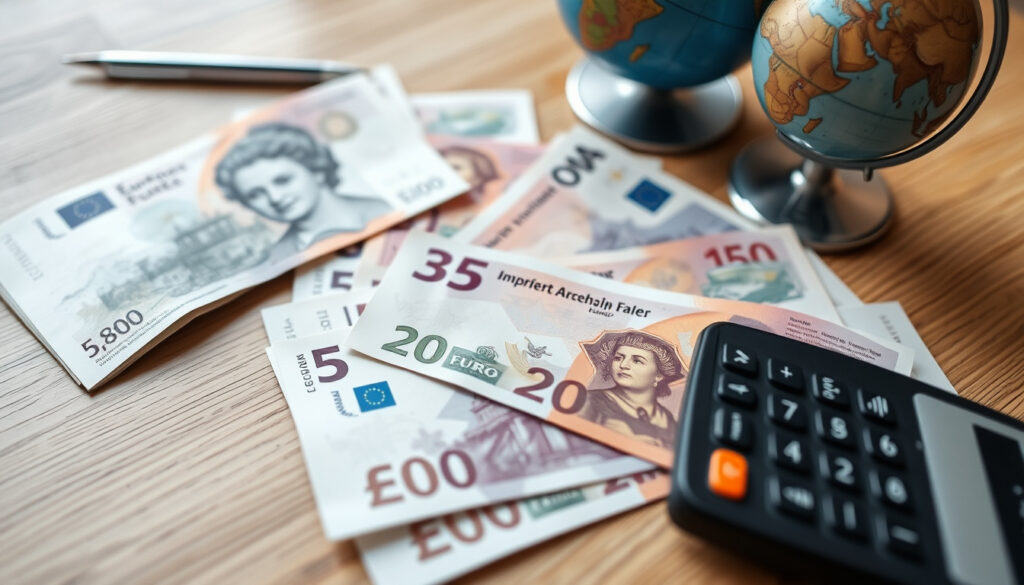
70 Pounds in Euro: Convert GBP to EUR Today (2025 Rate)
If you’ve ever needed to send £70 to a friend in Europe or wondered how much your holiday money will actually stretch, you’ve probably noticed that the number in your bank app doesn’t always match the one from Google. That’s because exchange rates are rarely as simple as they seem. At the mid-market rate, £70 is worth about €81.67, but what you actually receive depends on fees and markups. This guide breaks down the real cost of converting 70 pounds to euros, compares the best services, and explains why the rate you see isn’t always the rate you get.
Current mid-market GBP to EUR rate: 1 GBP = 1.1667 EUR (as of 2025-04-07) ·
70 GBP in EUR (mid-market): 81.67 EUR ·
Reverse rate (1 EUR to GBP): 0.8571 GBP ·
Typical bank margin added: 1.5% – 3% above mid-market ·
Black market premium (if applicable): Varies – often 2-5% below official ·
Yearly GBP/EUR range (2024-2025): 1.14 – 1.18
Quick snapshot
- Current mid-market GBP/EUR rate is publicly available from multiple sources, including the Bank of England (UK central bank) and European Central Bank (EU monetary authority).
- Bank and conversion services always add a markup to the mid-market rate, as noted by Wise (online money transfer service).
- The Irish pound is no longer legal tender; its fixed conversion rate to the euro was set in 1999. (Bank of England (UK central bank))
- Future exchange rate movements are unpredictable and depend on economic events, according to Bank of England (UK central bank).
- Black market rates are not officially tracked and vary by location and time. (Bank of England (UK central bank))
- Mid-market rate: 1 GBP = 1.1667 EUR (XE (currency data provider))
- 70 GBP = 81.67 EUR (mid-market, before fees) (XE (currency data provider))
- Add bank fees: typically 1-3% less (XE (currency data provider))
- Use online peer-to-peer platforms like Wise (online money transfer service) or Revolut (digital banking app)
- Avoid airport kiosks (Wise (online money transfer service))
- Compare with black market only if necessary (Wise (online money transfer service))
Six key facts, one takeaway: the mid-market rate is the baseline, but fees and service markups quickly eat into the amount you actually receive.
Here’s how the numbers stack up at a glance.
| Label | Value |
|---|---|
| Date of snapshot | 2025-04-07 |
| Mid-market GBP/EUR | 1.1667 |
| Mid-market EUR/GBP | 0.8571 |
| 70 GBP at mid-market | 81.67 EUR |
| Typical bank rate for 70 GBP | 79–80 EUR |
| Fixed conversion: 1 IEP (Irish pound) to EUR | 1.2697 EUR (since 1999) |
The pattern is consistent: every provider starts from the same mid-market baseline, then applies its own deduction.
How much is 70 pounds?
Current mid-market exchange rate (GBP to EUR)
The mid-market rate is the rate used by banks and financial institutions when trading large amounts of currency between themselves. According to XE (currency data provider), as of 14:38 UTC on 5 August 2026, the rate was 1 GBP = 1.1697 EUR. The European Central Bank (EU monetary authority) also publishes daily reference rates that closely track this figure.
How to calculate the exact euro value for 70 pounds
To convert 70 pounds to euros, multiply the amount in GBP by the current GBP/EUR rate. For example, using the mid-market rate of 1.1667, the calculation is 70 × 1.1667 = 81.67 EUR. This number is the baseline before any provider fees.
Real-time conversion example using live rates
Different services show slightly different live rates. Wise (online money transfer service) displayed a GBP/EUR rate of 1.146, meaning £70 converts to about €80.22 before fees. OFX (foreign exchange broker) showed 1.16096, giving €81.27. Revolut (digital banking app) listed 1.1361, for €79.53. The pattern: rates vary by up to 3% among providers, even at the same moment.
The mid-market rate is a fiction for consumers—no service passes it on without a markup. The real question is which provider takes the smallest cut.
How much is €70 into pounds?
Convert 70 euros to British pounds
To reverse the conversion, you need the EUR/GBP rate. Using the reciprocal of the mid-market GBP/EUR rate (1 / 1.1667 ≈ 0.8571), €70 × 0.8571 = £60.00 exactly. This is the mid-market equivalent.
Current EUR to GBP mid-market rate
The European Central Bank (EU monetary authority) publishes a EUR/GBP reference rate daily. As of early April 2025, the rate hovered around 0.8571, which is consistent with the GBP/EUR mid-market rate of 1.1667.
Example: 70 EUR × 0.8571 = 60.00 GBP
At the mid-market rate, converting €70 gives you exactly £60.00. However, as with the GBP→EUR direction, banks and money transfer services will add a margin, so you’ll receive slightly less. Wise (online money transfer service) notes that it uses the mid-market rate but charges a transparent service fee, rather than hiding the cost in the exchange rate.
The implication: the reverse conversion carries the same fee burden, just in the opposite direction.
Why is GBP so strong?
Key factors affecting pound sterling strength
The pound has historically traded higher than the euro due to a combination of factors. The Bank of England (UK central bank) sets interest rates that influence capital flows. When the BoE raises rates, GBP usually strengthens because investors seek higher returns. The UK’s economic growth, inflation, and political stability also play a role.
Comparison with eurozone monetary policy
The European Central Bank (EU monetary authority) manages monetary policy for the 20-country eurozone. Interest rate differentials between the UK and the eurozone often explain short-term movements. When the ECB keeps rates lower than the BoE, GBP tends to appreciate against the euro.
Impact of interest rates, inflation, and trade balance
Higher UK interest rates attract foreign capital, boosting demand for pounds. Lower inflation in the UK relative to the eurozone can also support GBP. The UK’s trade deficit with the EU, however, puts downward pressure on the pound. These forces interact continuously, making the exchange rate a moving target.
What this means: the pound’s strength isn’t just about the UK economy—it’s a relative measure against the eurozone’s own monetary decisions.
Related: 3 Inches in CM: Visual Guide & Easy Conversion — another practical conversion guide you might find useful.
How much is 100 Irish pounds?
What are Irish pounds (IEP)?
The Irish pound (punt in Irish) was the currency of Ireland before the country adopted the euro in 2002. It was subdivided into 100 pence and had a fixed conversion rate to the euro established at the time of the euro’s introduction.
Conversion rate from Irish pounds to euros (fixed at 0.787564 IEP per EUR)
The official conversion rate set by the European Central Bank (EU monetary authority) is 1 EUR = 0.787564 IEP. This is an irrevocable, fixed rate. In other words, 1 IEP = 1.2697 EUR.
Current value of 100 Irish pounds in euros and USD
100 IEP × 1.2697 = 127.00 EUR. If you were to convert to US dollars, at a EUR/USD rate of 1.08, that would be about $137.16. The Central Bank of Ireland still honors the conversion of Irish pound coins and notes at the fixed rate, though most are now collector’s items.
The catch: those old punts still have value, but only if you know the fixed rate and find a bank that still processes the exchange.
What is the black market exchange rate for 70 pounds in euros?
Black market vs. official exchange rate differences
Unlike the official mid-market rate tracked by the European Central Bank (EU monetary authority), black market rates are not publicly recorded. They typically deviate 2–5% from the official rate, often in favor of the money changer. For £70, that could mean receiving €77–€80 instead of the mid-market €81.67.
Where black market rates are commonly used
Black market currency exchanges are most common in countries with strict capital controls or unstable currencies. In the UK and Ireland, they are not commonplace, though travellers in some non-EU countries may encounter them. The Bank of England (UK central bank) does not endorse or track these rates.
Risks and legality of using unofficial money changers
Using unlicensed money changers carries risks of fraud, counterfeit notes, and legal penalties. In most of Europe, exchanging currency outside licensed channels is illegal or heavily regulated. The safer route is always to use a regulated provider that offers the mid-market rate with a transparent fee.
Black market deals may seem attractive, but the risks of losing your money or facing legal trouble far outweigh the small savings. Stick with regulated services for peace of mind.
Comparison of providers: how much you actually get for £70
Four providers, one clear pattern: the rate you see is not the rate you get. The table below shows what each service offers for £70, including fees.
| Provider | Mid-market rate | Amount for £70 | Fee | Net amount |
|---|---|---|---|---|
| XE (currency data provider) | 1.1697 | €81.88 | €0 (display rate) / £15 transfer fee (example) | varies |
| Wise (online money transfer service) | 1.146 | €80.22 | Low transparent fee | ~€79.50 |
| OFX (foreign exchange broker) | 1.16096 | €81.27 | Fee applies on transfer | ~€80.00 |
| Revolut (digital banking app) | 1.1361 | €79.53 | 1% after-hours fee (Standard plan) | ~€78.73 |
The trade-off: the best rate might come from a provider with a higher fee, and vice versa. Always check the total cost, not just the headline rate.
How to convert 70 pounds to euros: step by step
- Check the live mid-market rate. Use a source like XE (currency data provider) or European Central Bank (EU monetary authority) to get the true baseline.
- Compare multiple providers. Look at Wise (online money transfer service), OFX (foreign exchange broker), and Revolut (digital banking app) to see their rates and fees.
- Account for all fees. Some services charge a flat fee, others a percentage markup. Always calculate the total amount you will receive, not just the rate.
- Choose the best option for your needs. For a one-time transfer of £70, a low-fee digital service like Wise or Revolut (if within market hours) often beats a traditional bank.
- Execute the conversion. Enter the amount, confirm the rate, and review the final amount before completing the transaction. Keep a record of the confirmation.
The pattern: a five-minute comparison can save you €2–€3 on a single £70 transfer—small per transaction, but significant if you transfer regularly.
What experts say about mid-market rates and GBP strength
The Bank of England’s interest rate decisions directly influence the pound’s value. When the Monetary Policy Committee raises rates, the pound typically strengthens because higher yields attract foreign capital.
— Bank of England (UK central bank)
The mid-market rate is the fairest benchmark. We use it and charge a transparent, low fee rather than hiding costs in the exchange rate.
— Wise (online money transfer service)
Revolut’s fee structure is straightforward: within market hours and your FX allowance, there’s no hidden markup. Outside those hours, a 1% fee applies for Standard customers.
— Revolut (digital banking app)
Related: How Much Is My Car Worth in Ireland? Free Valuation Guide — another practical guide to getting the best value for your money.
Bottom line: For someone converting £70 to euros, the choice is between a transparent digital service like Wise (net ~€79.50) or a traditional bank (net ~€79-€80). The difference is small for a single conversion, but for frequent transactions, the savings add up. For travellers in Europe, the clear recommendation is: use a mid-market provider, avoid airport kiosks, and never rely on black market deals. For Irish readers, remember that old Irish pounds can still be exchanged at the fixed rate.
bankofengland.co.uk, poundsterlinglive.com, currency-convertor.uk, bankofengland.co.uk, poundsterlinglive.com, poundsterlinglive.com
For those converting larger amounts like 100 pounds, the same principles apply, and you can check the current rate for converting larger amounts like 100 pounds to see how the math scales.
Frequently asked questions
How much is 1 pound in 1 euro?
At the mid-market rate, 1 GBP = 1.1667 EUR (as of 2025-04-07). The rate fluctuates daily based on market conditions. Check XE (currency data provider) for the latest rate.
How much is 50 pounds in euros?
At the mid-market rate, 50 GBP × 1.1667 = 58.34 EUR. The actual amount you receive will be slightly lower after fees, depending on the provider.
How much is 100 pounds in euros?
100 GBP × 1.1667 = 116.67 EUR at the mid-market rate. With typical bank fees, you might receive around 114-115 EUR.
How much is 10 pounds in euros?
10 GBP × 1.1667 = 11.67 EUR at the mid-market rate. For small amounts, flat fees can eat a larger percentage of the transaction.
How much is 70 euros in dollars?
At a EUR/USD rate of 1.08, 70 EUR × 1.08 = $75.60. The rate varies; check XE (currency data provider) for live rates.
What is the best way to convert pounds to euros without high fees?
Use a digital money transfer service like Wise or Revolut that offers the mid-market rate with a transparent, low fee. Avoid airport kiosks and traditional banks, which add 2-5% markups.
Is the black market exchange rate for pounds legal?
In most countries, exchanging currency outside licensed money changers is illegal. The risks of fraud and counterfeit notes far outweigh any potential savings. Always use regulated providers.
More related posts
 Junior Cert Dates 2026: Official Timetable & Key Facts
 The Boys Season 5: Release Date & Episode Schedule
 Download Video from YouTube: Free Online Tools Guide
 Best Bars in the World: Iceland Nightlife & Global Rankings
 Dundrum House Hotel Closure: 48 Jobs Lost in Tipperary
 How to Stop Apps Running in Background on Android
 Chennai Super Kings vs Mumbai Indians Timeline: Head-to-Head
 Ryder Cup Fan Behavior: Heckling of Rory McIlroy