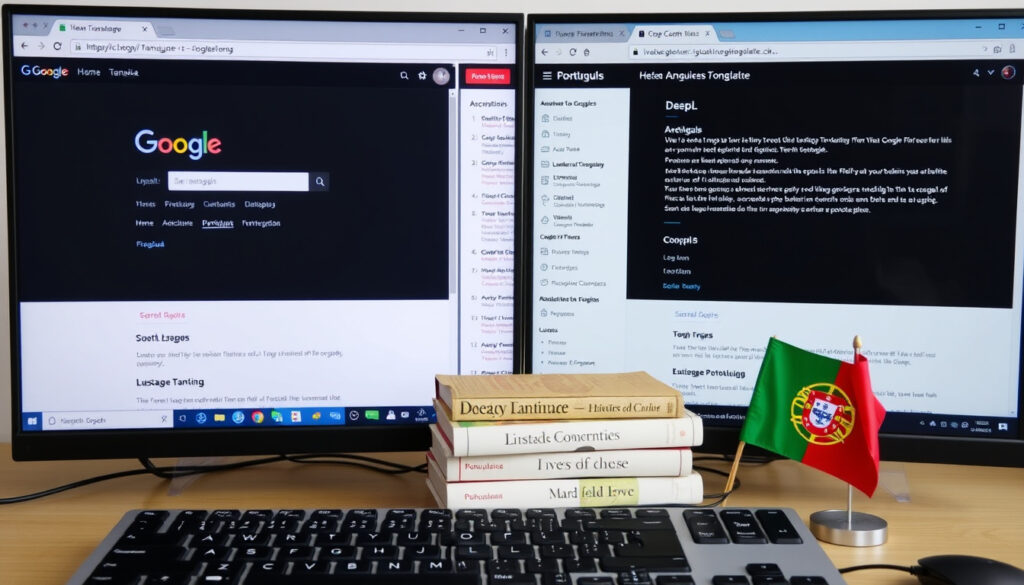
Best English to Portuguese Translators: Google, DeepL & More
Anyone who has tried translating a Portuguese phrase from English knows the dilemma: one tool gives you a word-for-word match, another captures the slang, and a third leaves you guessing. With Brazilian Portuguese and European Portuguese often handled differently, picking the right translator can make or break a message.
Google Translate: 100+ languages (TranslatePress) ·
DeepL: 32 languages (Centus) ·
Offline mode: Google Translate only (Centus)
Quick snapshot
- Google Translate covers 100+ languages with neural machine translation (TranslatePress)
- DeepL supports 32 languages and markets itself as “the world’s most accurate translator” (DeepL)
- Google Translate offers offline translation after downloading language packs (Centus)
- Exact accuracy of Lara Translate compared to Google or DeepL for Portuguese – no independent benchmarks
- Whether DeepL’s free character limit will change in the future
- Quality of Google Translate’s offline mode for European Portuguese vs Brazilian Portuguese
- User reviews in 2025 show strong performance variation by language pair (Bluente)
- Expect further model updates and more tools adding offline capability
- Users should double-check critical translations with a dictionary or Linguee
| Feature | Value |
|---|---|
| Number of tools compared | 4 |
| Google Translate languages | 100+ (TranslatePress) |
| DeepL languages | 32 (Centus) |
| Offline mode | Available on Google Translate only (Centus) |
| Best for casual use | Google Translate (voice, camera, offline features from Centus) |
| Best for professional writing | DeepL (cited as top alternative for accuracy by TranslatePress) |
How does Google Translate handle English to Portuguese translations?
Language support and dialects
Google Translate supports over 100 languages, including both Brazilian and European Portuguese (TranslatePress). The neural machine translation model handles regional vocabulary differences reasonably well, though users report that slang and informal expressions sometimes slip.
Offline mode availability
You can use Google Translate without an internet connection by downloading a language pack (Centus). Once installed, text translation works offline for Portuguese, making it convenient for travelers or areas with spotty connectivity.
Real-time translation via camera and voice
Google’s mobile app offers real-time voice translation and image translation using the phone camera (Centus). This feature works with Portuguese and is especially handy for menus, signs, or quick conversations.
Google’s breadth of features makes it the go‑to for casual use, but when nuance matters—say, translating a contract or a literary passage—its output can feel mechanical. DeepL often does a better job preserving context.
The implication: For gist and travel, Google Translate is the clear winner; for precision, it falls short.
Is DeepL more accurate than Google Translate for Portuguese?
Accuracy benchmarks for Portuguese
DeepL has positioned itself as “the world’s most accurate translator” (DeepL). In side‑by‑side comparisons, multiple sources point to it outperforming Google Translate for European languages, including Portuguese (TranslatePress). However, user reports on Bluente (2025) show that performance varies: some people find DeepL dramatically better for Spanish‑to‑English, while others say Google captures French slang more naturally (Bluente).
Contextual translation improvements
DeepL uses convolutional neural networks trained on Linguee data, which helps it handle idiomatic phrases and maintain tone across sentences. The Free plan supports up to 5 000 characters per translation (QuillBot provides a similar limit), but DeepL’s strength lies in fewer mistranslations of compound verb tenses common in Portuguese.
User interface and file upload limits
DeepL lets free users upload Word, PDF, and PowerPoint files up to 10 MB (Centus). The interface is cleaner than Google’s but lacks voice and camera input. For professional translators or anyone working with long documents, that file upload feature is a clear plus.
DeepL’s character limit can feel restrictive when translating an entire webpage or a long email. And without offline mode or camera translation, it’s less useful on the go.
The pattern: DeepL excels at depth; Google Translate at breadth. Neither is universally superior.
What is the difference between Linguee and traditional translators?
Corpus‑based translation vs. neural machine translation
Unlike Google Translate or DeepL, Linguee is not a generative translator. It’s a bilingual search engine that pulls example sentences from official documents, EU institutions, and professional websites (Centus mentions similar corpus tools). If you need to verify how a specific word or phrase is used in real‑world contexts, Linguee provides instant, sourced examples.
Bilingual example sentences
The tool displays millions of paired sentences, showing you how translators handled similar phrasing. For Portuguese, this is invaluable when deciding between formal (“você”) and informal (“tu”) registers, or choosing the correct preposition.
Suitability for professional translation
Linguee does not generate translations itself. Instead, it acts as a reference to check the work of other tools. Professional translators often keep it open alongside DeepL or Google Translate as a reality check (Bluente notes that even the best free tools still need dictionary or expert review for critical work).
What this means: Linguee is not a translator; it’s a verification layer that catches subtle register differences.
How can I translate English to Portuguese from my phone?
Mobile apps for translation
Google Translate, DeepL, and Lara Translate all offer free mobile apps for iOS and Android. Google’s app is the most feature‑packed: voice, camera, and offline all in one (Centus). DeepL’s app focuses on text translation with a clean interface but lacks camera input.
Voice and camera translation
Google Translate’s camera mode instantly translates text in photos or live camera view – ideal for menus or signs in Portuguese. Voice translation works in both directions, with text‑to‑speech for pronunciation help. DeepL’s app supports voice input but not camera translation.
Offline translation availability
Only Google Translate provides offline translation for Portuguese via downloaded language packs (Centus). DeepL and Lara Translate require an internet connection. If you’re traveling in Brazil or Portugal without reliable data, Google is your only free offline option.
| Feature | Google Translate | DeepL | QuillBot |
|---|---|---|---|
| Languages | 100+ (TranslatePress) | 32 (Centus) | 52 (QuillBot) |
| Offline mode | Yes (Centus) | No | No |
| File upload | Limited (web pages) | PDF, Word, PPT ( < 10 MB) (Centus) | No |
| Free limit | Unlimited | 5 000 chars/request | 5 000 chars/request (QuillBot) |
| Best for | Casual browsing, travel | Professional documents | Short text, paraphrasing |
Clarity check
Confirmed facts
- Google Translate handles 100+ languages with neural machine translation (TranslatePress)
- DeepL uses convolutional neural networks and markets itself as “the world’s most accurate translator” (DeepL)
- Google Translate offers offline language packs (Centus)
- Linguee is a bilingual dictionary with example sentences, not a generative translator
What’s unclear
- Exact accuracy of Lara Translate for Portuguese compared to Google or DeepL
- How often DeepL’s free character limit will change
- Whether offline packs provide equal quality for European vs. Brazilian Portuguese
“DeepL is approximately 1000x better than Google Translate for Spanish to English.”
— User quoted by Bluente (2025)
“Google performs much better than DeepL for French slang, expressions, and sayings.”
— Another user quoted by Bluente (2025)
The choice between these translators comes down to your scenario. For quick, on‑the‑go translation of signs or chats, Google Translate’s offline mode and camera are unmatched. For professional writing, DeepL’s contextual accuracy and file upload give it an edge. And when precision matters most, using Linguee alongside either tool helps catch the subtle register differences between Brazilian and European Portuguese. For anyone translating regularly between English and Portuguese, the smartest setup combines Google for speed, DeepL for depth, and Linguee for verification.
For a deeper comparison of the top options, check out this guide to English to Portuguese translation tools.
Frequently asked questions
Can Google Translate European Portuguese correctly?
Yes, Google Translate includes European Portuguese in its language set, but its neural model is trained more heavily on Brazilian sources. Users sometimes report that specific European terms (like “comboio” for train vs. “trem”) may not always appear in the first suggestion. For critical texts, cross‑check with DeepL or Linguee.
Is DeepL free for business use?
DeepL’s free plan allows 5 000 characters per translation and occasional file uploads, which is fine for personal or light business use. For heavy commercial translation, DeepL offers a Pro subscription with unlimited text and API access.
Does Lara Translate support English to Portuguese?
Lara Translate claims to support 200+ languages, and its website lists English and Portuguese among them. However, independent accuracy tests for this pair are still scarce, so treat its output with the same caution you’d apply to any newer AI translator.
How to use Linguee to check a translation?
Type the word or phrase into the Linguee search bar. It returns bilingual sentence pairs from official documents, EU sources, and professional websites. Scroll through the examples to see how native translators handled the same term in context.
What is the best translator for academic texts in Portuguese?
DeepL is generally the strongest choice for academic writing because it maintains register and handles compound verb tenses better than Google Translate. Always verify with Linguee or a native speaker for discipline‑specific terminology.
Can I translate a whole website with these tools?
Google Translate can translate entire web pages via the browser extension or by entering the URL. DeepL and Linguee cannot do full‑page translation; you need to copy and paste sections.
Why are some words not translated correctly in Portuguese?
Machine translation struggles with polysemy (words with multiple meanings), slang, and dialect differences. For example, “banana” is the same in both Portuguese dialects, but “rapariga” means “girl” in European and can be offensive in Brazilian. Using Linguee helps catch these traps.
How often are translation models updated?
Google and DeepL update their models regularly, but there are no public release calendars. Users notice improvements every few months. Lara Translate, being newer, may update more frequently based on user feedback.
More related posts
 Translate English to Ukrainian: Tools, Tips & Phrases
 What Time Is It in New York? EDT vs EST & Current Time
 Super Mario 3D World: Levels, Difficulty & Co-Op Guide
 Colin Glen Forest Park Guide: Free Entry, Cafe, Zipline & Alpine Coaster
 O’Sullivans Pharmacy Grange: Hours, Address, Contact Cork
 Signs of Low Iron: Symptoms, Causes, and Treatment
 10 Day Weather Forecast Carlow – Met Éireann, AccuWeather & More