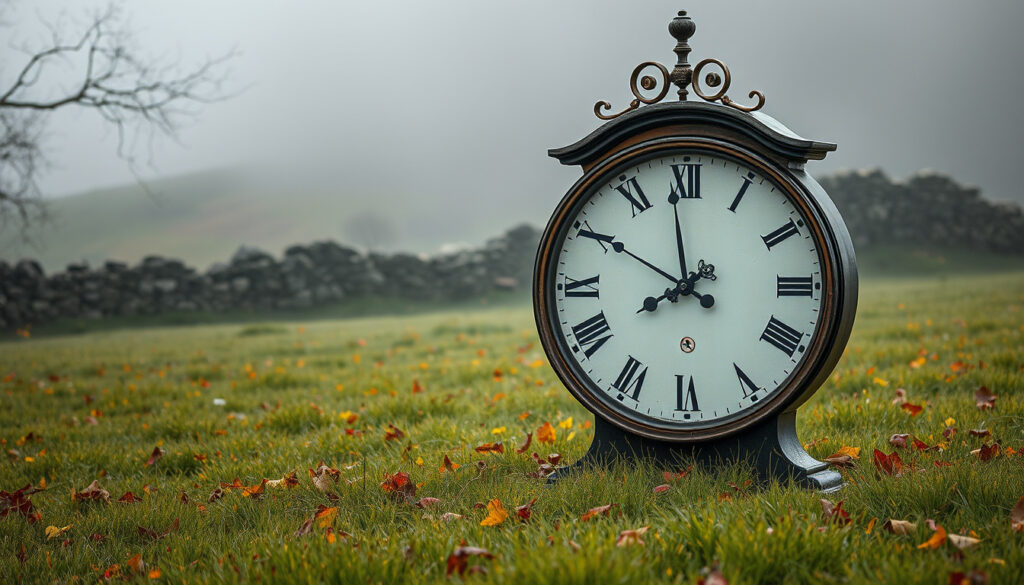
When Do Clocks Go Back in Ireland? 2026 Date & Time
There’s a small October ritual most people only notice when the evenings suddenly darken: the clocks go back and the country regains an hour. In 2026, that switch happens on Sunday, 25 October, when clocks fall from 2:00 am to 1:00 am and Ireland returns to Greenwich Mean Time, according to Citizens Information (the official government guidance).
Next clock back date (2026): 25 October 2026 · Clock back time: 2:00 AM becomes 1:00 AM · Daylight Saving begins (2026): 29 March 2026 · Time zone after fall-back: Greenwich Mean Time (GMT)
Quick snapshot
- Clocks go back at 2:00 am on Sunday, 25 October 2026 (Citizens Information (official government guidance)). (RTÉ (national public broadcaster))
- The change ends Irish Standard Time and returns Ireland to GMT (RTÉ (national public broadcaster)).
- Whether EU member states will keep seasonal clock changes; the current framework is Directive 2000/84/EC (timeanddate.com (time-zone reference)).
- Exact dates beyond 2026, though the pattern points to the last Sunday of March and the last Sunday of October (RTÉ (national public broadcaster)). (timeanddate.com (time-zone reference))
- The UTC shift happens at 01:00 UTC on 25 October 2026, and the next spring-forward is set for 28 March 2027 (timeanddate.com (time-zone reference)).
- Internet-connected devices update automatically when set to Irish time (Connacht Tribune (regional news)).
- Manual clocks and some household appliances still need a hands-on change (Irish Mirror (national news)).
Seven rows, one pattern: the rule has barely moved for years — Ireland falls back on the last Sunday of October at 2:00 am and springs forward on the last Sunday of March.
| Fact | Value | Source |
|---|---|---|
| Next clock back date (2026) | 25 October 2026 | timeanddate.com (time-zone reference) |
| Clock change time | 2:00 AM becomes 1:00 AM | timeanddate.com (time-zone reference) |
| 2026 summer time began | 29 March 2026 at 1:00 AM | timeanddate.com (time-zone reference) |
| Resulting time zone | Greenwich Mean Time (GMT) | RTÉ (national public broadcaster) |
| Change rule | Last Sunday of March and last Sunday of October | RTÉ (national public broadcaster) |
| Ireland vs UK (2026) | Same clock-change dates and local times | The Irish Times (national newspaper) |
| Net effect | One extra hour overnight | The Irish Times (national newspaper) |
For anyone with a radio alarm, an oven clock or a heating timer, the 2:00 am switch is the inconvenient part: those devices won’t fix themselves. Manual adjustment is still needed for traditional clocks and some household appliances, notes Irish Mirror (national news).
Do you get an extra hour in bed when the clocks go back?
Yes — that’s the selling point of the October switch. At 2:00 am local time, the clock moves back to 1:00 am, so the 1:00–2:00 am hour runs twice, according to timeanddate.com (time-zone reference). If you sleep through it, you genuinely collect one more hour.
The Irish Times (national newspaper) describes the result as an additional nominal hour overnight. The word “nominal” matters here: the total amount of time doesn’t grow. The clock simply re-labels 2:00 am as 1:00 am, so the same hour gets counted again.
- Shift workers on Sunday night experience the extra hour as a real 60 minutes at the end of a long shift.
- Parents of small children often meet it again as an earlier-than-usual wake-up instead of a lie-in.
The implication: the extra hour is real, but it lands at 2:00 am, when most of the country is asleep. The people who experience it are those still awake at that hour — everyone else just finds Sunday arriving on a slightly different schedule.
The clock change gives Ireland an extra hour at 2:00 am, but most people only notice a shift in their Sunday schedule.
Do we gain or lose an hour in October?
You gain an hour. “Fall back” is the memory hook: in October the clocks fall back from 2:00 am to 1:00 am, and the 1:00–2:00 am hour runs twice, as timeanddate.com (time-zone reference) confirms. The date stays pinned to the last Sunday of October (Citizens Information (official government guidance)).
- October (fall back): 2:00 am becomes 1:00 am — gain one hour
- March (spring forward): 1:00 am becomes 2:00 am — lose one hour
The spring side of that swap happened on 29 March 2026, when clocks moved from 1:00 am to 2:00 am and the 1:00–2:00 am hour was skipped entirely, per timeanddate.com (time-zone reference). The October change reverses the arithmetic, which is why the autumn switch always feels more generous.
The arithmetic: each March steals an hour from the morning, and each October gives it back before winter. The one-hour swap is the entire engine of Ireland’s seasonal time.
Ireland gains one hour in October and loses it the following March.
Do the clocks go back tonight?
If tonight is the night before the last Sunday of October, yes. In 2026, that falls on the night of Saturday 24 October into Sunday 25 October: at 2:00 am on Sunday, clocks go back to 1:00 am (timeanddate.com (time-zone reference)).
The autumn rule in Ireland is pinned to the last Sunday of October at 2:00 am — which this year lands one day earlier than 2025’s change, because the Sunday falls on the 25th (Citizens Information (official government guidance)).
- Manual clocks, kitchen timers, car clocks and some household appliances need a hands-on change, notes Irish Mirror (national news).
- Smartphones, computers and smart devices set to Irish time update automatically, reports Connacht Tribune (regional news).
The catch: “going back tonight” is easy to forget precisely because connected devices do it for you. The oven clock and the car clock will still be wrong on Sunday — and they’re always the ones you notice mid-morning.
If tonight is Saturday, 24 October, set manual clocks back before bed.
What date do clocks go forward in 2026?
The 2026 spring-forward already happened: Sunday, 29 March, at 1:00 am, when clocks jumped to 2:00 am and Ireland moved into its summer-time period (timeanddate.com (time-zone reference)). That period is formally called Irish Standard Time, and the October change brings it to an end (RTÉ (national public broadcaster)).
If you’re reading this after 25 October, the date that matters next is Sunday, 28 March 2027, at 1:00 am — the next spring-forward, set by the EU-wide clock-change framework (timeanddate.com (time-zone reference)). That’s the night when the hour gained this October gets collected again.
- After 25 October, Dublin runs one hour behind Central European Time for the winter (Citizens Information (official government guidance)).
- Ireland shares the winter arrangement with the UK and Portugal (Citizens Information (official government guidance)).
The trade-off: the spring change on 28 March 2027 takes back the exact hour Ireland gains on 25 October 2026. For shift workers and parents, the 1:00 am jump means one fewer hour in a Sunday night — and it arrives about six months after they’ve stopped thinking about it.
The pattern: the date that counts for planning is always the next one on the calendar. Right now, that’s 28 March 2027, because everything before it is already settled.
The next spring-forward after October 2026 is 28 March 2027.
Do I lose an hour of sleep on Sunday?
No — and this is the most common confusion around the October change. When the clocks go back, you gain an hour, so Sunday morning offers 60 extra minutes. The loss happens in the opposite direction: on 29 March 2026, clocks moved from 1:00 am to 2:00 am, skipping one full hour of the night (Citizens Information (official government guidance)).
- October (fall back): gain one hour of sleep
- March (spring forward): lose one hour of sleep
Your body will notice anyway, because the same alarm time now sits at a slightly different point in the natural morning. The reliable fix is mechanical: set manual clocks back before bed on Saturday 24 October, and let connected devices follow their time-zone settings (Irish Mirror (national news); Connacht Tribune (regional news)).
The practical point: you gain 60 minutes in bed, but darker evenings arrive with the same switch. The extra hour is a short-term loan, and the next spring-forward is the collection date.
You gain an hour of sleep in October, but darker evenings are the trade-off.
Clock changes around 2026: the full sequence
Ireland’s switches follow a fixed rhythm, but the dates drift by a day or two each year because they’re tied to the last Sunday of the month. The sequence around 2026 looks like this:
- — clocks went back at 2:00 am (Citizens Information (official government guidance))
- — clocks went forward at 1:00 am (timeanddate.com (time-zone reference))
- — clocks go back at 2:00 am (timeanddate.com (time-zone reference))
- — clocks go forward at 1:00 am (timeanddate.com (time-zone reference))
The pattern: the gap between changes stays close to six months, and the one-day drift comes from the “last Sunday” rule. If you know that rule, you can predict every date in this list without memorising any of them.
The pattern of last Sundays ensures dates shift slightly each year.
What’s confirmed and what’s still unclear
Most of the clock-change picture in Ireland is settled. A smaller part — the EU’s long-term policy — is genuinely open.
Confirmed facts
- Clocks go back on the last Sunday of October at 2:00 am (Citizens Information (official government guidance)).
- Clocks go forward on the last Sunday of March (RTÉ (national public broadcaster)).
- The 2026 dates are 29 March and 25 October (timeanddate.com (time-zone reference)).
What’s unclear
- Whether EU member states will keep seasonal clock changes; the current framework is Directive 2000/84/EC (timeanddate.com (time-zone reference)).
- Exact dates beyond 2026, though the pattern points to the last Sundays of March and October (RTÉ (national public broadcaster)).
- Whether all EU member states will continue to change clocks on the same dates if the Directive is revised.
- Exact dates for clock changes beyond 2027 depend on whether the EU revisits Directive 2000/84/EC.
- The current pattern of last Sunday of March/October could change if the EU framework is revised.
What to watch: Directive 2000/84/EC is the legal backbone of the EU-wide change. If it is revisited, Ireland’s last-Sunday dates could move — and every 2027-and-beyond date in this article becomes a historical footnote instead of a plan.
The difference between the two lists is the difference between a settled rule and an open question. For planning purposes, trust the confirmed column; for long-term forecasts, watch the directive.
The core rules are settled, but EU policy could alter future dates.
What the official sources say
The core facts come from government, broadcaster and reference sources, and they line up cleanly:
Clocks go back one hour on Sunday, 25 October 2026.
Citizens Information (official government guidance)
The autumn change ends Irish summer time — formally Irish Standard Time — and returns Ireland to Greenwich Mean Time.
RTÉ (national public broadcaster)
The UTC transition occurs at 01:00 UTC on 25 October 2026, and the next spring change is scheduled for 28 March 2027.
timeanddate.com (time-zone reference)
The pattern: government, broadcaster and reference sources agree on the date, the direction and the resulting time zone. When the sources align like this, the remaining uncertainty is policy, not arithmetic.
Official sources agree on the 2026 date, direction, and resulting time zone.
The upshot for 2026
When the clocks go back on 25 October 2026 (Citizens Information (official government guidance)), Ireland trades lighter evenings for an extra morning hour and settles into GMT for the winter. The rule itself is simple: last Sunday of October, 2:00 am, fall back. The confusion comes from remembering which Sunday, which direction, and whether the EU will eventually pull the plug on the whole system. For anyone with an alarm set for Monday 26 October, the practical move is clear: adjust the manual clocks on Saturday night, let connected devices handle their own update, and treat the extra hour as a real 60 minutes — or watch it disappear at the next spring-forward.
October 25, 2026, is the key date; adjust manual clocks on Saturday night.
Frequently asked questions
Why does Ireland change clocks?
Ireland follows the EU-wide seasonal time system set by Directive 2000/84/EC, which coordinates clock changes across member states, as timeanddate.com (time-zone reference) notes. All EU member states currently change clocks on the same dates in March and October (RTÉ (national public broadcaster)).
What is Irish Standard Time?
Irish Standard Time (UTC+1) is the formal name for Ireland’s summer time, used from the last Sunday of March to the last Sunday of October. When it ends, Ireland returns to GMT, according to RTÉ (national public broadcaster).
When was DST introduced in Ireland?
The current European framework for seasonal time changes is associated with Directive 2000/84/EC, which coordinates the dates across member states, as timeanddate.com (time-zone reference) notes. The practical effect is the same across the EU: one set of dates, applied by every member state (RTÉ (national public broadcaster)).
Do all EU countries change clocks?
Yes. All EU member states currently change clocks on the last Sunday of March and the last Sunday of October, under the existing system, according to RTÉ (national public broadcaster).
How do I adjust after the clock change?
Set traditional clocks and some household appliances back by hand before bed on Saturday 24 October — a step Irish Mirror (national news) says is still needed for those devices. Phones, computers and smart devices configured for Irish time update automatically, as Connacht Tribune (regional news) reports.
What time zone is Ireland in winter?
Greenwich Mean Time (GMT, UTC+0). Ireland shares that standard-time arrangement with the UK and Portugal and sits one hour behind Central European Time during the winter months, per Citizens Information (official government guidance).
More related posts
 Irish Immigration Contact Number: Official Contacts & Stamps
 Potatoes in Air Fryer: Can You Put Raw Potatoes? Tips & Times
 Liverpool FC Latest News: Transfers, Klopp, Mbappé
 Love at First Sight: Meaning, Science & 2023 Movie Guide
 What Time Is It in Melbourne? Current Time, Zone & Travel Guide
 Dark Lies the Island (2019): Cast, Plot & Streaming Guide
 Killruddery House and Gardens: Hours, Tickets & Filming
 Declan Breslin Donegal Tenancy Damages – Case Breakdown