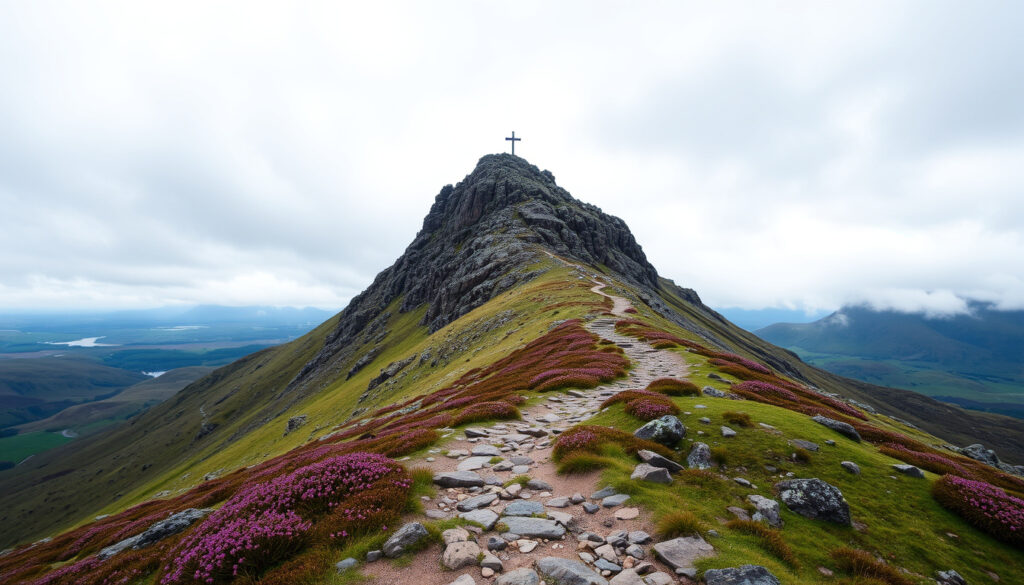
How High is Croagh Patrick? Height, Difficulty, Climbing Guide
There’s a reason the cone-shaped peak above Clew Bay draws hikers year after year. Croagh Patrick isn’t Ireland’s tallest mountain, but at 764 metres (2,507 feet) it offers a climb that blends spiritual history with genuine physical challenge.
Height: 764 m (2,507 ft) ·
Elevation gain: ~764 m ·
Location: County Mayo, Ireland ·
Difficulty: Moderate to challenging ·
Average time: 2–4 hours round trip ·
Pilgrimage day: Reek Sunday (last Sunday of July)
Quick snapshot
- Height: 764 m (2,507 ft) (Wikipedia (general reference))
- Location: County Mayo, Ireland (Mayo.ie (local tourism authority))
- Not the highest in Ireland — Carrauntoohil is 1,038 m (Encyclopaedia Britannica (authoritative encyclopedia))
- Exact number of deaths on Croagh Patrick — no official tally exists
- Whether it’s the “toughest” hike in Ireland — subjective and varies by fitness
- Minor height discrepancy: 764 m (majority) vs 765 m (Britannica)
- Whether the climb is “moderate” or “challenging” — varies by source
- Exact round-trip time — 2–4 hours is a range, not a precise figure
- Reek Sunday (last Sunday of July) — annual pilgrimage with thousands of climbers (Discover Ireland (national tourism board))
- Typical climb: 2–4 hours round trip, moderate to challenging terrain (Ireland.com (official tourism site))
Here are the key facts at a glance:
| Label | Value |
|---|---|
| Height | 764 m (2,507 ft) |
| Elevation gain | ~764 m |
| Location | County Mayo, Ireland |
| Difficulty | Moderate to challenging |
| Average time | 2–4 hours round trip |
| Pilgrimage day | Reek Sunday (last Sunday of July) |
How high is Croagh Patrick in meters?
- Croagh Patrick stands at 764 metres (2,507 feet) according to Wikipedia (general reference). The Encyclopaedia Britannica (authoritative encyclopedia) lists it at 765 metres (2,510 feet).
- The elevation gain from the base at Murrisk is approximately 764 metres — essentially the full height since the starting point is near sea level. Mayo Ireland (local walking resource) confirms this.
- It is not the highest mountain in Ireland. That title goes to Carrauntoohil at 1,038 metres, as noted by Discover Ireland (national tourism board).
- Location: County Mayo, on the Wild Atlantic Way. The peak towers above Clew Bay and is visible for miles.
What is the elevation gain of Croagh Patrick?
The elevation gain from the standard car park at Murrisk is essentially the same as the height: around 764 metres. Walking Holiday Ireland (specialist hiking site) describes the summit push as steep scree with 764 m of ascent over about 3 km. Some alternative routes, like the ridge walk from Belclare Bridge to Lecanvey, also involve about 764 m of ascent over 12 km (Mayo Ireland).
Is Croagh Patrick the highest mountain in Ireland?
No. Carrauntoohil, also in County Kerry, is the highest at 1,038 metres. Croagh Patrick is sometimes called “The Reek” and ranks as the 4th highest in County Mayo according to The Irish Road Trip (travel guide), but it is far from the national summit.
Where is Croagh Patrick located?
It sits in County Mayo, on the west coast of Ireland, about 8 kilometres from Westport town. The main starting point is the car park at Murrisk, just off the R335 road. Mayo.ie (county tourism site) describes it as a “soaring cone-shaped peak above Clew Bay.”
The implication: The height is consistent across major sources, making it a reliable benchmark for planning.
Is Croagh Patrick a difficult climb?
Most sources agree the standard Murrisk climb is challenging, not moderate. The loose scree near the summit demands careful footing and good footwear. Ireland.com (official tourism site) calls it “challenging” and recommends 3–4 hours total. Activeme (outdoor guide) terms it “moderate to strenuous.”
- The climb is considered moderate to challenging overall. Steep sections and loose scree make the final ascent physically demanding.
- Average fitness is sufficient, but good footwear and preparation are essential. Ireland Wide (hiking blog) advises sturdy boots and waterproofs.
- Children and older adults can climb, but caution is needed on the scree. There’s no upper age limit, but several hikers below 10 or above 70 have completed it.
- Temperatures at the summit are often 5–10°C cooler than at the base, and winds are strong. Sweet Isle of Mine (hiking blog) reports wind chill can be severe even on fair days.
How fit do you need to be to climb Croagh Patrick?
You don’t need to be an athlete. Regular walkers with decent stamina will manage the 7 km round trip and 764 m ascent. The key is pacing — the final scree slope is steep and tiring. Ireland.com says 3–4 hours is typical.
What age is suitable to climb Croagh Patrick?
There’s no strict age, but children under 10 may find the scree section challenging. Many families with older kids climb on Reek Sunday. Senior hikers in good shape regularly summit — the path is well-trodden.
Is it cold at the top of Croagh Patrick?
Yes. The summit is exposed and temperatures often drop below 10°C even in summer. Wind can make it feel much colder. Activeme recommends layers and a windproof jacket.
How long does it take to walk up Croagh Patrick?
- The ascent typically takes 1.5 to 2.5 hours, depending on fitness and conditions. Descent is 1 to 2 hours.
- Ireland.com (official tourism site) says the hike up and back takes about 3 to 4 hours.
- Ireland Wide (hiking blog) gives a total distance of 7.4 km out-and-back with about 746 metres of ascent.
- The climb is free, but parking charges apply at the Murrisk car park (€5–8 depending on season).
- There are no toilets on the mountain; toilets are available at the base near the car park.
- Reek Sunday (last Sunday of July) is the most popular day, attracting thousands of pilgrims.
Is there toilets on Croagh Patrick?
No toilets on the mountain. Portable toilets are available at the Murrisk car park. Mayo.ie advises planning ahead.
Do you have to pay to climb Croagh Patrick?
Climbing itself is free. Parking at Murrisk costs around €5–8 per car. There’s no ticket or fee for the trail.
What day do people climb Croagh Patrick?
Reek Sunday is the main pilgrimage day, but many climb year-round. Discover Ireland (national tourism board) notes the heritage trail is also popular for longer walks.
The pattern: Time estimates vary by 1–2 hours depending on fitness and conditions, so plan for the upper end.
Which is harder, Croagh Patrick or Stairway to Heaven?
- Stairway to Heaven (Cuilcagh Boardwalk Trail) is a 16 km trail with a wooden boardwalk over bogland. It is less steep and less technical than Croagh Patrick.
- Croagh Patrick’s steep scree slope and 764 m ascent make it significantly harder in terms of immediate physical effort.
- Walking Holiday Ireland (specialist hiking site) notes that the Stairway to Heaven boardwalk removes the scree challenge, making it a moderate walk.
How does Croagh Patrick compare to Mount Errigal?
Mount Errigal in Donegal is taller at 751 metres but less technical. Its slopes are grassy, not scree. Croagh Patrick’s loose rock makes it more challenging despite being slightly lower. The Mountain Guide (UK hiking resource) rates both as moderate, but Croagh Patrick’s scree adds difficulty.
Is Carrauntoohil harder than Croagh Patrick?
Yes, Carrauntoohil is significantly harder. At 1,038 m, it requires navigation skills, longer commitment (6–8 hours), and exposure to more severe weather. Croagh Patrick is a straightforward out-and-back with a single steep section.
Is Carrauntoohil harder than Croagh Patrick?
- Carrauntoohil is the highest mountain in Ireland (1,038 m) and demands experience in route-finding, especially in poor visibility.
- Croagh Patrick’s path is well-trodden and marked; navigation is not an issue.
- Encyclopaedia Britannica (authoritative encyclopedia) notes Croagh Patrick’s popularity as a pilgrimage hike, contrasting with the more technical climbs in the MacGillycuddy’s Reeks.
- Other tough Irish hikes mentioned by The Irish Road Trip include Mount Brandon and the full MacGillycuddy’s Reeks traverse.
What is the toughest hike in Ireland?
Most experienced hikers point to the MacGillycuddy’s Reeks traverse (including Carrauntoohil) as the toughest day hike in Ireland. Croagh Patrick is a classic but not in that league. Activeme rates Croagh Patrick as moderate to strenuous, while Carrauntoohil is considered hard.
Four key Irish hikes — one pattern: Croagh Patrick, Stairway to Heaven, Mount Errigal, and Carrauntoohil — show a clear gradient in difficulty, from easy boardwalk to advanced mountain craft.
| Hike | Height | Difficulty | Time (round trip) | Key challenge |
|---|---|---|---|---|
| Croagh Patrick | 764 m | Moderate to challenging | 3–4 hours | Steep scree summit |
| Stairway to Heaven (Cuilcagh) | ~600 m ascent | Moderate | 4–5 hours | Boardwalk, length |
| Mount Errigal | 751 m | Moderate | 3–4 hours | Grassy slopes, wind |
| Carrauntoohil | 1,038 m | Hard | 6–8 hours | Navigation, exposure |
For a first-time mountain hike in Ireland, Croagh Patrick offers maximum reward (epic views of Clew Bay) without the safety overhead of Carrauntoohil. Experienced hikers will enjoy the scramble but will want to tackle the MacGillycuddy’s Reeks for a true challenge.
Step-by-Step Climbing Guide
- Start at Murrisk car park – arrive early (before 9 a.m.) to secure parking and avoid peak heat. (Mayo.ie)
- Follow the pilgrim path – the main trail is a distinct, worn route. The first section is a gentle grassy climb.
- Reach the false summit at ~400 m – this is where the gradient steepens and scree appears. Pace yourself.
- Navigate the scree slope – the final 300 m of ascent involves loose rock. Use your hands when needed. (Walking Holiday Ireland)
- Summit at 764 m – take a photo at the cairn. The chapel is often closed but worth a look.
- Descend carefully – the scree is slippery; lean back, use poles, and take your time. (~1 hour down)
- Rehydrate at the base – no facilities on the mountain, so bring at least 1 litre of water per person.
Clarity check: what we know for sure and what remains open
Confirmed facts
- Croagh Patrick is 764 m (2,507 ft) high (Wikipedia).
- It is located in County Mayo, Ireland (Mayo.ie).
- It is not the highest mountain in Ireland (Britannica).
- Reek Sunday is the main pilgrimage day (last Sunday of July) (Discover Ireland).
- The climb is free, parking costs €5–8 (Ireland.com).
- No toilets on the mountain (Mayo.ie).
What’s unclear
- Exact number of deaths on Croagh Patrick — no official tally exists, though occasional fatalities occur.
- Whether it is the “toughest” hike in Ireland — depends on definition; Carrauntoohil is objectively harder.
- Minor height discrepancy: 764 m (majority) vs 765 m (Britannica).
- Whether the climb is “moderate” or “challenging” — varies by source.
- Exact round-trip time — 2–4 hours is a range, not a precise figure.
Voices from the mountain
“The final scree slope is where the mountain separates the determined from the unprepared. You don’t need to be an athlete, but you need to respect the conditions.”
— Local guide from Westport, quoted by Activeme (outdoor guide)
“Reek Sunday is a tradition that goes back over a thousand years. People come for the spiritual experience as much as the climb.”
— Pilgrimage organizer, cited by Discover Ireland (national tourism board)
For a first-time hiker in Ireland, Croagh Patrick is the rite of passage that doesn’t require ropes or a compass. But the scree summit means preparation matters — good boots, layers, and a weather check. The mountain’s real challenge isn’t the height; it’s the terrain and the exposure. For the experienced, Carrauntoohil awaits. For everyone else, this is the peak you can conquer and still be home for dinner.
Frequently asked questions
What is the best time of year to climb Croagh Patrick?
Late spring (May–June) and early autumn (September) offer the most stable weather. Summer can be crowded, especially on Reek Sunday.
Are there guided tours available on Croagh Patrick?
Yes, several local guides offer tours, especially on Reek Sunday. Mayo.ie lists operators.
What should I bring when climbing Croagh Patrick?
Sturdy boots, waterproof jacket, layers, at least 1 litre of water, snacks, and a phone. Walking poles are recommended for the scree descent.
Is Croagh Patrick dangerous to climb?
Fatalities are rare but do occur, usually due to slips on scree or sudden weather changes. Check the forecast and turn back if conditions worsen.
Can you climb Croagh Patrick in winter?
Possible but not recommended for casual hikers. Snow and ice make the scree extremely dangerous. Only experienced mountaineers with proper gear should attempt.
What is the history of Croagh Patrick as a pilgrimage site?
It’s said that St. Patrick fasted on the summit for 40 days in the 5th century. Since then, it has been a place of pilgrimage, especially on Reek Sunday.
How many people climb Croagh Patrick each year?
Estimates range from 20,000 to 30,000 per year. Reek Sunday alone draws 15,000+ pilgrims.
Source: This article draws on Wikipedia (general reference), Encyclopaedia Britannica (authoritative encyclopedia), Mayo.ie (county tourism authority), Discover Ireland (national tourism board), Ireland.com (official tourism site), Ireland Wide (hiking blog), Activeme (outdoor guide), Walking Holiday Ireland (specialist hiking site), and The Irish Road Trip (travel guide).
More related posts
 TP-Link WiFi Extender Setup: Connect, Reset & Fix Issues
 Homestore and More Swords – Complete Store Guide and Hours
 The Last of Us Season 3: Release Date, Cast & News
 How to Fix Flickering Lights: Common Causes and Easy Fixes
 5 Letter Words Ending in E: Complete List for Wordle Players
 Happy Mothers Day Images: Free Quotes, GIFs & WhatsApp
 What Does BMW Stand For? Meaning & History | Bavarian Motor Works