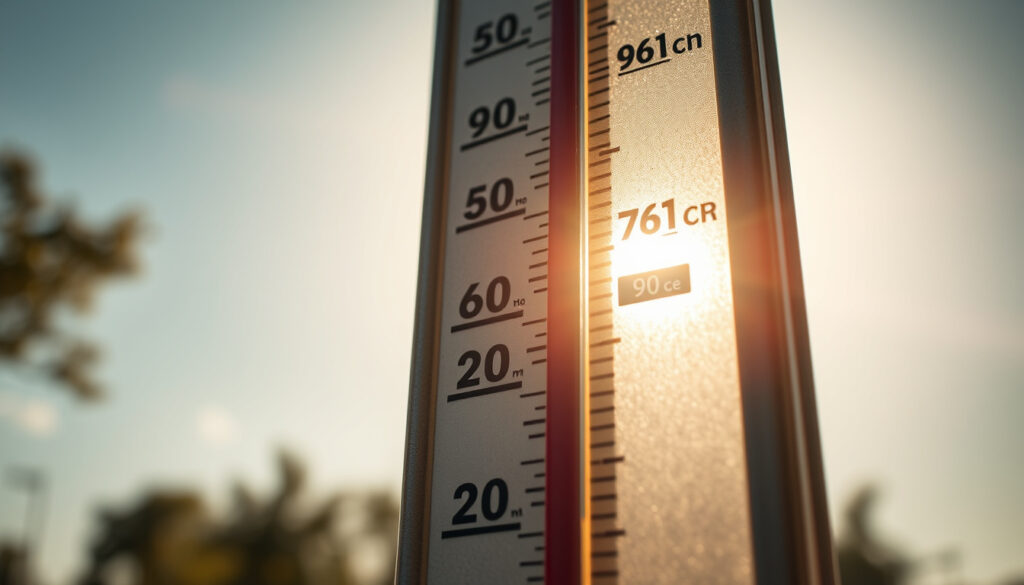
90 Fahrenheit to Celsius: Exact Conversion and Practical Guide
Few everyday conversions cause as much head-scratching as Fahrenheit to Celsius, especially when the number lands on 90 — that classic hot-summer-day reading. The exact answer is 32.22°C, and once you see why 90°F feels hot in some places and merely warm in others, the mental math gets a lot easier.
90°F in Celsius: 32.22°C · Freezing point of water: 32°F (0°C) · Boiling point of water: 212°F (100°C) · Normal human body temperature: 98.6°F (37°C) · Fever threshold (commonly): 100.4°F (38°C)
Quick snapshot
- 90°F converts to exactly 32.22°C using the standard formula (Mayo Clinic (nonprofit medical center)).
- Adult fever is most commonly defined as 100.4°F (38°C) or higher (Cleveland Clinic (academic medical center)).
- Fever thresholds shift by measurement method and time of day (MedlinePlus (U.S. National Library of Medicine)).
- Mental shortcuts are estimates, not exact conversions (UDTECH (conversion guide)).
- The conversion is a fixed constant — 90°F always equals 32.22°C (Ireland Press (conversion guide)).
- Time of day changes the signal: oral temperatures above 100.4°F (38°C) after early morning count as elevated (Merck Manual (clinical reference)).
- Use the exact formula or the subtract-30-then-halve trick for casual estimates (Evan Hahn (engineer’s heuristic notes)).
Seven reference points, one pattern: the numbers you actually deal with — weather, body temperature, and fever — all sit in a narrow band, and 90°F lands at 32.22°C.
| Reference point | Exact value |
|---|---|
| 90°F in Celsius | 32.22°C |
| 90°F in Kelvin | 305.37 K |
| Freezing point of water | 32°F / 0°C |
| Boiling point of water | 212°F / 100°C |
| Normal human body temperature | 98.6°F / 37°C |
| Adult fever threshold | 100.4°F / 38°C |
| Low-grade fever range | 99.1–100.4°F / 37.3–38.0°C |
The pattern: Fahrenheit spreads the same physical range across more degrees, so 90°F reads instantly to a U.S. audience while it takes a beat to translate into 32.22°C.
The fever rows follow published clinical grading: oral temperatures above 100.4°F (38°C) after early morning count as elevated (Merck Manual (clinical reference)), and the low-grade band comes from the Harvard Health fever classification cited below.
Is 90 F hot or cold?
Objectively, 90°F equals 32.22°C. Subjectively, it depends on where you’re standing and what you’re used to.
What 32.22°C feels like in different contexts
- Outdoors, 90°F (32.22°C) reads as a hot summer day in most regions.
- On the body, it’s far from fever territory: normal body temperature is 98.6°F (37°C), and adult fever starts at 100.4°F (38°C) (Harvard Health (Harvard Medical School’s patient guidance)).
- In humid climates, 90°F may feel oppressive; in dry heat, it’s more tolerable — perception, not math, decides the difference.
The last point is why two people in the same 90°F day can disagree about whether it’s “hot.” Humidity slows the evaporation that cools your skin, so the identical number can feel like two different climates.
The Celsius side — 32.22°C — looks deceptively mild to people who aren’t used to Celsius, because 32 is a low two-digit number. Anchoring helps: 37°C is body temperature, 38°C is a fever line, and 40°C is high-grade territory.
90°F in weather vs. indoor vs. health
Weather: hot in most regions · Indoor: above typical comfort settings · Health: below the 100.4°F (38°C) fever threshold
- Weather: destination forecasts — like this 14-day Playa de las Americas weather forecast — regularly put travelers in front of Fahrenheit numbers that need converting.
- Indoor: 90°F is warmer than most people set their thermostat, so it usually prompts a cooling decision.
- Health: 90°F is more than 10°F below the common adult fever threshold of 100.4°F (38°C).
The implication: “Is 90 F hot or cold?” is a weather question, not a health question. The Celsius conversion gives you the number; context gives you the verdict.
How do you convert F to C quickly?
The exact method takes ten seconds; the shortcut takes two. Use the formula when the number matters, the shortcut when you’re making conversation.
Subtract 32 then multiply by 5/9
(°F – 32) × 5/9 = °C. For 90°F: (90 – 32) × 5/9 = 58 × 5/9 = 32.22°C — the exact value every shortcut is measured against.
- Subtract 32 from the Fahrenheit value: 90 – 32 = 58.
- Multiply the result by 5: 58 × 5 = 290.
- Divide by 9: 290 ÷ 9 = 32.22.
- That’s the exact Celsius value: 32.22°C.
This is the same arithmetic medical references use when they publish temperature thresholds — the formula is standard across clinical and meteorological contexts (Mayo Clinic (nonprofit medical center)).
The most common arithmetic error is skipping the 32: multiply 90 by 5/9 and you get 50°C — nonsense for a summer day, and a red flag that the offset was dropped. The formula looks awkward because the scales don’t just shrink, they also shift.
Mental math shortcut: subtract 30 and halve
(°F – 30) ÷ 2 ≈ °C. For 90°F: (90 – 30) ÷ 2 = 30°C — fast and usable, but about 2°C below the exact 32.22°C.
According to the walkthroughs that popularize the trick, it’s an estimate, not an exact conversion (UDTECH (conversion guide)).
- Where it works: the everyday band of roughly 50°F to 100°F, where the error stays small enough for forecasts and casual conversation.
- Where it breaks: at the extremes — run it on 212°F and it returns 91°C instead of 100°C.
A slightly better mental version: subtract 32, then take a bit more than half of what’s left. That mirrors the true 5/9 ratio more closely at the cost of a little extra math (UDTECH (conversion guide)).
Is 100 Fahrenheit 40 Celsius?
No — and the gap matters more than the rounding suggests.
Exact conversion: 100°F = 37.78°C
100°F = 37.78°C · 40°C = 104°F · Gap: 2.22°C · Where it bites: fever interpretation
Run the formula: (100 – 32) × 5/9 = 68 × 5/9 = 37.78°C. The confusion is understandable — both numbers are round, and the 5/9 ratio scrambles intuitive shortcuts.
The health stakes are real: 100°F sits at the top of the low-grade fever band, which Harvard Health classifies as 99.1°F to 100.4°F (37.3°C to 38.0°C) (Harvard Health (Harvard Medical School’s patient guidance)).
Common misconception explained
- Round-number bias: 100°F and 40°C both look like obvious landmarks, so the brain pairs them.
- The reverse error is worse: 40°C is actually 104°F, and by the time a fever reaches 105°F (40.6°C), MedlinePlus advises seeking care unless it comes down readily and the person is comfortable (MedlinePlus (U.S. National Library of Medicine)).
- What providers usually mean by “a fever” is 100.4°F (38°C) — the same threshold cited across the references above.
If someone treats 40°C as 100°F, they’re 4°F off — enough to turn a moderately elevated reading into something that looks like high-grade territory, or the reverse.
The catch: the 100/40 mix-up survives because both numbers are clean. The formula is the tiebreaker.
Why is Fahrenheit still used today?
The short answer is momentum: Fahrenheit remains the everyday scale in the U.S. for weather, cooking, and health measurements, and the country never paid the switching cost to leave. If you’re searching “90 fahrenheit to celsius,” you’re probably holding a number from a U.S. source — a forecast, a recipe, or a thermometer.
Historical adoption in the United States
- Fahrenheit is the official everyday scale in the U.S., and it stayed that way when most of the world standardized on Celsius.
- The practical result: American weather reports, oven dials, and medical thermometers still read in Fahrenheit.
- For everyone outside the U.S., that means a constant translation burden — exactly the query that lands on a conversion page.
Practical advantages for weather reporting
- Fahrenheit gives 180 degrees between freezing (32°F) and boiling (212°F); Celsius gives 100 — nearly double the resolution for everyday readings.
- Because 1°C equals 1.8°F, Fahrenheit forecasts show smaller, finer temperature movements.
- Body temperature is a friendly landmark: 98.6°F (37°C) sits near 100, easier to remember than 37.
The trade-off: Fahrenheit is more granular but less interoperable. The same 180-degree scale that’s pleasant for local weather becomes friction the moment you cross a border.
What is 1 C to 1 F?
One degree Celsius represents a bigger temperature change than one degree Fahrenheit — specifically, 1°C equals 1.8°F. That ratio is the skeleton of the conversion formula.
Scale relationship: 1°C change = 1.8°F change
1°C = 1.8°F · 0°C = 32°F · 100°C = 212°F · Formula core: 5/9
Fahrenheit divides the water range into 180 parts; Celsius divides it into 100. So one Celsius degree covers 1.8 Fahrenheit degrees, and a 1°F step is barely more than half a Celsius degree (0.56°C).
Practical implications
- Thermostats: a 2°C adjustment equals 3.6°F — very noticeable on a wall dial.
- Fever tracking: 1°C of fever movement is roughly 1.8°F, which is why 38°C and 100.4°F are the same threshold expressed two ways.
- Travel planning: a 10°C swing (say, 22°C to 32°C) is an 18°F swing — the difference between a mild day and a genuinely hot one.
- Unit conversions follow the same “fixed ratio” logic everywhere — the formula for 1.85 m height in feet is just another constant you memorize once.
Five common Fahrenheit numbers, one pattern: the quick estimate stays usable near room temperature and drifts wider the hotter the number gets.
| Fahrenheit | Exact Celsius | Quick estimate | Estimate error |
|---|---|---|---|
| 80°F | 26.67°C | 25°C | -1.67°C |
| 90°F | 32.22°C | 30°C | -2.22°C |
| 98.6°F | 37.00°C | 34.3°C | -2.7°C |
| 100°F | 37.78°C | 35°C | -2.78°C |
| 104°F | 40.00°C | 37°C | -3°C |
| 212°F | 100.00°C | 91°C | -9°C |
The quick estimates use the subtract-30-and-halve method described above, and the error pattern at the hot end is exactly what Evan Hahn’s heuristic comparison warns about: the trick is tuned for weather, not boiling water.
The shortcut is the right tool for “should I bring a jacket?” and the wrong tool for “should I trust this thermometer?” — a 2–3°C gap in body-temperature range is too wide for health decisions.
The upshot: if a number will be acted on — medication, cooking safety, infant care — the exact formula is the only honest one.
Confirmed facts
- 90°F converts to exactly 32.22°C via (°F – 32) × 5/9.
- 100°F converts to 37.78°C — not 40°C, which would be 104°F.
- Most medical references put adult fever at 100.4°F (38°C) (Cleveland Clinic (academic medical center)).
What’s unclear
- How “hot” feels at 90°F depends on humidity, clothing, and acclimatization — no universal perception threshold exists.
- Fever thresholds vary by measurement site: armpit readings can indicate fever as low as 99°F (37.2°C), while oral readings are judged against a higher line (Mayo Clinic (nonprofit medical center)).
- Mental shortcuts are estimates, and their accuracy degrades at temperature extremes.
The confirmed/unclear split mirrors the practical reality: the math is exact, the perception isn’t.
Across sources, one threshold keeps coming back — 100.4°F (38°C) — with caveats about how the reading was taken.
“Fever in adults means a temperature of 100.4°F (38°C) or higher.”
“Most providers consider a fever to be 100.4°F (38°C), though some use 100.0°F (37.8°C).”
“An adult probably has a fever when their oral temperature is above 99°F to 99.5°F (37.2°C to 37.5°C), depending on the time of day.”
The pattern: 100.4°F (38°C) is the practical line between normal and fever in adults — and 90°F (32.22°C) is nowhere near it, whichever reference you consult.
The difference between 32.22°C and a mental-math 30°C rarely matters for deciding whether to bring a jacket. It matters enormously in the opposite direction — a misplaced 2°C on a thermometer reading can make a real fever look normal. For anyone reading a U.S. thermometer or weather forecast, the choice is clear: use the shortcut for casual conversation, run the exact formula before any health or safety decision — or accept a 2–3°C error where it hurts most.
my.clevelandclinic.org, mayoclinic.org, myhealth.alberta.ca, medicalnewstoday.com, drugs.com
Frequently asked questions
How hot is 80 in Celsius?
80°F converts to 26.67°C — warm enough for short sleeves in most regions, but clearly below the 32.22°C of 90°F.
Is 80 F very hot?
No. At 26.67°C, 80°F is a comfortable-to-warm summer day for most people. 90°F (32.22°C) is the next step up, where heat discomfort starts for many.
How to easily convert F to C mentally?
Subtract 30, then divide by 2. For 90°F, that returns 30°C — near the exact 32.22°C and accurate enough for weather talk.
Is there a simple C to F conversion trick?
Yes — the reverse shortcut: multiply Celsius by 2 and add 30. So 30°C estimates to about 90°F, which mirrors the Fahrenheit-to-Celsius trick.
Can I convert C to F in my head?
For estimates, yes: double the Celsius number and add 30. For exact values, use (°C × 9/5) + 32 = °F.
How to memorize F to C?
Anchor to pairs you already know: 32°F = 0°C (freezing), 98.6°F = 37°C (body), 100.4°F = 38°C (fever), 212°F = 100°C (boiling). 90°F sits at about 32°C.
Is 90°F considered a fever?
No. 90°F (32.22°C) is below normal body temperature and far below the adult fever threshold of 100.4°F (38°C).
What is 90°F in Kelvin?
90°F equals 305.37 K, using the standard conversion (°F – 32) × 5/9 + 273.15.
More related posts
 Equation of a Line: Formula, Examples, and Step-by-Step Guide
 New England Patriots 2026 Standings and Playoff Chances
 Sligo Rovers vs Drogheda United – 2-1 Win Ends Poor Start
 Mary-Kate Olsen Net Worth, Marriage, Children & Smoking
 Things to Do in Florence: Top Attractions & Travel Guide
 River Island Stores Closing Ireland 2025-2026: Full List
 Best Free PDF to Excel Converters (No Sign-Up Required)
 Cliffs of Moher Parking – 2024 Fees, Spots and Tips