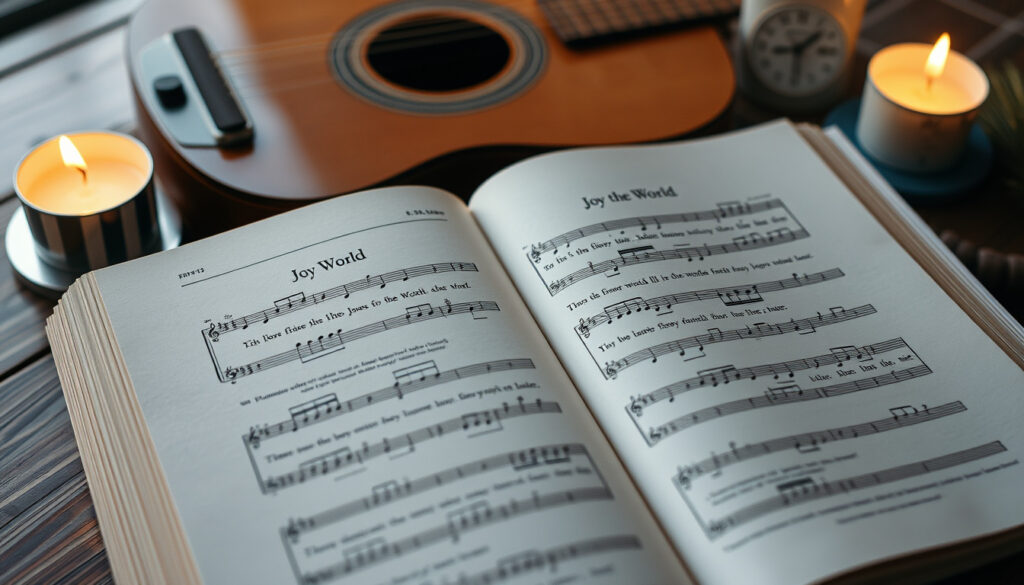
Joy to the World Lyrics: Original Text, Chords & History
Most people can hum the first line the moment the tree goes up, but the words they’re singing are older — and stranger — than the season itself. The carol traces back to Isaac Watts’s 1719 paraphrase of Psalm 98, and behind that familiar tune sits a disputed Handel connection, a handful of playable chords, and a four-stanza text that most recordings quietly shorten. Knowing which parts are Watts and which parts were added later changes how you hear the song every December.
First published: 1719 ·
Lyrics writer: Isaac Watts ·
Tune name: Antioch ·
Scripture basis: Psalm 98 ·
Notable recorded version: Pentatonix (2014)
Quick snapshot
- Isaac Watts wrote the lyric text in 1719 (Hymnary.org (hymn text archive))
- First published in “The Psalms of David,” 1719 (United Methodist Church (mainline denomination))
- A paraphrase of Psalm 98, especially verses 4–9 (United Methodist Discipleship Ministries (hymn history resource))
- How much of Mason’s tune came directly from Handel’s “Messiah” (Hymnology Archive (hymn research hub))
- Which editorial hand added or changed some later verses (Hymnology Archive (hymn research hub))
- Licensing status of individual recorded performances (Hymnology Archive (hymn research hub))
- Which early manuscript version Mason used as the base for Antioch (Hymnology Archive (hymn research hub))
- 1839: Lowell Mason prints a version of the tune in “The Modern Psalmist” (United Methodist Church (mainline denomination))
- 1848: The “National Psalmist” edition shapes the modern tune (Bethel University (hymn tune research))
- 2014: Pentatonix releases its version on “That’s Christmas to Me” (Wikipedia (community encyclopedia))
- Because the Watts text is public domain in the United States, new arrangements will keep arriving each December (United Methodist Discipleship Ministries (hymn history resource))
- Church teams can print the words without contacting a publisher — the tune arrangement is the layer to check (United Methodist Discipleship Ministries (hymn history resource))
Key facts about ‘Joy to the World’
Six facts anchor this carol’s story, and one pattern stands out: almost everything familiar about the tune was assembled decades after Watts wrote the words.
| Fact | Value |
|---|---|
| Author | Isaac Watts |
| First published | 1719 |
| Tune | Antioch |
| Meter | 8.6.8.6 common meter |
| Biblical basis | Psalm 98 |
| Copyright status | Public domain in the United States |
What are the original lyrics to ‘Joy to the World’?
Who wrote the original words of ‘Joy to the World’?
Author: Isaac Watts · Year: 1719 · Based on: Psalm 98
- Watts, an English minister and hymn writer, published the text in a collection titled “The Psalms of David: Imitated in the Language of the New Testament.”
- The original heading in that collection read “The Messiah’s Coming and Kingdom” (Hymnary.org (hymn text archive)).
- The collection reframed Old Testament psalms around Christian doctrine — Watts’s way of making the psalm book usable in church.
That heading is the key to the whole carol. Watts wasn’t describing a nativity scene; he was paraphrasing Psalm 98, where the whole earth is told to make a joyful noise because the Lord comes to judge the world with righteousness. The United Methodist Church’s hymn historians now call it the “accidental Christmas hymn” — a psalm song that later generations pulled into December (United Methodist Church (mainline denomination)).
The carol that now opens countless Christmas Eve services contains no manger, no shepherds, and no wise men — just a King arriving and all of creation singing.
When were the original lyrics first published?
- 1719: Watts’s psalm paraphrase appears in print for the first time.
- 1839–1848: Lowell Mason’s tune collections turn the poem into a singable hymn.
- 19th–20th century: The pairing becomes a Christmas standard across hymnals and recordings.
So the distance between the words and the tune is over a century. Watts’s poem sat as a psalm paraphrase until Mason’s collections — “The Modern Psalmist” (1839) and “The National Psalmist” (1848) — made it the song we recognize.
The implication: the “original” words are the stable part of this carol. Everything musical around them was settled later, and some of it is still in dispute.
What are the original lyrics in full?
Stanzas: 4 · Meter: 8.6.8.6 common meter · Language: English · Copyright: Public domain
Joy to the world, the Lord is come!
Let earth receive her King;
Let every heart prepare Him room,
And heaven and nature sing,
And heaven and nature sing,
And heaven, and heaven, and nature sing.Joy to the earth, the Savior reigns!
Let men their songs employ;
While fields and floods, rocks, hills, and plains
Repeat the sounding joy,
Repeat the sounding joy,
Repeat, repeat the sounding joy.No more let sins and sorrows grow,
Nor thorns infest the ground;
He comes to make His blessings flow
Far as the curse is found,
Far as the curse is found,
Far as, far as, the curse is found.He rules the world with truth and grace,
And makes the nations prove
The glories of His righteousness,
And wonders of His love,
And wonders of His love,
And wonders, wonders, of His love.
The text above follows Hymnary.org’s four-stanza presentation — the standard form behind most church hymnals and the version nearly every recording starts from (Hymnary.org (hymn text archive)). Some early editions space the repeated lines differently, and modern hymnals sometimes trim the echo lines to keep the page tidy. The implication: when you sing the full four stanzas, you’re singing Watts’s whole redemption story — the curse reversed, the nations judged, the earth singing — not a lullaby for the manger.
The implication: the full four stanzas are the definitive text for any choir or congregation to return to.
What are the English lyrics to ‘Joy to the World’?
This question is easier to answer than it sounds: the carol was written in English, so the “translation” question is really a version question. English-language hymnals have settled on a four-stanza text, and the only real debate is what happens with the repeated lines.
What is the full traditional English text?
- The traditional text is the four-stanza Watts poem, printed in English with no translation changes.
- Modern hymnsheets keep Watts’s wording but often shorten the repeated echo lines — the “And heaven, and heaven, and nature sing” refrain is the first thing editors trim.
- The phrase “the Lord is come” is older English for “the Lord has come”; it is not a grammar error, it’s an archaic perfect tense.
That last point matters more than it looks. Singers often stumble on “the Lord is come” because it sounds like a mistake. It isn’t — Watts was using the older perfect construction that matched the hymn’s meter. Keep it as written, and the line scans exactly with “Let earth receive her King.”
What do the lyrics mean?
Psalm basis: Psalm 98 · Key theme: Christ’s coming and reign · Imagery: earth, skies, fields, floods
- “Joy to the earth” and “fields and floods, rocks, hills, and plains” — all creation joins the praise, echoing Psalm 98:4’s call to make a joyful noise.
- “He comes to make His blessings flow / Far as the curse is found” — the “curse” language reaches back to Genesis 3, according to Wikipedia’s reading of the hymn’s Christian interpretation (Wikipedia (community encyclopedia)).
- “He rules the world with truth and grace” — the final stanza turns from celebration to kingship, which is why the carol works for Advent as much as Christmas.
The meaning sits in the contrast: most Christmas songs look at a baby; this one looks at a ruler. That is the Watts signature — a psalm paraphrase that pushes the congregation from sentiment to theology before the solo ends.
Is there a modernized English version?
- Major hymnals keep Watts’s wording — the editorial decisions happen in the repeated lines, not in the vocabulary.
- Some contemporary worship arrangements drop stanza 3 entirely, since “No more let sins and sorrows grow” feels heavy for a Christmas playlist.
- Pop covers, including Pentatonix’s, adjust phrasing and dynamics, but the words they sing are still Watts’s.
The implication: if someone hands you “updated” lyrics, compare them against the 1719 text before you sing. The public-domain original is almost always the better version — and it’s the one the tune was actually shaped to fit.
The material point: the 1719 text is the stable base from which all modern versions derive.
What are the ‘Joy to the World’ lyrics and chords?
What are the easiest guitar chords for ‘Joy to the World’?
Key: D major · Simplified set: D · G · A · Full diatonic set: D, Em, F#m, G, A, Bm, C#dim
Piano.org’s D-major transcription of the carol uses exactly this harmonic language: a simplified accompaniment can run on D, G, and A — the I, IV, and V chords of D major — and a fuller version adds the rest of the diatonic set (Piano.org (sheet-music transcription)). The tune that carries these chords is named Antioch, the label used in hymnals and tracked in the tune research at Bethel University (Bethel University (hymn tune research)). For a guitar player, that means the whole carol sits inside three chord shapes you already know.
- Chord changes follow stressed syllables — the downbeats land on “Joy,” “world,” “come,” and “King,” and those are the beats where the harmony moves.
- Line by line, the carol is nearly a I–IV–V étude.
Here’s a practical four-line map in D major — every chord belongs to the I–IV–V skeleton, so a beginner can strum straight through:
| Lyric line | Simplified chords (D major) |
|---|---|
| Joy to the world, the Lord is come | D · G · D |
| Let earth receive her King | A · D |
| Let every heart prepare Him room | D · G · A |
| And heaven and nature sing | D · A · D |
If you want a softer, more churchy sound, swap in Bm for the D at the start of the third line — Bm is the vi chord in D major, and it belongs to the diatonic set listed above. The melody doesn’t change; the color just gets warmer.
What key is best for congregational singing?
- Default: D major — the key of the standard printed transcription, and the melody sits in a comfortable middle range for most voices.
- Capo: put the capo wherever the highest note of “And heaven and nature sing” lands comfortably in your voice.
- Rule of thumb: bright keys (D, C) suit the carol’s fanfare; darker keys lower the energy fast.
The trade-off: D major is bright and trumpet-like, which suits the carol’s character. Drop the capo low and you gain warmth but lose the “joy” sparkle; push it high and the song turns shouty. Leaders usually land on D or C for exactly that reason.
How do the chords align with each lyric line?
- “Joy to the world, the Lord is come” — the harmony moves D → G → D, landing on D exactly when “come” resolves the phrase.
- “Let earth receive her King” — one shift A → D, with the dominant chord lifting “receive” and D catching “King.”
- “Let every heart prepare Him room” — D → G → A builds tension toward “room,” the V chord pushing into the final line.
- “And heaven and nature sing” — D → A → D finishes with a full cadence, which is why the repeat of this line feels so inevitable.
That’s the whole trick of the carol: it’s harmonically simple because the melody is a scale. The momentum comes from the V–I pull on “King” and “room,” not from fancy chords.
Don’t credit Handel as the composer of the tune. Lowell Mason published it as arranged “from Handel,” and the exact authorship of the Antioch melody is still disputed among hymn historians (Hymnology Archive (hymn research hub)).
The practical result: any guitarist with three open chords can lead this carol without hesitation.
What are the keyboard notes for ‘Joy to the World’?
What are the letter notes for the main melody?
Key: D major · Opening phrase: D5 C#5 B4 A4 · G4 F#4 E4 D4 · First leap: A4 on “Let”
- The first eight notes are a descending D-major scale: D5, C#5, B4, A4, G4, F#4, E4, D4. Label them above the words — “Joy” takes D5, “to” takes C#5, “the” takes B4, “world” takes A4, “the” takes G4, “Lord” takes F#4, “is” takes E4, “come” takes D4 — and the entire opening phrase becomes readable at sight (Piano.org (sheet-music transcription)).
- The ninth note, A4, starts “Let earth receive her King.” That jump from D4 up to A4 is the first real leap in the melody, and it’s the spot beginner hands rush.
Slow the jump down. The scale before it is the easy part; the leap is where the phrase opens up and the carol’s fanfare character kicks in.
How do I play the melody with the right hand?
- Play one note at a time — the carol’s first phrase is entirely stepwise, so a single-line arrangement needs no chords in the right hand.
- Use a five-finger position so the scale falls under the hand; beginner arrangements of this carol are built around exactly that.
- Keep the rhythm steady and let the words dictate phrasing — “Joy” gets a small accent because it’s the highest note and the strongest syllable.
The whole first stanza uses only the notes D, E, F#, G, A, B, and C# — a D-major palette — so there are no surprises after the opening phrase. Once the descending scale is under your fingers, the rest is a matter of keeping the pulse.
Where can I find keyboard notes for the full carol?
- Piano.org hosts a D-major piano transcription of the carol, including the letter-note sequence for the opening phrase (Piano.org (sheet-music transcription)).
- Hymnary.org and other hymn-text archives print all four stanzas, so you can add letter names above the words stanza by stanza.
- Hymnology Archive’s page on the carol includes historical notation context, which helps if you want to compare tune versions.
If you can play a descending D-major scale, you can already play the hardest musical phrase of the carol — the rest is one small leap and a lot of repetition.
The bottom line: technical mastery starts with the D-major scale.
What are the Pentatonix lyrics for ‘Joy to the World’?
Which Pentatonix album includes ‘Joy to the World’?
Album: “That’s Christmas to Me” · Released: 2014 · Style: a cappella pop · Text: adapted from the traditional carol
Pentatonix released its version on the 2014 holiday album “That’s Christmas to Me” (Wikipedia (community encyclopedia)).
- The arrangement borrows the familiar four stanzas rather than rewriting them — the a cappella pop treatment changes texture and dynamics, not the lyric core.
- The “Pentatonix lyrics” are Watts’s lyrics, sung faster and stacked in harmony. There is no separate studio rewrite to learn.
Do the Pentatonix lyrics match the traditional carol text?
- Yes — the stanzas are the same four Watts wrote; the arrangement does not replace the words.
- The group adapts the traditional text for a cappella pop, which means repeated lines get re-sung for musical effect rather than changed for meaning.
- If you’re singing along, the standard hymn text above is all you need — no separate “Pentatonix edition” lyric sheet is required.
That makes this cover unusual: the group trusts Watts’s text completely and lets the production do the talking.
How does the Pentatonix arrangement change the feel of the carol?
- Tighter rhythm: where a congregation sings in long hymn-phrases, the pop arrangement pushes the tempo and accents harder.
- Studio dynamics: solo lines and layered harmony replace the congregation’s unison — the feel changes even though the words don’t.
The “a cappella pop stylings” keep Watts’s words front and center; the emotional center shifts from the pews to the performance.
The text is public domain, but a Pentatonix-style cover is not: the performance, the arrangement, and the recording all carry their own rights, even though Watts’s words are free.
The takeaway for cover artists: clear the arrangement rights, not the psalm. The words cost nothing; the production you’re copying is someone else’s property.
How to learn ‘Joy to the World’ in five practical steps
- Pick D major. It’s the key of the standard printed transcription, and it puts the melody in a comfortable range for most voices.
- Map the three chords. D, G, and A cover every line in the chart above; strum them in order until the changes feel automatic.
- Learn the opening descent. D5, C#5, B4, A4, G4, F#4, E4, D4 — play it slowly, then add the A4 on “Let.”
- Sing the text in four stanzas. Use the Hymnary.org form so the echo lines land correctly; most recordings trim them, but the full text is where the structure lives.
- Decide your verse cuts before the service. If you’re printing a handout, print the public-domain Watts text and check whether your chosen arrangement adds its own copyright line.
The sequence matters because the carol’s difficulty isn’t in the notes — it’s in the transitions: the D-to-A lift on “Let,” the cadence on “King,” and the echo of “And heaven and nature sing.” Work those three spots and the rest of the song plays itself.
How ‘Joy to the World’ became a Christmas carol
- 1719: Watts publishes the psalm paraphrase in “The Psalms of David” — not yet a Christmas carol.
- 1832–1833: Versions of the tune appear in circulation before Mason’s printed editions (Hymnology Archive (hymn research hub)).
- 1839: Lowell Mason prints a version of the tune in “The Modern Psalmist.”
- 1848: The “National Psalmist” edition cements the modern form of the tune (Bethel University (hymn tune research)).
- 19th–20th century: Hymnals and Christmas songbooks pair the text with the tune named Antioch, and the carol becomes a December standard.
- 2014: Pentatonix releases its arrangement on “That’s Christmas to Me,” introducing the carol to a new streaming audience.
The pattern: a Second Coming hymn took more than a century to become a Christmas carol — and the tune did most of the traveling. The words stayed Watts’s; the musical identity kept shifting until 19th-century hymnal editors fixed it in place.
What’s confirmed — and what’s still unclear
Confirmed facts
- Isaac Watts wrote the lyric text in 1719 (United Methodist Discipleship Ministries (hymn history resource))
- The text paraphrases Psalm 98
- The familiar tune is named Antioch
- Pentatonix released a version on “That’s Christmas to Me”
What’s unclear
- How much of Mason’s tune was directly adapted from Handel’s “Messiah”
- Which editorial hand added or changed some later verses
- Licensing status of individual recorded performances
- Which early manuscript version Mason used as the base for Antioch
The takeaway: the words are the solid part of this carol; the tune is a 19th-century reconstruction with a disputed Handel connection — and the licensing questions live in the recordings, not in the text.
Three texts that explain the carol
Make a joyful noise unto the LORD, all the earth: make a loud noise, and rejoice, and sing praise.
Psalm 98:4 (KJV) — the text Watts paraphrased (United Methodist Discipleship Ministries hymn history resource)
Joy to the world, the Lord is come! Let earth receive her King; Let every heart prepare Him room, And heaven and nature sing.
Isaac Watts, “The Psalms of David,” 1719
The tune’s exact authorship is disputed and should not be stated simply as “composed by Handel.”
Hymnology Archive research summary (hymn research hub)
Why this matters: when someone calls the carol “a Handel tune,” they’re repeating a shorthand the primary record never quite supports. Watts’s text is the solid foundation; the melody is a 19th-century arrangement with a contested family tree.
The takeaway
Every December, the same argument restarts in church vestibules and group chats: is “Joy to the World” a Christmas carol, a psalm paraphrase, or a Handel tune in disguise? The record says it started as a 1719 poem about the Messiah’s coming kingdom, gained a disputed tune called Antioch in the 1830s, and only later became the season’s default opener. For a worship leader planning a Christmas Eve service, the choice is clear: print the full four-stanza Watts text and credit the tune as “Antioch, arr. Lowell Mason,” or keep the radio-friendly repeats and explain to the choir why the credits don’t quite match the history.
Frequently asked questions
Is ‘Joy to the World’ in the public domain?
Yes — in the United States, the 1719 Watts text is public domain. Some published arrangements of the Antioch tune carry their own copyright, and recorded performances have separate rights.
Can I print ‘Joy to the World’ lyrics in a church handout?
You can print the Watts text itself without permission, because the words are public domain. If your handout includes a specific arrangement of the tune, check the arrangement’s copyright line first.
Who is credited with composing the tune ‘Antioch’?
Lowell Mason published the tune in the 19th century and credited it as arranged from Handel. Hymn historians say the exact authorship is disputed and should not be simplified to “composed by Handel.”
Why do some recordings skip a verse?
Recordings routinely trim the four stanzas to fit a runtime or arrangement. There is no official “canonical cut”; the dropped verse varies, though the somber third stanza is often the first to go.
What is the meaning of ‘Joy to the World’?
It is a paraphrase of Psalm 98 celebrating the Lord’s coming to reign. Watts titled it “The Messiah’s Coming and Kingdom,” so the carol is about Christ’s rule over the whole earth — not just the nativity scene.
Is ‘Joy to the World’ only sung at Christmas?
No — it became a Christmas standard, but it began as a general hymn about Christ’s coming and kingdom. That is why it also works for Advent services and any worship time focused on Christ’s reign.
More related posts
 Vodafone Pay As You Go Guide
 Best Locro de Zapallo Near Me: Authentic Peruvian Pumpkin Stew
 Autumn Wedding Guest Dresses 2026: Trends & What to Wear
 Cast of Slow Horses: Full List and Behind-the-Scenes Facts
 Everton F.C. vs Leeds United Standings: H2H & Results
 Gabe Missing Boy Greystones: 13-Year-Old Found Safe
 FC Barcelona vs Real Madrid Lineups: Predicted XI (10 May 2026)
 Signs of Low Iron: Symptoms, Causes, and Treatment