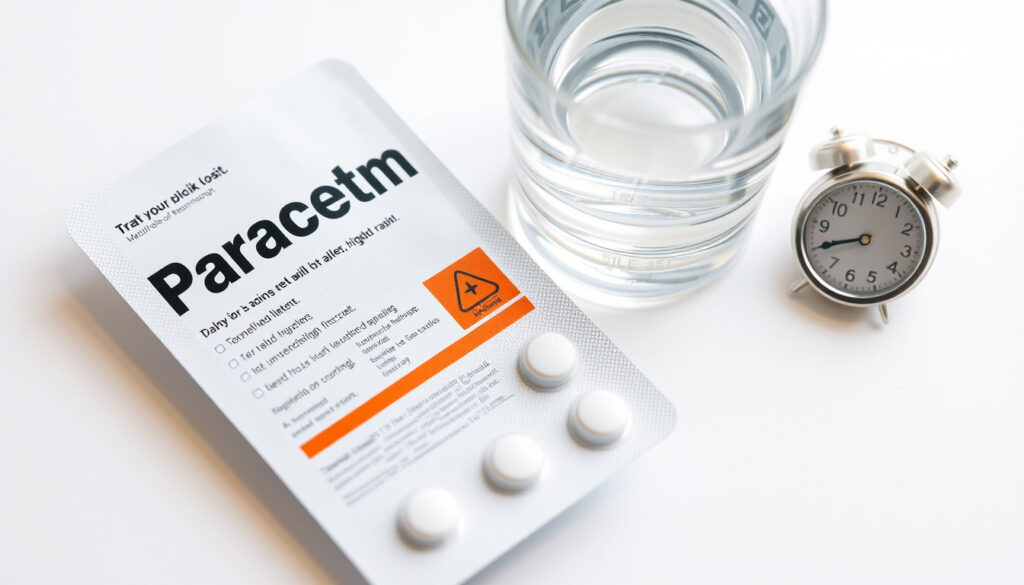
How Many Paracetamol a Day? NHS Safe Dosage & Risks
You’ve got a headache, reach for the paracetamol. It’s the go-to painkiller in most UK medicine cabinets — easy, reliable, and you probably don’t think twice about how many you take. But there’s a hard limit your liver won’t forgive you for crossing. This guide lays out exactly how many paracetamol a day is safe, based on official NHS guidance, and what happens if you push past that line.
Maximum daily dose (adults): 4,000 mg (8 x 500 mg tablets) ·
Minimum time between doses: 4 hours ·
Common tablet strength: 500 mg ·
Onset of action: 30–60 minutes ·
Duration of effect: 4–6 hours
Quick snapshot
- 1–2 tablets (500–1,000 mg) per dose every 4–6 hours (NHS)
- Maximum 8 tablets (4,000 mg) per 24 hours (NHS Inform)
- Taking more than 4,000 mg in 24 hours (North Tees and Hartlepool NHS Trust)
- Accidental overdose of 10+ tablets (North Tees and Hartlepool NHS Trust)
- Symptoms of liver damage (yellow skin, dark urine) (North Tees and Hartlepool NHS Trust)
- Rare at recommended doses (NHS)
- Allergic reactions (rash, swelling) (NHS)
- Long-term daily use may affect liver (NHS)
Eight 500 mg tablets is the ceiling for a healthy adult. Exceed that once, and you’ve entered the zone where your liver starts processing a toxic metabolite it can’t keep up with — and the damage may not announce itself for hours or days.
The table below condenses the dosing limits and key timing windows into a quick-reference format.
| Attribute | Value |
|---|---|
| Maximum daily dose | 4,000 mg (8 x 500 mg tablets) |
| Maximum single dose | 1,000 mg (2 tablets) |
| Minimum dose interval | 4 hours |
| Onset of relief | 30–60 minutes |
| Duration of effect | 4–6 hours |
| Liver damage risk | >4,000 mg in 24 hours |
How much paracetamol can I take in 24 hours?
The NHS NHS (UK health authority) states the usual adult dose is 1 or 2 paracetamol tablets or capsules, with at least 4 hours between doses, and no more than 8 tablets or capsules in 24 hours. For a standard 500 mg tablet, that works out to a maximum of 4,000 mg — or 4 grams — per day.
Maximum single dose
- The maximum single dose is 2 tablets (1,000 mg).
- Taking more than 1,000 mg at once exceeds the recommended single dose NHS (dosing guidelines).
Recommended dosing schedule
- Every 4 to 6 hours, as needed.
- Do not take more than 4 doses (8 tablets) in 24 hours NHS Inform (Scotland’s health service).
What counts as a dose (1 or 2 tablets)
- One dose equals 1 or 2 tablets (500–1,000 mg).
- The electronic Medicines Compendium (UK medicines database) confirms adults and adolescents over 16 may take 500 mg to 1,000 mg up to three to four times a day.
When to skip a dose and restart
- If you miss a dose, skip it entirely and take the next one at the scheduled time — never double up.
- If you accidentally take more than the maximum dose, seek medical advice immediately NHS (overdose warning).
How long does it take for 2 paracetamol to kick in?
If you’ve just swallowed two 500 mg tablets and are waiting for the ache to fade, the clock runs somewhere between half an hour and an hour.
Typical onset time
- Paracetamol usually starts working within 30–60 minutes after taking it NHS (onset of action).
- Peak effect occurs around 1–2 hours after the dose.
Factors that affect absorption
- Taking paracetamol on an empty stomach may speed absorption.
- Food, especially high-fat meals, can delay the onset.
- The form matters: soluble tablets and liquid suspensions are absorbed faster than standard tablets electronic Medicines Compendium (pharmacokinetics).
Comparing paracetamol to ibuprofen onset
- Ibuprofen typically starts working within 20–30 minutes, slightly faster than paracetamol.
- Paracetamol’s effect lasts about 4–6 hours, similar to standard ibuprofen.
- The key difference: ibuprofen is an NSAID that can irritate the stomach lining, while paracetamol is gentler on the stomach but carries higher overdose risk to the liver Therapeutic Goods Administration (Australian regulator).
Faster onset with an empty stomach may sound tempting, but the real risk isn’t speed — it’s forgetting when you last dosed. The 4-hour gap exists because your liver needs that window to clear the drug from your system.
What happens if you take 4 paracetamol instead of 2?
Taking four 500 mg tablets (2,000 mg) at once doubles the standard single dose. Here’s what that does to your body.
Immediate effects of double dose
- You may not feel anything unusual for several hours.
- The single dose limit is 1,000 mg (2 tablets) — four tablets is double that threshold NHS (maximum single dose).
When it becomes dangerous
- A single 2,000 mg dose is not typically toxic for a healthy adult, but repeated high doses accumulate risk.
- Accidentally taking 10 tablets (5,000 mg) in 24 hours is a medical emergency NHS (emergency guidance).
Symptoms of paracetamol overdose
- Early symptoms: nausea, vomiting, and abdominal pain — but they can be delayed by up to 24 hours NHS (overdose symptoms).
- Later signs: yellowing skin or eyes (jaundice), dark urine, confusion, and liver failure.
What to do if you accidentally take too much
- Call NHS 111 or go to your nearest A&E department immediately.
- Bring the paracetamol packet with you so medical staff know the exact dose and time.
- Do not wait for symptoms — early treatment with acetylcysteine can prevent liver damage Medical Journal of Australia (poisoning guidelines).
Which organ gets damaged from too much paracetamol?
Every major health authority points to the same target: your liver.
Liver damage mechanism
- High doses of paracetamol deplete glutathione, the liver’s main antioxidant, allowing a toxic metabolite called NAPQI to build up NHS (toxicity mechanism).
- NAPQI damages hepatocytes — liver cells — leading to cell death and potential organ failure.
Symptoms of liver injury
- Early: nausea, vomiting, loss of appetite, fatigue.
- Advanced: jaundice, dark urine, upper right abdominal pain, confusion.
- Liver injury may not show symptoms for 12–24 hours after overdose North Tees and Hartlepool NHS Trust (safety leaflet).
Risk factors for liver toxicity
- Chronic alcohol use (especially more than 3 units per day).
- Pre-existing liver disease (e.g., hepatitis, cirrhosis).
- Malnutrition or fasting — depleted glutathione stores increase vulnerability.
- Certain medications (e.g., warfarin, enzyme-inducing drugs) can amplify toxicity risk Lancashire and South Cumbria NHS Formulary (risk-adjusted dosing).
How much paracetamol causes liver damage?
- In healthy adults, toxicity typically occurs above 4,000 mg in 24 hours.
- In vulnerable individuals, lower doses (e.g., 3,000 mg or even 2,000 mg) can cause harm Right Decisions Scotland NHS (risk-stratified dosing chart).
- The Therapeutic Goods Administration (Australian drug regulator) recommends the same 4,000 mg ceiling, with reductions for at-risk groups.
If you’re a regular drinker — even at moderate levels — your liver’s ability to process paracetamol is compromised. The NHS advises anyone who drinks more than 14 units per week to take no more than 3,000 mg daily, and ideally only under a doctor’s supervision.
What are the side effects of taking paracetamol daily?
Most people tolerate paracetamol without issues, but “daily” is not the same as “occasional.”
Common side effects
- At recommended doses, side effects are uncommon.
- Some people report mild nausea or drowsiness.
- Allergic reactions (skin rash, itching, swelling) are rare but possible NHS (side effects).
Rare but serious side effects
- Serious skin reactions (e.g., Stevens-Johnson syndrome) — extremely rare but require immediate medical attention.
- Blood disorders (thrombocytopenia, leukopenia) — also very rare.
- Liver injury from chronic use at or above the maximum dose NHS (serious side effects).
Interaction with alcohol
- Avoid alcohol while taking paracetamol to reduce liver strain.
- Combining heavy alcohol use with paracetamol — even at moderate doses — can accelerate liver damage.
- NHS guidance advises caution for anyone who drinks more than 14 units per week NHS (alcohol warning).
When daily use is considered safe
- Paracetamol can be taken safely for up to 3 days for a fever, or up to 10 days for pain, without medical review.
- Longer daily use should be supervised by a doctor NHS Inform (duration of use).
- The University Hospitals of Leicester NHS Trust (pharmacy guideline) notes that standard maximums apply for short-term use only.
Steps for safe paracetamol use
Following a simple routine keeps you on the right side of the safety line.
- Check the strength. Most UK tablets are 500 mg, but always read the label.
- Take 1 or 2 tablets at a time. One dose = 500–1,000 mg.
- Set a timer. Wait at least 4 hours before the next dose.
- Count your tablets. Stop at 8 tablets (4,000 mg) in any 24-hour period NHS (step-by-step instructions).
- Check other medicines. Many cold and flu remedies also contain paracetamol — do not double up NHS (drug interactions).
- Watch for red flags. Yellow skin, dark urine, or nausea after high doses — go to A&E.
For a detailed look at the official NHS safe dosage guidelines, including maximum daily tablet counts and timing intervals, see the full guide.
Frequently asked questions
Can I take paracetamol with other painkillers?
Do not take paracetamol with other medicines that also contain paracetamol, such as many cold and flu products. You can alternate paracetamol with ibuprofen (an NSAID) as long as you follow the dosing schedules for each. Always check labels NHS (combination guidance).
Is it safe to take paracetamol on an empty stomach?
Yes — unlike ibuprofen, paracetamol does not irritate the stomach lining. Taking it on an empty stomach may even speed absorption NHS (dosing advice).
What if I miss a dose of paracetamol?
Do not take a double dose. Wait until the next scheduled dose time and continue as normal. Skipping one dose is safe NHS (missed dose guidance).
Can I take paracetamol while pregnant or breastfeeding?
Paracetamol is considered safe during pregnancy and breastfeeding at the standard adult dose. However, take it for the shortest time possible and consult your GP for prolonged use NHS Inform (pregnancy guidance).
Does paracetamol expire and is it still safe?
Yes, paracetamol expires — check the label for the expiry date. Never use expired medication, as its effectiveness and safety cannot be guaranteed NHS (storage and expiry).
How does paracetamol compare to ibuprofen for pain relief?
Both work for pain and fever, but they act differently. Ibuprofen reduces inflammation (an NSAID), while paracetamol does not. Ibuprofen is gentler on the liver but can irritate the stomach. Paracetamol is safer for the stomach but carries a higher overdose risk to the liver Therapeutic Goods Administration (comparative guidance).
Paracetamol is one of the most studied and widely used medicines in the world. Its safety record is strong when used correctly. The tragedy is almost always preventable — and it begins with someone thinking “one more tablet won’t hurt.” For the UK patient managing pain at home, the choice is clear: dose by the clock, count the tablets, or call NHS 111 before the symptoms start.
More related posts
 Where is Cape Verde? Location, Facts & Travel Tips
 Compare Car Insurance Ireland: 2024 Guide to Cheapest Quotes & Providers
 Latest Trump News Today: Live Updates and Headlines
 Dolce and Gabbana The One: Scent Guide & Variants
 Chennai Super Kings vs Mumbai Indians Timeline: Head-to-Head
 Commercial Property for Sale in Ireland: 2025 Guide
 Sunderland vs Liverpool: Head-to-Head Standings & History
 How to Post on Instagram from Desktop: Complete Guide