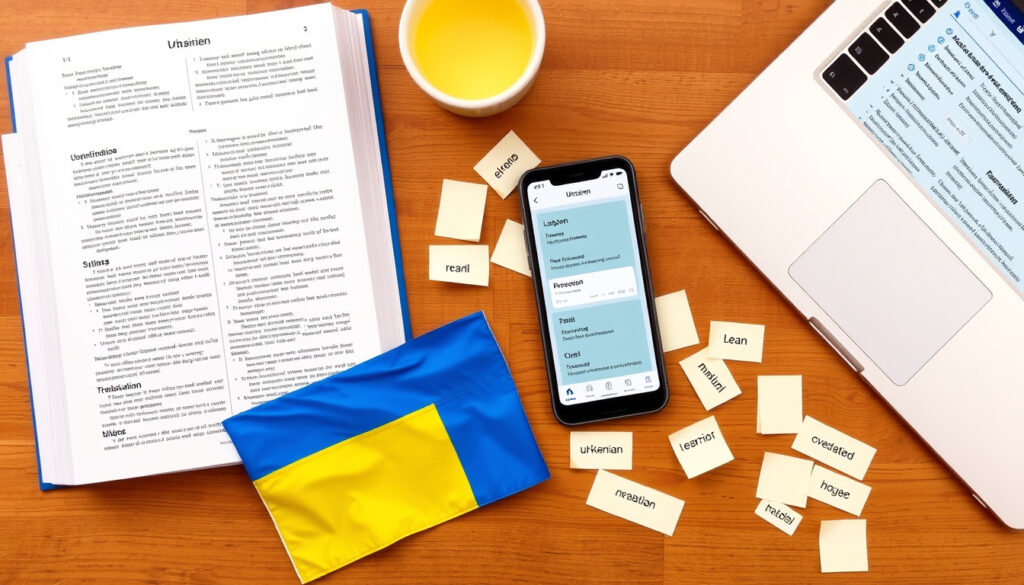
Translate English to Ukrainian: Tools, Tips & Phrases
If you’ve ever tried to move a phrase from English into Ukrainian and ended up staring at a wall of Cyrillic, you already know it’s not a simple word-swap. Ukrainian’s seven grammatical cases and its own 33-letter alphabet mean a sentence can change shape depending on who’s speaking, who’s listening, and what’s being said. This guide walks you through the best free tools, the essential phrases worth memorizing, and the cultural signals that translation apps won’t tell you.
Ukrainian alphabet: Cyrillic, 33 letters ·
Official language of: Ukraine ·
Language family: Indo-European, East Slavic ·
Closest language: Belarusian (by lexical similarity) ·
Common informal greeting: Привіт (pryvit)
Quick snapshot
- Ukrainian is an East Slavic language written in Cyrillic with 33 letters (Microsoft Translator Languages)
- The exact percentage of lexical similarity between Ukrainian and Russian versus Polish varies by linguistic dataset and method
- Voice translation support in Google Translate is not available in every browser context (Google Help)
- Microsoft Translator supports spoken translation and conversation mode on mobile, including Ukrainian (Microsoft Translator Help for Android)
Free translation tools work best when you respect the case system — and that means understanding when you need a human (or at least a very good grammar engine) to step in.
Key facts at a glance
Six facts that frame the whole translation equation — the writing system, the family tree, and the greetings you will actually use.
| Label | Value |
|---|---|
| Writing system | Cyrillic, 33 letters |
| Official language | Ukraine |
| Language family | Indo-European, East Slavic |
| Closest language | Belarusian (by lexical similarity) |
| Common informal greeting | Привіт (pryvit) |
| Common formal greeting | Добрий день (dobryi den) |
The pattern: one alphabet, one country, and a greeting system that pivots on formality — which is exactly where machine translation earns its keep.
How do I translate English to Ukrainian?
Start with the free tools already on your phone, then layer in keyboard setup and browser checks.
How do I use Google Translate for English to Ukrainian?
- Google Translate supports voice input and voice output for Ukrainian on its web product (Google Translate)
- Voice translation requires microphone access and supports spoken input in the Google Translate app (Google Translate)
The catch: browser support varies. Ukrainian voice input reportedly does not work in every browser context, so test your setup before relying on it for a live conversation (Google Help).
What this means: if voice fails in one tab, try another browser — or switch to the mobile app, which handles speech more consistently.
How can I translate English to Ukrainian by voice?
- Microsoft Translator supports spoken translation and conversation mode on mobile, including Ukrainian (Microsoft Translator Help for Android)
- Microsoft’s language list shows Ukrainian has Text, Speech, and Text-to-speech support (Microsoft Translator Languages)
- The Microsoft Translator Android help describes using the microphone button, selecting source and target languages, and holding the microphone to speak (Microsoft Translator Help for Android)
The trade-off: Google is faster for single phrases; Microsoft’s conversation mode is built for back-and-forth dialogue, and it reports native-accent audio output for Ukrainian (Microsoft Translator Languages).
How can I type Ukrainian words with an English keyboard?
- Ukrainian is written in Cyrillic, so English-to-Ukrainian keyboard input may require a Ukrainian keyboard layout or virtual keyboard
- Free apps on Google Play claim offline voice translation and real-time conversations between English and Ukrainian (Google Play)
The pattern: if you are typing, add a Ukrainian layout in your OS settings; if you are speaking, the apps handle the rest.
Is translating English to Ukrainian free?
- Google Translate offers English-to-Ukrainian translation as a free web service (Google Translate)
- Microsoft Translator help states the app does not require authentication to use (Microsoft Translator Help for iOS)
- Apple App Store listings show that Ukrainian Translator apps are free but include in-app purchases (Apple App Store)
Why this matters: the entry price is zero everywhere, but premium tiers and in-app purchases appear once you need offline packs or advanced features.
What language is closest to Ukrainian?
One classification, one alphabet, and a linguistic puzzle that trips up even fluent speakers.
What language family does Ukrainian belong to?
- Ukrainian is an East Slavic language in the Indo-European language family (Microsoft Translator Languages)
- Ukrainian uses a Cyrillic alphabet with 33 letters (Microsoft Translator Languages)
The implication: when you translate English to Ukrainian, you are not just swapping words — you are shifting scripts and grammar systems wholesale.
Is Ukrainian closer to Polish or Russian?
- Belarusian is generally considered the closest language to Ukrainian by lexical similarity
- Ukrainian shares significant vocabulary with Polish and Russian, but its grammar and vocabulary are distinct
The catch: the exact similarity percentages shift depending on which linguist you ask and which corpus they measure, so treat any “closer to X” claim as approximate.
Ukrainians often understand Polish speakers better than Russians understand Ukrainians, even though Russian and Ukrainian share the Cyrillic script — because grammar cases and vocabulary diverge more than the alphabet suggests.
What this means for translation: a Russian speaker might recognize the script, but they will still need a translator for full sentences — and a Ukrainian speaker will do the same with Russian text.
What is the Ukrainian word for welcome?
Context matters more than the dictionary definition, so match the phrase to the situation.
What is goodbye in Ukrainian?
- The Ukrainian word for “welcome” is “Ласкаво просимо” (laskavo prosymo) in formal contexts
- A common Ukrainian farewell for “goodbye” is “До побачення” (do pobachennia)
The pattern: both phrases lean formal, and both are the safe default when you are unsure who you are addressing.
How do I say “I’m sorry” in Ukraine?
- The Ukrainian phrase for “I’m sorry” is “Вибачте” (vybachte) in formal situations and “вибач” (vybach) informally
- Ukrainian speakers often use “окей” (okei) for “OK” in informal speech
The trade-off: the formal version protects you with strangers; the informal version marks you as familiar — choose according to the relationship.
How do Ukrainians say “I love you”?
- The Ukrainian phrase for “I love you” is “Я тебе кохаю” (ya tebe kohaiu) for romantic love and “Я тебе люблю” (ya tebe liubliu) for broader affection
Why this matters: using the wrong verb changes the register — “kohaiu” is romantic, “liubliu” covers friends, family, and even pizza.
What do Ukrainians say before drinking?
- A common Ukrainian toast before drinking is “Будьмо” (budmo) or “За здоров’я” (za zdorovia)
The upshot: “Budmo” is short and communal; “Za zdorovia” is the classic “to health” toast, and either works at a table of new friends.
How do Ukrainians say “hi”?
Formality is the dividing line — and getting it wrong reads as either cold or overfamiliar.
How do you greet a Ukrainian girl?
- The informal Ukrainian word for “hi” is “Привіт” (pryvit)
- The formal Ukrainian greeting is “Добрий день” (dobryi den), meaning “good day”
- Greetings in Ukrainian depend on the level of formality and familiarity
- In formal or first-time situations, a handshake and a verbal greeting are more common than a kiss or hug
The pattern: pryvit for friends, dobryi den for anyone you do not know well — and a handshake, not a kiss, for the first meeting.
What this means: when you translate “hi” to Ukrainian, the app gives you the informal version by default. If you are meeting someone professionally, lead with “Добрий день” instead.
What does a Ukrainian kiss mean?
Context decides everything — a kiss on the cheek is not a universal romantic signal.
Is a kiss on the cheek common in Ukrainian greetings?
- A kiss on the cheek in Ukraine can be a friendly greeting or a sign of affection among friends and family
- The meaning of a kiss depends on context, relationship, and region
- In formal or business settings, handshakes are more common than kisses
- A kiss on the cheek is not inherently romantic in Ukrainian social culture
The catch: what reads as friendly in one city might feel forward in another, so mirror the other person’s lead.
If you are translating a greeting and the app suggests a phrase that feels too intimate, default to “Добрий день” and a handshake — it works in every region and every register.
The trade-off: over-formality reads as distant, but under-formality can read as disrespectful — the handshake-plus-verbal greeting splits the difference safely.
What is a common Ukrainian name?
Names come with their own translation challenge: transliteration, not word-for-word mapping.
How do I translate an English name into Ukrainian?
- English names are usually transliterated into Cyrillic based on pronunciation, not spelling
- Ukrainian names use the Cyrillic alphabet, so the same English name can have multiple transliterations
The implication: “John” becomes “Джон” (Dzhon) because it sounds like that, not because it looks like that.
What are common Ukrainian male and female names?
- Common Ukrainian male names include Oleksandr, Andriy, Dmytro, Taras, and Bohdan
- Common Ukrainian female names include Olena, Kateryna, Anastasia, Iryna, and Oksana
The pattern: Ukrainian names often carry Slavic roots — Taras and Bohdan are not just names, they are cultural markers tied to Ukrainian history.
Why this matters: if you are naming a character, translating a document, or introducing yourself, the transliteration rule (sound, not spelling) is the one that matters.
Free translation tools compared
Three solid options, one clear pattern: Google wins on raw speed, Microsoft wins on voice conversation, and dedicated apps win on offline features.
| Tool | Free tier | Voice support | Offline mode | Best for |
|---|---|---|---|---|
| Google Translate | Yes, full web access | Yes, browser-dependent | Yes, via app | Quick single phrases (Google Translate) |
| Microsoft Translator | Yes, no authentication | Yes, conversation mode | Yes, via app | Live back-and-forth dialogue (Microsoft Translator Help for Android) |
| English Ukrainian Translator (Play Store) | Yes, free download | Yes, voice input | Claimed | All-in-one phone tool (Google Play) |
The trade-off: Google and Microsoft have the deeper language engines; the Play Store apps bundle voice, camera, and document translation into one interface — but at the cost of polish.
For any of these tools, the grammar cases force you to check the output. A word-for-word swap is rarely the final answer — you want a translator that handles nominative, accusative, and genitive endings automatically.
Upsides and downsides of common translation routes
Each method has a clear winner depending on whether you value speed, accuracy, or conversation flow.
Upsides
- Google Translate is free and instant for single words or short phrases
- Microsoft Translator shines in real-time conversation mode with Ukrainian speech output (Microsoft Translator Languages)
- Dedicated apps pack voice, camera, and document translation into one download (Google Play)
Downsides
- Browser-based voice input can fail for Ukrainian depending on the browser (Google Help)
- Play Store apps carry in-app purchases behind the free tier (Apple App Store)
- Case endings and grammar rules mean machine output still needs a human check for formal writing
The upshot: for a quick trip, Google Translate covers you. For a real conversation, Microsoft Translator’s voice mode is the better free bet. For offline use, you pay somewhere.
lingua.direct, microsoft.com, play.google.com, play.google.com, play.google.com, translate.google.com.ua
Frequently asked questions
Straight answers to the questions people actually ask when they start translating between English and Ukrainian.
What is the best Ukrainian-to-English translator?
Google Translate leads for speed and free access, while Microsoft Translator offers comparable quality with stronger conversation support. Both handle the core grammar well enough for everyday use (Google Translate, Microsoft Translator Languages).
What is the best app for translating English to Ukrainian?
Microsoft Translator is the strongest free choice for voice work because its language list confirms Ukrainian text, speech, and text-to-speech support (Microsoft Translator Languages). For an all-in-one tool that also handles camera and documents, the English Ukrainian Translator app on Google Play bundles those features into a single free download (Google Play).
Does Ukrainian use the same alphabet as Russian?
Both use Cyrillic, but Ukrainian has 33 letters and lacks three Russian characters, while adding its own — so the alphabets overlap but are not identical (Microsoft Translator Languages).
How do I pronounce Ukrainian words?
Microsoft Translator’s language list confirms Ukrainian supports text-to-speech output with native-accent playback, so you can hear a pronunciation model before you say it yourself (Microsoft Translator Languages).
What is the Ukrainian word for “please”?
The standard Ukrainian word for “please” is “будь ласка” (bud laska) — one phrase that works for both “please” and “you’re welcome,” so it is the single most useful word to memorize for politeness.
Related reading
More related posts
 Access the Daily Mail Classic Homepage: Step-by-Step
 Galway Motor Tax Office: Hours, Renewal & Fines
 Katy Perry and Orlando Bloom Paddle Board: The Viral Incident
 What Is ChatGPT? Features, Safety, and Risks Explained
 Diageo Guinness Price Increase 2026: Pint Costs Rise
 Four Star Pizza Menu: Prices, Deals & Regional Options
 Gross to Net Ireland 2025/2026: Calculate Your Take-Home Pay
 Wordle Today Answer: FRILL with Hints for July 31